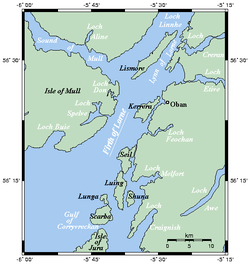
The Clachan Bridge (also known as the Bridge over the Atlantic) is a simple, single-arched, hump-backed, masonry bridge spanning the Clachan Sound, 13 kilometres (8 mi) southwest of Oban in Argyll and Bute, west of Scotland. It links the west coast of the Scottish mainland to the island of Seil. The bridge was originally designed by John Stevenson of Oban (and not by Thomas Telford as sometimes quoted) and was built between 1792 and 1793 by engineer Robert Mylne. The original design had two arches, but it was finally built with a single high arch, of roughly 22 metres (72 ft) span and about 12 metres (39 ft) above the bed of the channel, to allow the passage of vessels of up to 40 tonnes (39 long tons) at high tide. The bridge is still in use today, forming part of the B844 road, and is in the care of Historic Scotland. Because the Clachan Sound connects at both ends to the Atlantic Ocean, and might therefore be considered part of that ocean, the bridge came to be known as the Bridge over the Atlantic (Scottish Gaelic: a' Dhrochaid thar a' Chuain Siar). Such an appellation has also been applied to certain other bridges having similar situations, such as the Brúgvin um Streymin in the Faroe Islands and between Lewis and Great Bernera in the Outer Hebrides.

Lieux à Proximité Voir Menu
Location Image
0 m

Clachan Bridge

Clachan Bridge est un pont d'une seule arche, enjambant le détroit du Clachan Sound, à 13 kilomètres (8.1 miles) au sud-ouest d'Oban dans le comté d'Argyll (Écosse). Il relie la côte ouest de l'Écosse continentale à l'île de Seil. Le pont a été conçu par John Stevenson d'Oban ; il est construit entre 1792 et 1793 par l'ingénieur Robert Mylne (en). La conception originale prévoyait deux arches, mais le pont a finalement été construit avec une seule grande arche, de 22 mètres de long, et à environ 12 mètres au-dessus du lit du canal, permettant le passage de bateaux jusqu'à 40 tonnes à marée haute. Le pont est toujours utilisé aujourd'hui. Comme le Clachan Sound touche l'Océan Atlantique à ses deux extrémités, et peut donc être considéré comme faisant partie de cet océan, ce pont est connu comme le pont sur l'Atlantique. Cette dénomination est également appliquée à d'autres ponts ayant des situations similaires, comme le pont entre Norðskáli et Oyri dans les îles Féroé.
Location Image
3.0 km

Seil (île)

Seil est une île du Royaume-Uni située à l'ouest d'Argyll en Écosse dont elle est séparée par un détroit, le Flotta Clachan Sound sur lequel s'élève le Clachan Bridge. L'île de Seil fait partie de l'archipel des îles Slate. Au sud, un autre détroit le Cuan Sound, la sépare de l'île de Luing.
Location Image
4.5 km

Firth of Lorn

Le Firth of Lorn, parfois appelé de manière non officielle Firth of Lorne, en gaélique écossais An Linne Latharnach, est un firth situé dans l'Ouest de l'Écosse, au Royaume-Uni. Il constitue une avancée de l'océan Atlantique dans les Hébrides intérieures, séparant l'île de Mull à l'ouest et le reste de l'Écosse à l'est, notamment les îles Slate. Il communique au nord avec le détroit de Mull, le Lynn of Lorne ainsi que le Loch Linnhe et au sud avec l'océan Atlantique.
Location Image
4.9 km

Eilean-a-beithich

Eilean-a-beithich ou Eilean nam Beitheach (« l'île des bouleaux ») était autrefois l'une des îles Slate, dans les Hébrides intérieures, en Écosse. Creusée de l'intérieur pour ses gisements d'ardoise (« slate » en anglais), l'île finit par être envahie par la mer en 1881, et disparait.
5.4 km

Championnats du monde de ricochet

Les championnats du monde de ricochet, en anglais World Stone Skimming Championships, sont une compétition sportive annuelle se tenant à Easdale, une petite île d'Écosse, au Royaume-Uni. La première édition s'est déroulée en 1983 et la seconde seulement en 1997. Plus de 300 participants répartis en différentes catégories d'âge s'affrontent en effectuant plusieurs séries de ricochets dans l'une des anciennes carrières abandonnées et noyées de l'île.