

 English
 Français

Battle of Wakefield
The 'Battle' of Wakefield has traditionally been said to have taken place in Sandal Magna near Wakefield in northern England, on 30 December 1460. Recent research demonstrates that it was not a battle in the proper sense of a word, but a small-scale skirmish that resulted in the capture of subsequent death of Richard, Duke of York, his second son, Edmund, Earl of Rutland, and Richard Neville, Earl of Salisbury. For several years before the battle, the Duke of York had become increasingly opposed to the weak King Henry's court and his Queen, Margaret of Anjou. After open warfare broke out between the factions and Henry became his prisoner, he laid claim to the throne, but lacked sufficient support. Instead, in an agreement known as the Act of Accord, he was made Henry's heir to the throne, displacing from the succession Henry and Margaret's 7-year-old son Edward, Prince of Wales. Margaret of Anjou and several prominent nobles were irreconcilably opposed to this accord and massed their armies in the north. Richard of York marched north to deal with them. As the Lancastrians held Pontefract Castle, York made for his manor of Wakefield. Later Yorkist and Tudor accounts claimed his took residence in Sandal Castle, but the manorial accounts show that he stayed in the town itself, probably at the Moot Hall. The traditional accounts give several unlikely reasons for him leaving the supposed safety of Sandal Castle to engage a larger Lancastrian army, but the earliest accounts, documentary and chronicle, are in agreement that the Duke and his followers were ambushed on 29 December, probably as they left Wakefield for York, captured and murdered.
Lieux à Proximité Voir Menu

Bataille de Wakefield
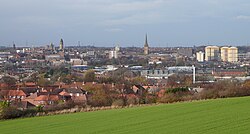
Wakefield

Gare de Wakefield Kirkgate
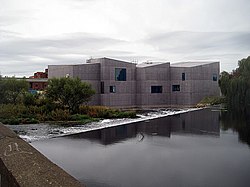
The Hepworth Wakefield
