

 English
 Français
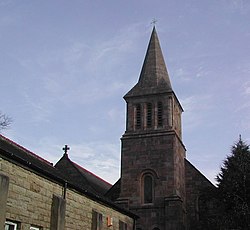
St Andrew's Church, Ashton-on-Ribble
St Andrew's Church is in Blackpool Road, Ashton-on-Ribble, Preston, Lancashire, England. It is an active Anglican parish church in the deanery of Preston, the archdeaconry of Lancaster, and the diocese of Blackburn. The Church is recorded in the National Heritage List for England as a designated Grade II listed building, and is the burial site of Edmund Robert Harris (c.1804 - 1877), the principal benefactor of a range of local institutions, from the Harris Museum to the Harris Technical School (now known as the University of Lancashire). He is buried in a triple coffin in the Church vault.
1. History
The foundation stone of the church was laid on 20 August 1835, and the church was built in the 1836 consecrated on 7 October 1836 by the Rt Revd John Bird Sumner, bishop of Chester. At this time the church seated about 300 people. In 1873–74 the architect Ewan Christian added a north aisle and converted the nave windows into Early English style. A vestry was added in 1902.
1. = Present day =
St Andrew's Church is within the Conservative Evangelical tradition of the Church of England and it receives alternative episcopal oversight from the Bishop of Ebbsfleet.
1. Architecture


1. = Exterior =
The church is constructed in sandstone with slate roofs. Its plan consists of a four-bay nave, a wide north aisle, a north porch, a chancel with an organ chamber to the north, a vestry to the east, and a small west tower. The tower is in Romanesque style, and the rest of the church is in Early English style. The tower is in three stages, with buttresses, and a short broach spire. In the bottom stage are two round-headed lancet windows, with a similar but larger window in the middle stage. The bell openings are louvred, and consist of triple round-headed lancets. Along the sides of the nave and the aisle are three two-light windows, and a three-light window in the eastern bay.
1. = Interior =
Inside the church, the arcade is carried on cylindrical piers of polished pink granite. In the chancel is a sedilia. On the wall of the church are monuments to members of the Pedder family. The stained glass in the east window is by Hardman. The three-manual organ was built in 1902 by Henry Willis & Sons. It was overhauled in 1969 by J. W. Walker, and again in 2001 by Wood of Huddersfield.
1. External features
The churchyard contains the war graves of a Royal Air Force officer of World War I, and an Army Dental Corps officer and Royal Army Medical Corps sergeant of World War II.
1. Further reading
Douglas B Cochrane, A History of the Parish of St Andrew's Ashton-on-Ribble, ASAA
1. See also
Listed buildings in Preston, Lancashire
1. References
Lieux à Proximité Voir Menu

Église Sainte-Walburge de Preston

Lea (Lancashire)

Preston (Lancashire)

Gare routière de Preston
