
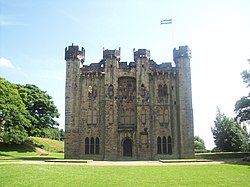
Hylton Castle ( HIL-tən) is a stone castle in the North Hylton area of Sunderland, Tyne and Wear, England. Originally built from wood by the Hilton (later Hylton) family shortly after the Norman Conquest in 1066, it was later rebuilt in stone in the late 14th to early 15th century. The castle underwent major changes to its interior and exterior in the 18th century and it remained the principal seat of the Hylton family until the death of the last Baron in 1746. It was then Gothicised but neglected until 1812, when it was revitalised by a new owner. Standing empty again until the 1840s, it was briefly used as a school until it was purchased again in 1862. The site passed to a local coal company in the early 20th century and was taken over by the state in 1950. One of the castle's main features is the range of heraldic devices found mainly on the west façade, which have been retained from the castle's original construction. They depict the coats of arms belonging to local gentry and peers of the late 14th to early 15th centuries and provide an approximate date of the castle's reconstruction from wood to stone. The castle is owned by English Heritage, a charity which manages the historical environment of England. The surrounding parkland is maintained by a community organisation. The castle and its chapel are protected as a Grade I listed building and a scheduled monument. In February 2016, plans were announced to turn the castle into a community facility and visitor attraction, with the Heritage Lottery Fund awarding £2.9 million, and Sunderland Council £1.5 million, to provide classrooms, a cafe and rooms for exhibitions, meetings and events.

Lieux à Proximité Voir Menu
Location Image
0 m

Château de Hylton

Le château de Hylton est un château en pierre, actuellement en ruine, situé près de Sunderland dans le Tyne and Wear en Angleterre. Construit à l'origine en bois, par un des baron Hylton, juste après la conquête normande de l'Angleterre. Il est reconstruit en pierre de la fin du XIVe jusqu'au début du XVe siècle. Le château a ensuite subi d'importantes modifications aux XVIIIe et XIXe siècles. Il sert divers usages après la fin de la maison Hylton en 1746, le bâtiment a été négligé puis est devenu une école en 1840, avant appartenir à une société houillère au XXe siècle, pour enfin être pris en charge par l'État en 1950, pour enfin appartenir aujourd'hui à l'English Heritage, organisme public chargé du patrimoine historique. Le château est réputé hanté par le Cauld Lad of Hylton.
Location Image
3.6 km

Stadium of Light

Le Stadium of Light est le stade de football du Sunderland AFC. Ce stade de 48 353 places est inauguré en 1997, par le prince Andrew, duc d'York, à l'occasion d'une rencontre entre le Sunderland AFC et l'Ajax Amsterdam.
Location Image
3.6 km

Newcastle Road

Newcastle Road était un stade de football situé à Sunderland, en Angleterre. C'est le terrain du Sunderland AFC entre 1886 et 1898.
3.9 km

Bishopwearmouth

Bishopwearmouth est un quartier de Sunderland, ville du Nord-Est de l'Angleterre.
Location Image
4.0 km

Cité de Sunderland

La Cité de Sunderland (en anglais : City of Sunderland) est un district du Tyne and Wear, en Angleterre. Elle a le statut de district métropolitain et de cité (city). Elle porte le nom de sa principale ville, Sunderland, et couvre un territoire comprenant les villes de Hetton-le-Hole, Houghton-le-Spring, Washington, ainsi que des villages suburbains. Le district a été créé en 1974 sous le nom de District métropolitain de Sunderland (Metropolitan Borough of Sunderland) par le Local Government Act 1972. Il est issu de la fusion de quatre anciens districts du comté de Durham. Il a reçu le statut de cité en 1992, à l'occasion du 40e anniversaire de l'accession au trône de la reine Élisabeth II. Au recensement de 2001, la cité de Sunderland comptait 280 807 habitants, dont une majorité réside à Sunderland.