


Kinghorn Lifeboat Station is located at St James Place, Kinghorn, a town and seaside resort on the northern shore of the Firth of Forth, on the Fife peninsula, on the east coast of Scotland. A lifeboat station was established at Kinghorn by the Royal National Lifeboat Institution (RNLI) on 26 June 1965.


Localisation
2 explorateurs ont visité ce lieu


The station currently operates a B-class (Atlantic 85) Inshore lifeboat, Tommy Niven (B-836), on station since 2009.
History
In 1964, in response to an increasing amount of water-based leisure activity, the RNLI placed 25 small fast Inshore lifeboats around the country. These were easily launched with just a few people, ideal to respond quickly to local emergencies. Kinghorn Lifeboat Station was established in 1965, to help provide more cover in the Firth of Forth, as leisure craft became more prevalent in the area at that time. Initially a small "Hardun" type shed structure was constructed to house the lifeboat, a D-class (RFD PB16) Inshore lifeboat (D-64), which was launched across the beach by hand. The first launch of the lifeboat in 1965, saw the crew deliver letters to residents of the islands of Inchkeith and Inchcolm in the Firth of Forth, to inform them of the opening of the lifeboat station. Most Inshore stations were initially operational only for the summer months. However, it was decided to maintain winter operations at 20 stations for 1965, where there were reasonable launching conditions, even in poor weather. Kinghorn was one of three such stations in Scotland. The station would also remain in service in the winter of 1966. A new pre-cast boathouse was built in 1982, to replace the previous structure. On 10 June 1985 the station received a C-class (Zodiac Grand Raid IV) Inshore lifeboat (C-514), a faster twin-engine version of the D-class. This boat was also accompanied with a sea-going tractor to assist launching.
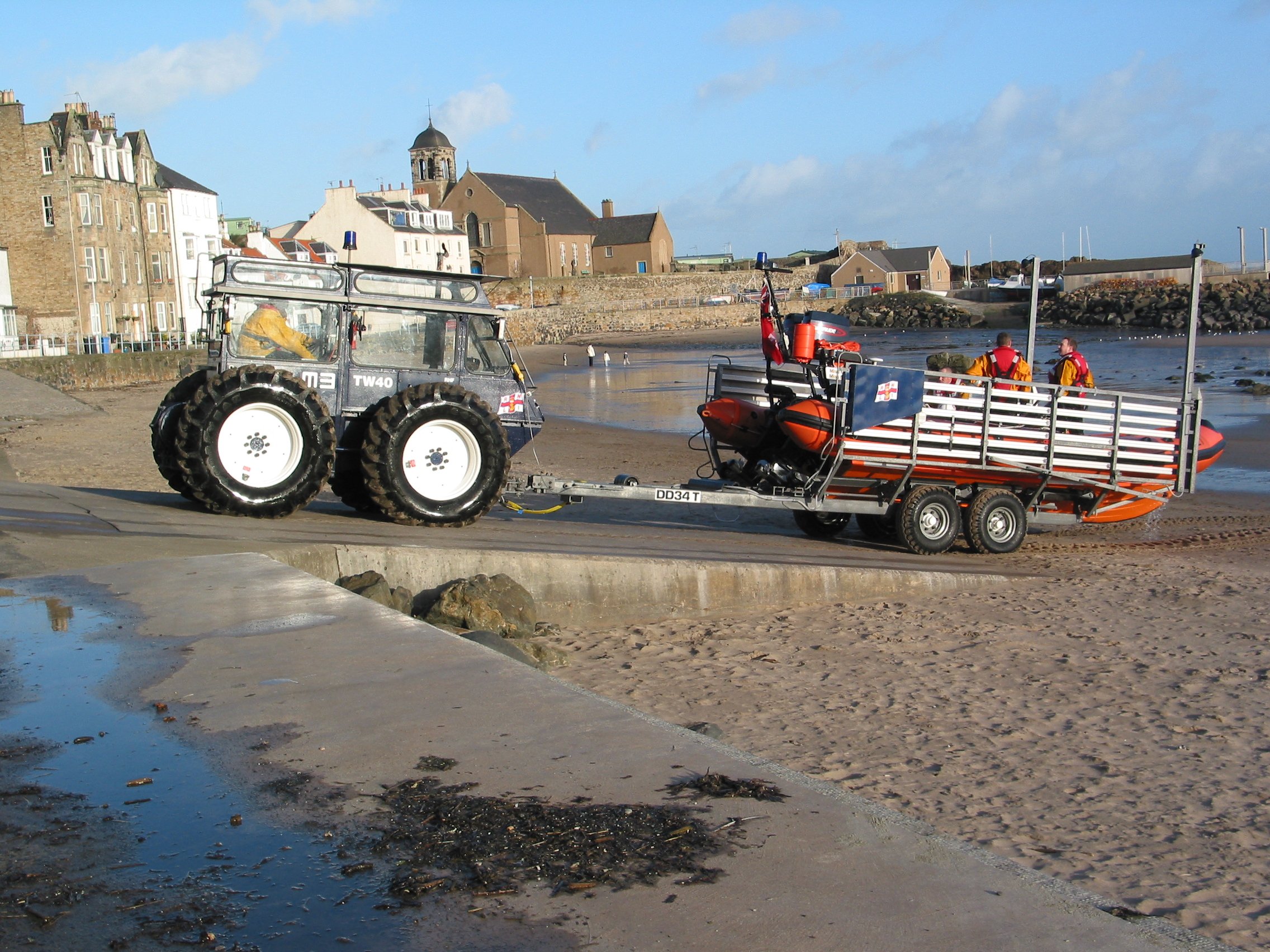
The station building was altered in 1987, to accommodate both the lifeboat and launch carriage. In 1995 the station was upgraded significantly, with a new two-storey building erected, in preparation to accommodate a larger lifeboat, and the Talus MB-764 County amphibious launch tractor. In addition, the station now had improved lifeboat crew facilities, as well as an operation centre, and visitor souvenir shop. A launch ramp and concrete slipway was installed at the same time. On 29 June 1995, a twin-engine B-class (Atlantic 21) RIB Inshore lifeboat (B-533) was brought into temporary service for familiarisation purposes. Six months later, on 12 December, the Atlantic 21-class was replaced with an B-class (Atlantic 75), Frederick Robertson (B-720).
Current service
The B-class (Atlantic 85) Inshore lifeboat, Tommy Niven (B-836), was brought into service on 22 October 2009, funded from the bequest of the late Mr Thomas Niven. In 2019 a balloon in the shape of the fictional superhero character Iron Man was mistaken for a person in the water off Kirkcaldy. The Kinghorn lifeboat was scrambled and spent an hour searching for the missing person. A local Subaru car dealership later admitted to accidentally allowing the balloon to blow away and made a donation to the station. The station holds an annual sponsored Loony Dook, an event on New Years Day, when locals take a dip in the sea, sometimes in fancy dress, and an open day is held during the summer, both to raise funds for the running of the facility.
See also
List of RNLI stations List of former RNLI stations Royal National Lifeboat Institution lifeboats
Connaissez-vous Kinghorn Lifeboat Station ?
In 1965, Kinghorn was chosen as one of only three stations in Scotland to maintain what operational status?
16 utilisateurs ont répondu correctement