
Location Image

Boardwalk (music club)

The Boardwalk was a nightclub in Manchester, England, which was open from 1986 to 1999. This medium-sized club, owned by David, Colin and Donald Sinclair, was a popular live music venue and nightclub in the late 1980s and early 1990s. It had multiple floors, with a rehearsal space in the basement. Colin Sinclair and his father bought the Boardwalk building, located on Little Peter Street, in 1985. Originally a school operated by St. Peter's church, the building's top floor had been used as a rehearsal space for the Hallé Orchestra under John Barbirolli, and, from the 1970s, as a home for an alternative theatre company, the Green Room (which later moved to Whitworth St West) . The first live event at the Boardwalk took place 15 December 1985, although at the time the venue had no alcohol licence. Along with other clubs like the Haçienda, and the International, the Boardwalk provided an important live venue for many bands, from local to national. Sue Langford organised in-house bookings at the Boardwalk, with various independent promoters also hosting shows at the venue (including Simon Moran). Bands such as Oasis and Northside made their live debuts at the Boardwalk. The Man From Delmonte, the Charlatans, Happy Mondays, Female Brothers and Dub Sex, were amongst the many Manchester bands that appeared frequently at the Boardwalk before acquiring international recognition or disappearing into obscurity. The venue also saw a variety of other acts including The Stone Roses, Hole, Sonic Youth, Chumbawamba, Jayne County, Verve, Bob Mould and Rage Against the Machine. The venue was also known as a focus of Britain's C86 music scene. The basement of the venue served as a rehearsal space. The Membranes, James, Simply Red, and A Certain Ratio were among the acts who took rehearsal space at the Boardwalk in the 1980s. In the early 1990s, Oasis shared a rehearsal room with Sister Lovers. The venue added a mezzanine floor in December 1990 marking a shift to club nights every Saturday. 'Freedom' took place every Saturday from December 1990 until June 1996, featuring former Haçienda DJ Dave Haslam alongside guest DJs including Erick Morillo, Pete Heller, Nick Warren and Pete Tong. From March 1992 until March 1999 a second club night, 'Yellow' was staged every Friday at the Boardwalk. Funkademia was started by DJ and promoter David Payne at The Boardwalk in 1995 and has since gone on to become one of Manchester's longest running club nights. The nightclub site now has a blue plaque, featuring a smiley face, a symbol associated with acid house. Beneath the symbol is a description of The Boardwalk as a "Madchester Venue Nightclub and Rehearsal Rooms".

Lieux à Proximité Voir Menu
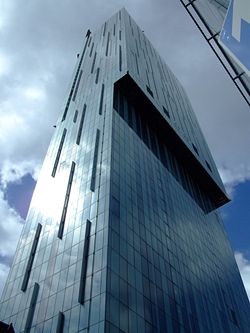
Location Image
175 m

Beetham Tower (Manchester)

La Beetham Tower est un gratte-ciel situé dans la ville de Manchester, en Angleterre. Construit de 2004 à 2006, il mesure 168 m de haut et comporte 48 étages. Le bâtiment est nommé ainsi d'après ses concepteurs, la Beetham Organization. Il a été conçu par l'architecte Ian Simpson et construit par l'entreprise Carillion. Le gratte-ciel est aussi connu sous le nom de Hilton Manchester, il contient en effet un hôtel Hilton jusqu'au 23e étage, les autres niveaux étant occupés par des appartements. Il comporte également deux niveaux souterrains, des espaces de stationnement pour les résidents des appartements. Cette tour a la particularité de produire un son intense en présence de vent violent. Un effet non prévu par l'architecte lors de la conception.
Location Image
198 m

The Haçienda

Fac 51 Haçienda, plus communément appelé The Haçienda, est un ancien nightclub de Manchester au Royaume-Uni. Inauguré entre autres par Tony Wilson en mai 1982, le club doit fermer en 1997 après le décès d'une jeune raveuse, des suites d'une overdose. L'Haçienda est également l'épicentre du mouvement musical Madchester. Conçu comme un espace ouvert et transversal par les designers Ben Kelly et Peter Saville, le club proposait également des cafés, des expositions, projection de films, conférences, défilés de mode, un coiffeur.
Location Image
330 m

Castlefield

Castlefield est un quartier de la ville de Manchester. Cette zone est délimitée par l'Irwell, Quay Street, Deansgate et la route de Chester. C'est là que se tenait sous l'empire romain le castrum de Mamucium, auquel la ville doit son nom. C'est également à Castlefield que se termine le Bridgewater Canal, le premier canal industriel au monde construit en 1764. Le premier chemin de fer transportant des passagers se terminaient ici en 1830, à la Liverpool Road railway station. Le Rochdale Canal rejoint le Bridgewater Canal à Castlefield en 1805 et dans les années 1830 ils sont raccordés aux voies navigables sur l'Irwell et la Mersey. En 1848, les deux viaducs de la Manchester, South Junction and Altrincham Railway traversent Castlefield pour se rejoindre, deux autres viaducs et une station principale suivent.
Location Image
333 m

Gare de Manchester Central

La gare de Manchester Central (Manchester Central railway station) est une ancienne gare du district de Manchester city centre (en) de la ville de Manchester, en Angleterre. Elle a été l'une des principales gares de la ville de son ouverture en 1880 jusqu'à sa fermeture en 1969. Elle a depuis été convertie en un centre d'expositions et de conférences appelé le Manchester Central Convention Complex.
Location Image
337 m

Manchester Central Convention Complex

Le Manchester Central Convention Complex (communément appelé Manchester Central) est un centre d'exposition et de conférence à Manchester, en Angleterre. Le bâtiment a été autrefois l'ancienne gare de Manchester Central. Il a conservé son toit voûté distinctif avec une envergure de 64 mètres - la deuxième plus grande envergure de toit de gare au Royaume-Uni et a obtenu le statut de bâtiment classé Grade II * en 1963. Après avoir servi 89 ans comme terminus ferroviaire, il a fermé ses portes aux passagers en mai 1969. Il a été rénové pour devenir un centre d'exposition anciennement connu sous le nom de G-Mex Centre en 1982 pendant lequel il a été le principal lieu de concerts de musique de Manchester jusqu'à la construction de la Manchester Arena. Après sa rénovation en 2007, le lieu a repris son ancien nom de Manchester Central. En 2020, à l'exemple de l'hôpital chinois de Fangcang, le complexe est devenu un hôpital de campagne temporaire pour les patients atteints de covid en état de santé critique. Il a alors fait partie du réseau des hôpitaux temporaires du NHS Nightingale Hospitals.