Location Image

Liverpool Naval Memorial

The Liverpool Naval Memorial, also known as the Memorial to the Missing of the Naval Auxiliary Personnel of the Second World War or the Merchant Navy War Memorial, is a war memorial at Pier Head beside the River Mersey in Liverpool, near to the Royal Liver Building and the Museum of Liverpool. It commemorates nearly 1,400 men from the British Merchant Navy who died on active service with Royal Navy in the Second World War, and who have no known grave. More than 13,000 officers and seamen of the Merchant Navy agreed to serve with the Royal Navy in the Second World War, serving mainly in auxiliary vessels such as armed merchant cruisers, subject to military discipline but still receiving civilian pay. The depot for registration and administration of the naval auxiliaries from the Merchant Navy was established at Liverpool. After the Second World War, the Imperial War Graves Commission (later the Commonwealth War Graves Commission) organised a competition for a memorial, with a budget of £5,000, open to architects who had served in the armed forces. The winning design was created by architects Charles Frederick Blythin and Stanley Harold Smith, with sculpture by George Herbert Tyson Smith. It was unveiled by Admiral of the Fleet Viscount Cunningham of Hyndhope on 12 November 1952. The memorial comprises a narrow cylindrical column of Portland stone topped by a glazed lantern, which has glass lenses with a reflective backing intended to resemble a lighthouse, which stands on a semicircular Portland stone platform surrounded by curved walls. The platform is reached by flight of six steps, and the walls support a pair of stone globes, one terrestrial and one celestial. The memorial bears the inscription "These officers and men of the Merchant Navy died while serving with the Royal Navy and have no grave but the sea 1939–1945". The names of the dead are inscribed on 25 bronze plaques arranged around the curved Portland stone walls of the memorial. It became a Grade II listed building in 2010. Among several other memorials at Pier Head are memorials to seamen from Norway, Poland, China, the Netherlands and Belgium who served in the Second World War, and a memorial dedicated to the Merchant Navy unveiled in 1998. There is a proposal to erect a large Battle of the Atlantic memorial nearby. Merchant seamen lost at sea in the First and Second World Wars are also commemorated by the Merchant Navy Memorial at Tower Hill in London.

Lieux à Proximité Voir Menu
Location Image
83 m

Musée de Liverpool

Le musée de Liverpool, en anglais : Museum of Liverpool, est un musée sur l'histoire locale situé à Liverpool au Royaume-Uni. Créé en 2011, il remplace le Museum of Liverpool Life. La construction du nouveau bâtiment a couté 72 millions de livres.
Location Image
138 m

Pier Head

Le Pier Head est un ensemble de bâtiments se trouvant sur les rives de la rivière Mersey à Liverpool. Il fait partie du patrimoine mondial de l'UNESCO depuis 2004 à travers la dénomination de « Liverpool – Port marchand ». Le site historique comprend un trio de monuments se trouvant sur ce qui s'appelait le George's Dock qu'on a l'habitude de désigner par The Three Graces, « les trois grâces » : le Royal Liver Building, construit entre 1908 et 1911 par Walter Aubrey Thomas. Il se présente sous la forme de deux tours à horloge, toutes deux couronnées par une statue du Liver bird, symbole de Liverpool. Le bâtiment abrite le siège de la Royal Liver Friendly Society ; le Cunard Building, construit entre 1914 et 1916, c'est l'ancien siège de la Cunard Line ; le Port of Liverpool Building, construit entre 1903 et 1907, il abritait la direction des Mersey Docks. Également classé, le tunnel du Mersey, à l'est des monuments, fut construit dans les années 1930 et contient les bureaux ainsi que la ventilation du tunnel de Queensway. De nombreux projets de réaménagement du site ont été imaginés. En 2002 le projet Fourth Grace, « quatrième grâce », imaginé par Wil Alsop et connu sous le nom de the Cloud, « le nuage », fut commencé avant d'être abandonné en 2004 à cause de son coût. En 2007 ont commencé des travaux pour déplacer le Museum of Liverpool Life. La même année, la construction du Liverpool Canal Link a démarré, long de 1,6 mile (2,6 km), il doit relier le Leeds-Liverpool Canal au South Docks.
Location Image
148 m

Port of Liverpool Building

Le Port of Liverpool Building est un bâtiment classé situé à Liverpool, en Angleterre. Il a été construit entre 1903 et 1907 sur Pier Head, aux côtés du Cunard Building et du Royal Liver Building. Il abritait à l'origine la direction des Mersey Docks and Harbour Board (MDHB). Le bâtiment a été conçu par Arnold Thornely and F.B. Hobbs d'un style "Edwardian Baroque".
Location Image
198 m

Cunard Building

Le Cunard Building est un bâtiment classé situé à Liverpool, en Angleterre. Il a été construit entre 1914 et 1916 sur Pier Head, aux côtés du Port of Liverpool Building et du Royal Liver Building. C'est l'ancien siège de la Cunard Line.
Location Image
263 m

Royal Liver Building

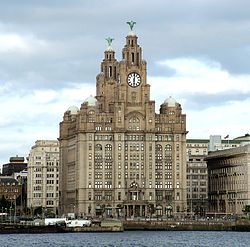
Le Royal Liver Building est un bâtiment classé, haut de 103 m, l'un des premiers au monde réalisés en béton armé, situé à Liverpool, en Angleterre. Il a été construit entre 1908 et 1911 par Walter Aubrey Thomas sur Pier Head, aux côtés du Cunard Building et du Port of Liverpool Building. Il se présente sous la forme de deux tours horloge, toutes deux couronnées par une statue du Liver bird, symbole de la ville. Le bâtiment abrite le siège de la Royal Liver Friendly Society.