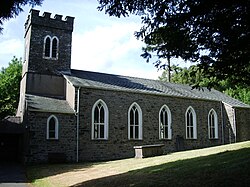
Cartmel Peninsula is a peninsula in Cumbria in England. It juts in a southerly direction into Morecambe Bay, bordered by the estuaries of the River Leven to the west and the River Winster to the east. It is, along with the Furness Peninsula, (from which it is separated by the River Leven) one of the two areas of that formed Lancashire North of the Sands, and the better known 'Furness' is often used to describe both peninsulae together. To its north, the peninsula's borders are usually given as the banks of Windermere and the border with the historic county of Westmorland between the Lake and the head of the Winster. Historically, the area was controlled by the monks of Cartmel Priory. Following its dissolution, much of the local land fell into the ownership of the Preston family at Holker Hall. Through marriage Holker became part of the estate of the Cavendish Family, and today is the home of Lord Cavendish. As well as the estate around Holker, the Cavendish family still owns much of the land of the Peninsula. The Cartmel Peninsula is largely rural dominated by limestone outcrops and the overlooking Cumbrian mountains. There is some agriculture, with saltmarsh lamb raised on the sands of Morecambe Bay that surround the peninsula, but this is limited by the challenging landscape. The modern peninsula is a popular tourist destination, and together with Furness, Cartmel has been marketed as part of the Lake District Peninsulas, though the Lake District National Park only covers the northern portion of the peninsula. Cartmel's only town is Grange-over-Sands, a Victorian seaside resort. Grange's growth was a result of the Furness Railway, which runs along the peninsula's southern edge, with stations at Grange, Cark and Cartmel and Kents Bank. Cartmel's name is known internationally as a 'foodie' destination. It is home to L'Enclume, a Michelin two-star restaurant named the best in the UK by the Good Food Guide between 2013 and 2017, and to Cartmel sticky toffee pudding, produced in the village shop and sold globally. The following settlements and sites can be found on the peninsula:

Allithwaite, Ayside Cartmel, Cartmel Priory, Cartmel Racecourse, Cark Flookburgh Grange-over-Sands High Newton, Holker Hall Lindale, Low Newton, Cumbria Newby Bridge Ravenstown

1. References
Lieux à Proximité Voir Menu
Location Image
2.2 km

Broughton East

Broughton East est une paroisse civile de Cumbria, située dans le nord-ouest de l'Angleterre.
Location Image
2.9 km

Cartmel (Cumbria)

Cartmel est un village de Cumbria, en Angleterre. Il est situé dans le sud du comté, à 3,5 km au nord-ouest de la ville de Grange-over-Sands, près de la rivière Eea (en). Administrativement, il relève de la paroisse civile de Lower Allithwaite, qui comprend également le village d'Allithwaite (en), et du district de South Lakeland. Au recensement de 2011, la paroisse civile comptait 1 831 habitants. Le village abrite notamment l'hippodrome de Cartmel (en).
Location Image
3.4 km

Haverthwaite

Haverthwaite est un village et une paroisse civile de Cumbria, situé dans le nord-ouest de l'Angleterre.
Location Image
3.8 km

Lindale and Newton-in-Cartmel

Lindale and Newton-in-Cartmel est une paroisse civile de Cumbria, située dans le nord-ouest de l'Angleterre.
Location Image
4.2 km

Holker Hall

Holker Hall (prononcé Hooker par certains) est une maison de campagne privée située à environ 2 km au sud-ouest du village de Cartmel dans le comté cérémoniel de Cumbria et le comté historique de Lancashire, en Angleterre. C'est « le plus grand [bâtiment] de sa période dans le Lancashire ... par les meilleurs architectes vivant alors dans le comté. ». Le bâtiment date du XVIe siècle, avec des modifications, des ajouts et des reconstructions aux XVIIIe et XIXe siècles. La reconstruction du XIXe siècle est réalisée par George Webster dans un style néo-jacobéen et les rénovations ultérieures sont réalisées par E.G. Paly. Hubert Austin a un cabinet commun avec Paley dans les années 1870 et ils reconstruisent tous deux l'aile ouest après qu'elle a été détruite par un incendie majeur en 1871, une décennie seulement après les travaux précédents de Paley sur la structure. L'incendie a également détruit un certain nombre d'œuvres d'art remarquables. L'historien de l'architecture Nikolaus Pevsner exprime l'opinion que l'aile ouest est le "travail domestique exceptionnel" de Paley et Austin. En 1970, la maison elle-même, ainsi que son mur de terrasse, sont classés Grade II*. La maison se trouve dans un domaine d'environ 80 hectares, et est entouré de jardins à la française, de parcs et de bois. Dans le parc se trouvent six structures répertoriées au grade II. Depuis qu'il est devenu une maison privée à la suite de la dissolution des Monastères, le domaine n'a jamais été vendu, étant passé par héritage de la famille Preston à la famille Lowther, puis à la famille Cavendish. En chronostratigraphie, le sous-étage britannique de la période carbonifère, le « Holkerian » tire son nom de Holker Hall.