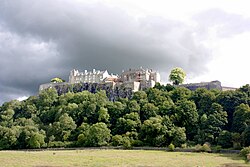
Mote Hill is the northern tip of the Gowanhills, Stirling, the northern half of the Royal Park that extends around Stirling Castle. The wider park includes the King's Knott and sections of a 2-metre-high deer wall, first established in the 12th century, though Gowan Hill only became park of the Royal Park around 1500. Ten thousand years ago, Mote Hill was a promontory projecting into a lost prehistoric sea. On the opposite bank of the River Forth lies Abbey Craig, upon which sits the National Wallace Monument. These two rocky outcrops were, for thousands of years, the lowest crossing point of the Forth. Mote Hill is also known as Heiding Hill or Murdoch's Knowe or Hurlie Haw and is the location of the Beheading Stone, the traditional execution block of medieval Stirling. The stone itself is now on a concrete mount and under an iron cage, but you can still see the axe marks from the executions. Mote Hill is also the site of a vitrified fort, destroyed by fire in the first half of the first millennium AD. This date was confirmed by excavation by Dr Murray Cook, Stirling Council's archaeologist.

Lieux à Proximité Voir Menu
Location Image
547 m

Bataille du pont de Stirling

La bataille du pont de Stirling (en anglais : Battle of Stirling Bridge ; en gaélique écossais : Blàr Drochaid Shruighlea) constitue une des batailles des guerres d’indépendance de l’Écosse. Le 11 septembre 1297, les armées d'Andrew de Moray et de William Wallace affrontent celles de Jean Ier de Warenne, 6e comte de Surrey, leur infligeant une défaite.
Location Image
562 m

Château de Stirling

Situé dans la ville de Stirling en Écosse, le château de Stirling est l'un des plus grands et des plus importants châteaux d'Écosse, et même d'Europe occidentale, tant du point de vue historique qu'architectural. Érigé sur la "colline du château" (the castle hill), un crag volcanique, il est entouré sur trois côtés par des falaises à pic, ce qui le rend facile à défendre. Cette caractéristique, ainsi que sa position stratégique, ont fait de lui une importante place forte dès l'origine, objet de lutte entre Écossais et Anglais. Plusieurs rois et reines d'Ecosse y sont nés, morts ou y ont été sacrés. Classé monument national, le château est aujourd'hui régi par Historic Scotland, l'agence écossaise des monuments historiques.
Location Image
562 m

Siège de Stirling

Le siège de Stirling par le royaume d'Angleterre eut lieu en 1304.
Location Image
770 m

Église de la Sainte-Croix de Stirling

L'église de la Sainte-Croix est une église presbytérienne située dans la ville écossaise de Stirling. Appelée en anglais Church of the Holy Rude (« rude » étant un terme ancien pour « croix »), cet édifice, remarquable pour sa tour-clocher, vit se faire couronner, en 1567, un roi d'Écosse sous son exceptionnelle charpente : Jacques VI.
Location Image
970 m

Gare de Stirling

La gare de Stirling est une gare ferroviaire desservant la ville écossaise de Stirling au Royaume-Uni.