Location Image

St Agatha's Church, Easby

St Agatha's Church is the parish church of Easby, a village near Richmond, North Yorkshire, in England. The church lies immediately south of Easby Abbey. It was probably built in the 1150s, from which period the west end of the nave and south side of the chancel survive. The south side of the nave dates from about 1200, including a contemporary doorway, while the north wall of the chancel and east window are from later in the 13th century. A north transept was added in the early 14th century, and a south aisle and porch in the late 14th century. It was restored by George Gilbert Scott in 1869, and was Grade I listed in 1969. The church is part of the parish of Easby, Skeeby, Brompton on Swale, and Bolton on Swale; part of the Richmond Deanery in the Anglican Diocese of Leeds.

The church is built of stone, and has roofs of lead, stone slate and artificial slate. It consists of a nave with a west bellcote, a south aisle, a south porch, a north transept and a chancel. At the west end, pilaster buttresses flank a lancet window with a hood mould, and the bellcote above has two lights. The porch is gabled, and has two storeys, and a buttress on the left. It contains a double-chamfered doorway with a pointed arch and a hood mould, and above it is a trefoil-headed niche. Inside, there is a barrel vault, a doorway with a pointed arch in the east wall, two openings in the west wall, and a doorway in the north wall with a chamfered surround, shafts, and a hood mould.

The door to the church may be 14th century. The font is 12th century, with a later stem. The south chapel has Perpendicular wooden screens, and a brass monument to Eleanor Bowes, dating from 1623. The chancel has a piscina and sedilia, and a stone coffin with no lid. The east window includes two pieces of 12th century stained glass, depicting Saint John and a Premonstratensian canon, and a 15th-century section depicting an angel. There is also a plaster replica of the carved stone Easby Cross, which was extracted from the wall of the church and reassembled in the 20th century, and is now in the Victoria and Albert Museum. The church is best known for its 13th century wall paintings, which were rediscovered during the 19th century restoration, and restored by Burlinson and Grylls. Those on the north side of the nave depict characters sowing, digging, pruning and hawking; along with scenes from the Garden of Eden. On the south side are scenes from the Nativity and Passion of Jesus.

Lieux à Proximité Voir Menu
Location Image
210 m

Easby (Richmondshire)

Easby est un village et une paroisse civile du Yorkshire du Nord, en Angleterre.
Location Image
1.5 km

Richmond (Yorkshire du Nord)

Richmond est une ville située dans le Yorkshire du Nord en Angleterre, au Royaume-Uni. Elle est rattachée administrativement au district du Yorkshire du Nord.
Location Image
2.0 km

Hipswell

Hipswell est un village et une paroisse civile du district du Richmondshire, au Yorkshire du Nord en Angleterre. La paroisse civile comprend entre autres la partie nord de la garnison de Catterick. Le village de Hipswell se trouve dans l'extrême Sud de la paroisse civile et forme un quartier annexe de cette garnison.
Location Image
2.3 km

Garnison de Catterick

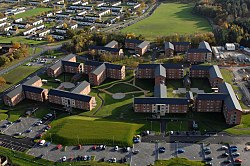
La garnison de Catterick est une garnison majeure et une ville militaire à 3 milles (4,8 kilomètres) au sud de Richmond, Yorkshire du Nord, Angleterre. C'est la plus grande garnison de l'armée britannique au monde avec une population d'environ 14 000 habitants en 2021 et une superficie de plus de 2 400 acres. Selon les plans annoncés par le ministère de la Défense (MoD) en novembre 2005, la population de la garnison de Catterick devrait atteindre plus de 25 000 personnes d’ici à 2020, ce qui en fera le plus grand centre de population de la région.
Location Image
2.6 km

Colburn (Royaume-Uni)

Colburn est une ville, une paroisse civile et une circonscription électorale du district de Richmondshire, dans le North Yorkshire, en Angleterre. C'est environ 2 milles (3,2 kilomètres) à l'ouest du village de Catterick et elle compte 4 860 habitants au recensement de 2011. Le village tire son nom des premiers colons installés le long du ruisseau Colburn Beck. Cela signifie "flux froid", "flux de charbon" ou "flux froid et noir" et est un mélange de vieil anglais et de vieux norrois (Col, Kol et Burna). Une "brûlure" fait référence à une vallée érodée par les écoulements d'eau. La famille Colburn (Coburn) est répandue dans le monde entier, y compris Edward Colburn, arrière-grand-père de Reuben Colburn, arrivé en Amérique en 1635 sur le navire "Defence" de la Grande Migration puritaine des années 1630 dirigée par John Winthrop. Le nom Colburn est utilisé pour décrire à la fois le petit village ancien situé au nord et (plus fréquemment) le grand lotissement suburbain situé au sud, également connu sous le nom de Colburn Lane Estate. Colburn Hall, un ancien manoir, ainsi qu'un ancien bâtiment de tribunal adjacent sont des monuments historiques. Les quartiers environnants de Colburn incluent Walkerville, les boutiques de Broadway et Richmondshire Walk. Un centre de sports et de loisirs ouvert en 2004 offre aux habitants de Colburn un lieu de détente, d’exercice physique et de sports divers, dont le football. En 2005, Colburn fut au centre d'une vive controverse locale concernant les projets du conseil du district de Richmondshire. Le conseil voulait se doter de nouveaux bureaux situés dans une zone commerciale développée par le conseil, mais vide depuis plusieurs années. Les nouveaux bureaux devaient coûter quatre fois plus que les bureaux actuels du conseil. Le conseil devait alors construire dans le même projet des appartements sur les parkings du centre-ville, dans le quartier historique de Richmond, à proximité, pour financer le déménagement. Le projet a fini par avorter. En 2007, Colburn a célébré les 50 ans du nouveau lotissement en organisant de nombreux événements, de la pantomime aux soirées quiz.