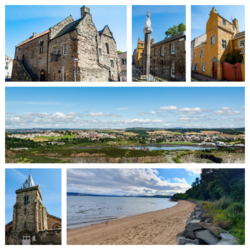
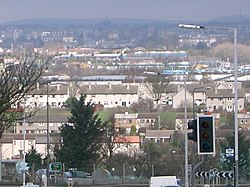
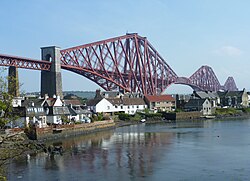
Inverkeithing ( ; Scottish Gaelic: Inbhir Chèitinn) is a coastal town, parish and historic Royal burgh in Fife, Scotland. The town lies on the north shore of the Firth of Forth, 9+1⁄2 miles (15.5 kilometres) northwest of Edinburgh city centre and 3+1⁄2 mi (5.5 km) south of Dunfermline. A town of ancient origin, Inverkeithing became an important centre of trade and pilgrimage during the Middle Ages. Inverkeithing was granted Royal burgh status by 1161 and was the meeting place of the Parliament of Scotland in 1354 and the Convention of Royal Burghs from 1487 to 1552. The town witnessed the Battle of Inverkeithing in 1651, a conflict in the Wars of the Three Kingdoms. Following the Industrial Revolution, Inverkeithing developed industries including distilling, ship breaking and quarrying. Inverkeithing town centre is a conservation area following a medieval town plan, home to 55 listed buildings including the best-preserved medieval friary in Scotland and one of the finest examples of a medieval Mercat Cross. The town's annual highland games and Lammas fair are among the oldest in Scotland. Inverkeithing lies on the Fife Coastal Path, one of Scotland's Great Trails, and the Fife Pilgrim Way. Inverkeithing railway station is a main stop for trains running over the nearby Forth Rail Bridge, and the town is home to the Ferrytoll Park & Ride. Around half of Inverkeithing's workers commute to Edinburgh city centre or Dunfermline (2024). The town has a population of 4,820 (2020) and the civil parish has a population of 8,878 (2022).

Lieux à Proximité Voir Menu
Location Image
860 m

Inverkeithing

Inverkeithing est une ville qui se trouve dans la banlieue d'Edimbourg et un ancien burgh royal du comté de Fife en Écosse. Selon le recensement de 2006, la population de la ville est de 5 265 habitants. Son port a reçu le statut de burgh du roi David Ier d'Écosse (1124- 1153) au XIIe siècle. La ville se situe à environ 9 kilomètres de l'aéroport d'Édimbourg et à 6 km de Dunfermline, le chef-lieu du comté. La ville jouxte Rosyth et Dagelty Bay.
Location Image
1.3 km

Bataille d'Inverkeithing

La bataille d'Inverkeithing se déroule le 20 juillet 1651, à Inverkeithing en Écosse. Elle est l'une des dernières batailles de la guerre anglo-écossaise de 1650-1652. Les troupes parlementaires de la New Model Army commandées par John Lambert remportent la victoire sur l'armée royaliste, prédominément écossaise, de Charles II d'Angleterre, menée par David Leslie (en).
Location Image
2.2 km

Dalgety Bay

Dalgety Bay est une ville située dans le Fife, en Écosse. En 2020 la population de Dalgety Bay est estimée à 9 710 habitants.
Location Image
2.2 km

Rosyth

Rosyth (se prononce « Ross-sythe » ; Ros Fhìobh en gaélique (gd), mais on rencontre aussi parfois Ros Saidhe ou Ros Saoithe) est une ville située sur l'estuaire de la rivière Forth, le Firth of Forth, sur la côte est de l'Écosse. Au sud, à environ 1,6 kilomètre, se situe Dunfermline, et Fife, à environ 19 kilomètres au nord-ouest d'Édimbourg, et Lothian au sud.
Location Image
2.3 km

North Queensferry

North Queensferry est un village du council area de Fife en Écosse, sur la rive nord du Firth of Forth, entre le pont du Forth ferroviaire, son pont suspendu homonyme routier et un troisième pont à haubans, le nouveau pont du Forth, mis en service en 2017, à 16 km d'Édimbourg. Selon l'estimation de 2011, le village a une population de 1 076 habitants.