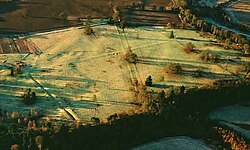
Wolfhill is a village in Perthshire, Scotland, with a population of 316 (2001 census). Formerly known as Carolina, it was given the nickname of "Snipetown" many years ago by locals, owing to the high numbers of snipes that used to inhabit the area. The hamlet is near the source of the Burrelton Burn and lies between the Sidlaw Hills and the River Tay, 2 miles (3 km) north east of Guildtown and 7 miles (11 km) north-east of Perth. Close to Wolfhill are examples of pre-historic standing stones. One of the best-known sites in folklore is "The Witches' Stane" located between Wolfhill and St Martins. According to local legend, this was the stone to which Macbeth's witches were chained, and it does indeed bear chain marks. "MacBeth's Castle" (a hill fort) can be found at the nearby village of Collace, near the Council Quarry on the Sidlaws. There are varying stories on how the village got its name, one being that the "Wolf of Badenoch" (Alexander Stewart, Earl of Buchan) camped there before going to Perth in the 14th century to be officially forgiven by the church for his evil ways. He is buried at Dunkeld Cathedral in a cask. It is also said that the last wolf in Scotland was killed in Wolfhill but many other villages across the country lay claim to the same story. There is no doubt that wolves inhabited the area at one time. The monks of nearby Coupar Angus Abbey, who formerly owned the land, stipulated in certain mid-16th-century lease agreements recorded in the document known today as the Rent Book of Coupar-Angus Abbey (Rogers 1880; pages 251, 262) that tenants were required to "... sustene and nwrice ane leche of hundis for tod and wolf.." – that is to say, "...sustain and nourish a leash of hounds for (hunting) fox and wolf..". Birthplace of James Croll, FRS, joiner, janitor, librarian and arguably first world climatologist.

Lieux à Proximité Voir Menu
Location Image
4.7 km

Rivière Isla (Perthshire)

La rivière Isla (en gaélique écossais: Abhainn Ile) est un affluent du fleuve Tay, dans le Perthshire, en Écosse. Elle coule sur 74 kilomètres au travers de Glen Isla (Gleann Ile) et de Strathmore (en) (Srath Mòr). Elle ne doit pas être confondue avec la rivière Isla de Moray, qui traverse Strathisla.
Location Image
6.1 km

Dunsinane Hill

Dunsinane Hill est une colline d'Écosse.
Location Image
6.9 km

Inchtuthil

Inchtuthil ou Pinnata Castra est un site archéologique d'un ancien camp romain en Écosse. Construit en 82 et 83 par les troupes de Cnaeus Julius Agricola, il est par la suite occupé par la Legio XX Valeria Victrix, et démantelé en 87.
Location Image
7.4 km

Scone (Écosse)

Scone (en écossais : Sgàin ; en moyen irlandais : Scoine) est un village d'Écosse, dans la région de Perth and Kinross. Son nom est prononcé « scoune ». À Scone se trouvait la Pierre du destin, dite aussi Pierre de Scone, sur laquelle les rois d'Écosse étaient couronnés. La pierre fut emmenée comme butin de guerre à Westminster par le roi Édouard Ier d'Angleterre en 1296. Mais les rois écossais continuèrent à se faire couronner à Scone, jusqu'à Charles II, en 1651. Au début du XIIe siècle, Alexandre Ier d'Écosse construisit à Scone une abbaye pour y conserver la Pierre du destin. L'endroit servit aussi de résidence royale. Un village médiéval, Old Scone, se développa peu à peu autour de l'abbaye. Mais au XIXe siècle, l'ensemble fut rasé par le comte de Mansfield pour construire le château actuel. Et un nouveau village — New Scone — fut construit en 1805, à deux kilomètres à l'ouest de l'ancien. Il comprend de nos jours 4 000 habitants et fait partie de la banlieue de Perth. La Pierre du destin a été rétrocédée à l'Écosse le 15 novembre 1996. Elle est désormais exposée au château d'Édimbourg.
7.7 km

Raid de Scone

Après la révolte de Lanark, William Wallace joignit ses forces en juin 1297 à celles de William Douglas et fit un raid sur la ville de Scone, occupée par les Anglais. Ils mirent en déroute William de Ormesby (en), le justiciar anglais, et prirent le contrôle de la ville. Wallace dirigea ensuite son armée vers Stirling et battit l'armée anglaise en septembre 1297.