

 English
 Français

Ramshorn Cemetery
The Ramshorn Cemetery is a cemetery in Scotland and one of Glasgow's older burial grounds, located within the Merchant City district, and along with its accompanying church, is owned by the University of Strathclyde. It has had various names, both official and unofficial: North West Parish Kirkyard; St David's Kirkyard; and Ramshorn and Blackfriars. The latter name tells of its link to Blackfriars Church, linking in turn to the pre-Reformation connection to the Blackfriars Monastery in Glasgow.
The burial ground was used from 1719 to 1915. In the 20th century it was remodelled along the lines of the London Improvements Act, moving most stones to the perimeter to create a usable park area. Apart from some flat stones still remaining in-situ this has largely disconnected the stones to the actual spot of interment.
In 1813 the body of Janet McAlister was stolen from the graveyard, being found with 4 others in College Street Medical School.
In 1824 the church of St David was built on its southern side, designed in a fine Gothic style by the English architect Thomas Rickman, with modifications by local architect James Cleland.
The cemetery is effectively in three sections: the original cemetery; an enclosed central walled area where the old church stood; and two small walled sections flanking the new church. Unusually monuments adopt only two forms: wall monuments and flat slabs, other than a small row of small 18th-century stones upright but partly sunk into the ground, standing in a line to the north-east.
Despite its great simplicity, the majority of graves are to rich Glasgow merchants. The austere style reflects Scottish Calvinist views.
John Anderson, the founder of Anderson's Institute - which would evolve into the Royal College of Science and Technology and then ultimately the University of Strathclyde, is also interred in the site.
Lieux à Proximité Voir Menu

Hôtel de ville de Glasgow

Royal College of Science and Technology

Corinthian Club
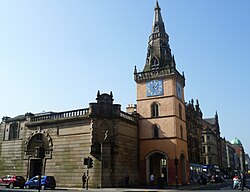
Tron Theatre
