Location Image

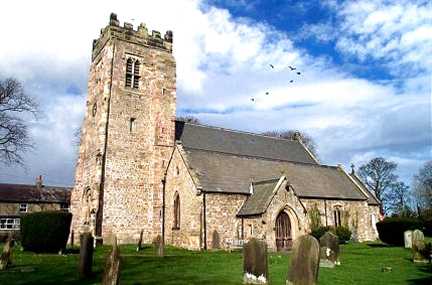
St Mary's Church, Bolton-on-Swale

St Mary's Church is the parish church of Bolton-on-Swale, a village in North Yorkshire, in England. The oldest parts of the current church are the south aisle and south doorway, which date from the early 14th century. The chancel and vestry are 15th century, while the tower dates from about 1550. It was heavily restored by George Fowler Jones in 1857, the work including rebuilding much of the nave, most of the windows, and replacing the roof. The chancel was remodelled in 1877 by Eden Nesfield. The church was grade II* listed in 1969. The church is built of sandstone with Westmorland slate roofs. It consists of a nave, north and south aisles, a chancel with a north vestry and organ chamber, and a west tower. The tower has three stages, diagonal buttresses, a southeast stair turret, a three-light west window, a clock face on the west side, two-light bell openings, with cinquefoil heads, continuous decorated lintels and hood moulds, and an embattled parapet with coats of arms. Inside the church is a 14th-century piscina, in the south aisle. The sanctuary has decorative tiles made by Nesfield with a mural above depicting angels ascending to Heaven, while the Carpenter chapel has similar tiling, with bas relief plasterwork depicting maritime and pastoral scenes from the Bible. In the south wall are part of four Mediaeval tomb slabs, while next to the pulpit is part of an Anglo-Danish cross shaft. There is a large black marble slab commemorating Henry Jenkins, who died at the supposed age of 169.

Lieux à Proximité Voir Menu
Location Image
120 m

Bolton-on-Swale

Bolton-on-Swale est un village et une paroisse civile du Yorkshire du Nord, en Angleterre.
Location Image
1.1 km

Scorton

Scorton est un village et une paroisse civile du Yorkshire du Nord, en Angleterre.
Location Image
1.2 km

Ellerton-on-Swale

Ellerton-on-Swale est un village et une paroisse civile du Yorkshire du Nord, en Angleterre.
1.6 km

Bataille de Catraeth

La bataille de Catraeth est un affrontement qui aurait eu lieu vers le début du VIIe siècle entre les Bretons du royaume de Gododdin et les Angles de Bernicie ou du Deira. Un groupe de 300 guerriers bretons provenant de tout le Hen Ogledd aurait été réuni par le roi Mynyddog Mwynfawr à Din Eidyn (Édimbourg), la capitale du Gododdin. Ils auraient chevauché vers le sud pour attaquer la forteresse de Catraeth (Catterick, dans le Yorkshire ?), mais ils auraient subi une défaite écrasante face aux Angles. Seuls quelques-uns en auraient réchappé, parmi lesquels le héros Cynon ap Clydno (en) et le poète Aneirin. Cette bataille n'est quasiment connue qu'à travers le poème gallois Y Gododdin, une série d'élégies pour les guerriers du Gododdin tués au combat attribué à Aneirin. Le nom de Catraeth est également mentionné dans deux autres poèmes gallois, le Gweith Gwen Ystrat et le Moliant Cadwallon (cy). Le Y Gododdin, qui est celui qui offre le plus d'informations, est difficile à dater et à interpréter. La « bataille de Catraeth » a été postulée par le philologue gallois Ifor Williams dans son édition du poème en 1938. Longtemps acceptée par la communauté scientifique, sa théorie est cependant remise en question par des lectures plus récentes. Dans un article de 1910, Edward Nicholson (en) propose une interprétation du nom Catraeth en cath Raith, « la bataille de Raith ». Cela situerait selon lui la bataille à Raith (en), dans la région du Fife.
Location Image
1.8 km

Catterick

Catterick est un village et une paroisse civile du Yorkshire du Nord, en Angleterre. Administrativement, il dépend du district de Richmondshire. Au moment du recensement de 2011, il comptait 3 155 habitants. La ville héberge une garnison militaire.