Location Image

Sproxton, North Yorkshire

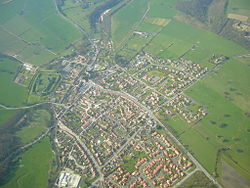
Sproxton is a village and civil parish in North Yorkshire, England. It is 1.2 miles (2 km) south of Helmsley and on the junction between the A170 road and the B1257 road on the edge of the North York Moors National Park. The village was founded by the Banks family who originated from the Barlow family who designed the original wooden Nelson Gates. The 1806 stone version serves as the southern entrance/exit to Duncombe Park. The Grade II listed structure is inscribed with "To the memory of Lord Viscount Nelson and the unparalleled gallant achievements of the British Navy" on the front and on the rear side is inscribed with "Lamented Hero! O price his conquering country grieved to pays o dear brought glories of Trafalgar Day!" In the time of Edward the Confessor, Sproxton (Sprostune) was in the hands of three local noblemen, but by 1086 the land belonged to the crown. The name Sproxton itself derives from Sprok's farm or settlement with Sprok being the farm owner's given name. St Chad's Church, Sproxton is grade II listed, and is unusual in that it was originally built in the 17th century as the chapel of West Newton Grange and moved to the village brick by brick in 1879. It is also reputedly the smallest in North Yorkshire (in terms of attendance) as it has only nine pews. The 43 ha (110 acres) wood at the eastern edge of the village was bought by the Woodland Trust in 2008, having previously been part of the Duncombe Park estate. In the 12th and 13th centuries, the wood was part of the deer park in the Helmsley area. The Woodland Trust refers to the site as Robson's Spring, but is it actually three woods named Ness Great Wood, Green Sykes and Robson's Spring. Sproxton lies within the Kirkbymoorside electoral division of North Yorkshire Council. It was part of the Ryedale district from 1974 to 2023. For Westminster elections Sproxton comes under the Thirsk and Malton constituency, currently represented by Kevin Hollinrake, a Conservative who has been incumbent since May 2015.

Lieux à Proximité Voir Menu
Location Image
0 m

Sproxton (Yorkshire du Nord)

Sproxton est un village et une paroisse civile du Yorkshire du Nord, en Angleterre.
Location Image
2.1 km

Château de Helmsley

Le château de Helmsley (également connu anciennement sous le nom de Hamlake) est un château médiéval situé dans le bourg de Helmsley, dans le parc national des North York Moors, dans le Yorkshire du Nord, en Angleterre.
Location Image
2.3 km

Helmsley

Helmsley est un village et une paroisse civile du Yorkshire du Nord, en Angleterre. Il est situé sur la rivière Rye (en), sur la route A170 (en), à l'est de Thirsk et à l'ouest de Pickering. La population comptait 1 702 habitants en 2021. Le sentier Cleveland Way (en) commence à Helmsley, et fait une boucle en fer à cheval autour du parc national des North York Moors jusqu'à Filey. Les restes d'un château, le Château de Helmsley, est vers Helmsley. Le groupe One Night Only est originaire de cette ville.
Location Image
2.9 km

Oswaldkirk

Oswaldkirk est un village et une paroisse civile du Yorkshire du Nord, en Angleterre. Il est situé à environ six kilomètres au sud de la ville de Helmsley, au bord du massif des Howardian Hills. Au recensement de 2011, il comptait 230 habitants et au recensement de 2021, il comptait 233 habitants.
3.0 km

Abbaye de Gilling

L'abbaye de Gilling était un monastère médiéval anglo-saxon situé dans l'actuel Yorkshire. Elle fut fondée à Gilling West dans l'actuel Yorkshire à l'initiative de la reine Eanflæd, femme du roi Oswiu de Northumbrie, qui persuada son mari de la fonder à l'endroit même où le roi tua son rival et parent, Oswine de Deira en 651 ou 652. Eanflæd força son mari à fonder le monastère, peu de temps après la mort d'Oswine, afin d'expier ce crime, Eanflæd étant également une parente (petite cousine) d'Oswine. Selon les lois de l'époque, la seule façon pour Eanflæd de se venger était de tuer son mari ou d'accepter un weregild. L'abbaye était donc située sur les terres qu'elle reçut en weregild et elle demanda que le premier abbé soit un parent d'Oswine. D'autres sources identifient Collingham ou Gilling East comme lieu de la mort d'Oswine et de l'abbaye. Le monastère encouragea le culte d'Oswine, un des nombreux rois anglo-saxons assassinés qui furent considérés comme des saints. Le premier abbé du monastère fut un parent d'Oswine, nommé Trumhere. Il eut pour successeur Cynefrith, qui plus tard quitta l'abbaye pour se rendre en Irlande. Un autre abbé, Trumbert, devint évêque de Hexham après avoir été abbé, ou au contraire devint abbé après avoir été destitué de son poste d'évêque. Gilling peut être identifié au monastère d'Ingetlingum qui avait des liens étroits avec le monastère de Ripon, dirigé par Wilfrid. Peu de temps avant 669, Gilling fut dépeuplé par la peste, et un de ses moines, Ceolfrith, frère de Cynefrith, rejoignit Ripon. Ceolfrith gagna plus tard Wearmouth-Jarrow, où il devint abbé.