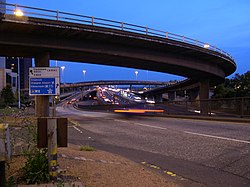
The A82 is a major road in Scotland that runs from Glasgow to Inverness via Fort William. It is one of the principal north-south routes in Scotland and is mostly a trunk road managed by Transport Scotland, who view it as an important link from the Central Belt to the Scottish Highlands and beyond. The road passes close to numerous landmarks, including Loch Lomond, Rannoch Moor, Glen Coe, the Ballachulish Bridge, Ben Nevis, the Commando Memorial, Loch Ness, and Urquhart Castle. Along with the A9 and the A90 it is one of the three major north–south trunk roads connecting the Central Belt to the North. The route is derived in several places from the military roads constructed through the Highlands by General George Wade and Major William Caulfeild in the 18th century, along with later roads constructed by Thomas Telford in the 19th. The modern route is based on that designed by Telford, but with a number of improvements primarily dating from the 1920s and 30s. These include a diversion across Rannoch Moor, and another around Loch Leven which was subsequently replaced by the Ballachulish Bridge. Several travel guides have praised individual parts of the road, such as the section from Tyndrum to Glencoe across Rannoch Moor, as providing memorable driving experiences. Tourists find the A82 a popular route because of its scenery, and it serves as a main artery for commercial and heavy goods traffic. Transport Scotland have publicly declared a commitment to improve congestion and safety along the road. Some sections are occasionally closed for maintenance, which has resulted in strong protest from the local community, and the road has been criticised for its poor accident record.

Lieux à Proximité Voir Menu
Location Image
301 m

Synagogue de Garnethill

La synagogue de Garnethill est la « synagogue cathédrale » historique d'Écosse. Elle est située dans le quartier de Garnethill à Glasgow. Elle est membre de la United Synagogue, de courant juif orthodoxe.
Location Image
414 m

Anderston

Anderston (Anderstoun en scots, Baile Aindrea en gaélique écossais) est un district de la ville écossaise de Glasgow. Cette ancienne ville, devenue burgh of barony (en) en 1824, a été rattachée à Glasgow en 1846. Le paysage local a été bouleversé dans les années 1960 par la construction de l'autoroute M8, qui traverse le district, et de la mégastructure de l'Anderston Centre (en), combinant magasins, arrêt de bus et immeubles résidentiels et de bureaux.
Location Image
465 m

Glasgow School of Art

La Glasgow School of Art (litt. « École d'art de Glasgow », abrégée en GSA) est une école d'art située dans le quartier de Garnethill (en) à Glasgow en Écosse (Royaume-Uni). Cette école est à l'origine un établissement technique de dessin (Glasgow Government School of Design) fondé en 1845 et transformé pour les nouvelles ambitions de sa direction. Le nouveau bâtiment situé dans Renfrew Street est l'œuvre de l'architecte Charles Rennie Mackintosh. Sa première tranche est achevée en 1899, la seconde en 1909. Le bâtiment a été en partie détruit par deux incendies, l'un en 2014, l'autre en juin 2018. Sa reconstruction à l'identique est annoncée sans calendrier précis.
Location Image
613 m

Bibliothèque Mitchell

La Bibliothèque Mitchell (Mitchell Library) est une grande bibliothèque publique et siège du système de bibliothèques publiques de la ville de Glasgow, en Écosse.
Location Image
636 m

Cathédrale Sainte-Marie de Glasgow

La cathédrale Sainte-Marie (en anglais : St Mary's Cathedral) est une cathédrale de l'Église épiscopalienne écossaise. Elle est située dans le West End de Glasgow, en Écosse. Le bâtiment actuel a été inauguré le 9 novembre 1871, mais la flèche a été achevée en 1893. L'architecte en était George Gilbert Scott. Elle a été élevée au rang de cathédrale en 1908. La hauteur totale de la cathédrale est de 63 mètres. L'église a été reconnue en raison de son importance artistique comme un immeuble classé « Grade A ».