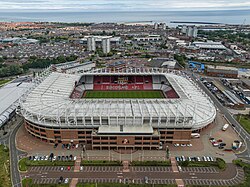
The Stadium of Light is an all-seater football stadium in Sunderland, England, and the eighth and current home to Sunderland. With seating for 49,000 spectators, the Stadium of Light is the 10th largest football stadium in England. The stadium primarily hosts Sunderland home matches. The stadium was named by chairman Bob Murray to reflect the coal mining heritage of the North East and the former Monkwearmouth Colliery site on which it stands. A Davy lamp monument stands at the entrance to reflect the coal mining industry that brought prosperity to the town. As well as hosting Sunderland games, the stadium has hosted three matches for the England national football team, as well as an England under-20, an England under-21 and two England women's team matches. With an original capacity of 42,000, it was expanded in 2000 to seat 49,000. Its simple design is apparently to allow for redevelopments up to a capacity of 64,000. The attendance record at the Stadium of Light is 48,353 set on 13 April 2002, when Sunderland played Liverpool with the visitors running out 1–0 winners. Along with hosting football matches, the stadium has played host to performers such as Beyoncé, Rihanna, Oasis, Take That, Kings of Leon, P!nk, Coldplay, Spice Girls and Elton John. The ground also holds conference and banqueting suites, the 'Black Cats Bar', and a club shop selling Sunderland merchandise.

Lieux à Proximité Voir Menu
Location Image
4 m

Stadium of Light

Le Stadium of Light est le stade de football du Sunderland AFC. Ce stade de 48 353 places est inauguré en 1997, par le prince Andrew, duc d'York, à l'occasion d'une rencontre entre le Sunderland AFC et l'Ajax Amsterdam.
Location Image
520 m

Newcastle Road

Newcastle Road était un stade de football situé à Sunderland, en Angleterre. C'est le terrain du Sunderland AFC entre 1886 et 1898.
Location Image
533 m

Cité de Sunderland

La Cité de Sunderland (en anglais : City of Sunderland) est un district du Tyne and Wear, en Angleterre. Elle a le statut de district métropolitain et de cité (city). Elle porte le nom de sa principale ville, Sunderland, et couvre un territoire comprenant les villes de Hetton-le-Hole, Houghton-le-Spring, Washington, ainsi que des villages suburbains. Le district a été créé en 1974 sous le nom de District métropolitain de Sunderland (Metropolitan Borough of Sunderland) par le Local Government Act 1972. Il est issu de la fusion de quatre anciens districts du comté de Durham. Il a reçu le statut de cité en 1992, à l'occasion du 40e anniversaire de l'accession au trône de la reine Élisabeth II. Au recensement de 2001, la cité de Sunderland comptait 280 807 habitants, dont une majorité réside à Sunderland.
Location Image
601 m

Pont de Wearmouth

Le pont de Wearmouth (en anglais : Wearmouth Bridge) est un pont en arc traversant la rivière Wear à Sunderland. C'est le dernier pont sur le fleuve avant son embouchure avec la mer du Nord. Le pont ferroviaire de Monkwearmouth (en) se situe en amont.
Location Image
861 m

Abbaye de Wearmouth-Jarrow

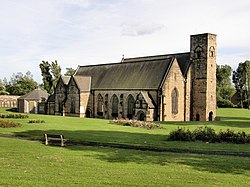
L’abbaye de Wearmouth-Jarrow, ou de Monkwearmouth-Jarrow, est une abbaye bénédictine, composée de deux monastères jumeaux, fondés en Northumbrie par Benoît Biscop, l’un en 674, l’autre en 682. Bien que ces monastères soient distants d'une dizaine de kilomètres, leur histoire est si étroitement liée qu’on associe le plus souvent leurs noms. Tous deux sont des monastères d’hommes : il ne s’agit donc pas d’un monastère double. Bède le Vénérable (figure illustre de Jarrow) en parle comme de « monastères jumeaux pour hommes ».