Agecroft Cemetery and Crematorium is a public cemetery in Pendlebury, Salford, Greater Manchester. Agecroft Cemetery was opened as Salford Northern Cemetery by Alderman Sir William StephensSalford County Borough Council on 2 July 1903 on 45 acres (18.2 hectares) of ground because the existing cemetery at Weaste was near to capacity. The new cemetery, which lies in the Irwell Valley alongside the river bounded by Agecroft Road (A6044) and Langley Road in Pendlebury, was initially outside the Salford county borough boundary, but has lain within the city since Pendlebury was incorporated into the City of Salford in 1974. Since the cemetery was opened more than 53,700 interments have been carried out. The original non-conformist chapel was converted to a crematorium in January 1957 which since then has handled nearly 60,000 cremation services. The crematorium chapel can hold up to 60 mourners. In the grounds is a large disused mortuary chapel with a clock tower. It is now derelict and hidden by trees. It is listed as a heritage building at risk by the Victorian Society. At the very opposite side of the cemetery to what was the original non-conformist chapel (and now the crematorium), there stood a Roman Catholic chapel surrounded largely by Catholic graves. This was pulled down many years ago and all that remains is a grassed/shrubbery roundabout. Near the entrance is a stone memorial to the seven-man crew of Lancaster bomber PB304 which crashed in Regatta Street, off Langley Road, Agecroft, Pendlebury very close to the then boundary between Pendleton, Salford and Pendlebury on 30 July 1944 carrying a full bomb load. The cemetery contains the war graves of 164 Commonwealth service personnel of both of the 20th century's world wars. The majority of the graves are scattered within the cemetery but there is a group of eleven and two special memorial headstones to those whose graves could not be marked.

Lieux à Proximité Voir Menu
Location Image
1.3 km

Grand Manchester

Le Grand Manchester (en anglais : Greater Manchester) est un comté métropolitain situé en Angleterre du Nord-Ouest qui comporte une population totale de 2,8 millions d'habitants. Il comprend une des plus importantes aires urbaines du Royaume-Uni. Il s'étend sur 1 276 km2 autour de Manchester et comprend les districts de Bolton, Bury, Oldham, Rochdale, Stockport, Tameside, Trafford, Wigan, ainsi que la ville de Salford. Depuis 2011, il est administré par l'autorité combinée du Grand Manchester.
Location Image
1.3 km

Kersal Moor

Kersal Moor est une aire de détente située à Kersal, dans la ville de Salford, dans le Grand Manchester, en Angleterre, composé de huit hectares de landes, dont les limites sont formées par Moor Lane, Heathlands Road, St. Paul's Churchyard et Singleton Brook.
Location Image
1.4 km

Pendlebury

Pendlebury est une ville située dans la Cité de Salford, dans le Grand Manchester en Angleterre. Sa population en 2011 était de 13 069 habitants.
Location Image
1.8 km

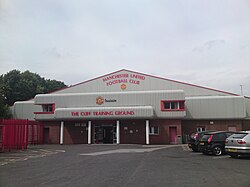
The Cliff

The Cliff est un terrain de sport dans Broughton, Greater Manchester qui a été utilisé au début par l'équipe de rugby à XIII des Broughton Rangers jusqu'en 1933. Le terrain est ensuite acheté par le club de football de Manchester United pour s'en servir comme terrain d'entraînement et le sera jusqu'en 1999, date où il est remplacé par le Trafford Training Centre de Carrington. Toutefois, il continue d'accueillir les matchs de l'équipe réserve des Red Devils, et est parfois utilisé par les Salford City Reds comme stade d'entrainement.
2.1 km

Wat Charoenbhavana

Wat Charoenbhavana, Manchester - également connu en anglais comme le Centre de Méditation bouddhiste du Nord-Ouest, établi le 8 février 2004, est le premier temple bouddhiste thaïlandais dans le nord-ouest de l'Angleterre. Il est situé dans une ancienne usine de rail pour rideau de Salford. Le temple a été nommé Wat Charoenbhavana (Manchester) par la communauté thaïlandaise (littéralement « le temple pour la pratique de la méditation ») et a été consacré, avec la bénédiction du très vénérable Phrarajbhavanavimol, à la tête de la mission bouddhiste thaïlandaise en Angleterre. Le temple a été accepté comme lieu officiel de culte religieux (no.81212) le 4 juin 2004 avec l’aide du Forum de culture Thaï d’Angleterre. À l’origine, le temple n'avait pas d’image de Bouddha. L’image de Bouddha de huit pieds qui a la place d'honneur dans la pièce principale du sanctuaire a été sauvée d'un bord de route à Cardiff. Le temple gère une variété de services pastoraux pour la communauté bouddhiste à Manchester et marque la plupart des événements du calendrier bouddhiste thaïlandais. Une variété de cours du soir sur le bouddhisme et de méditation sont présentés durant les jours de semaine et des cours de langue thaïe la fin de semaine.