Location Image

Irvine, North Ayrshire

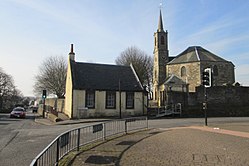
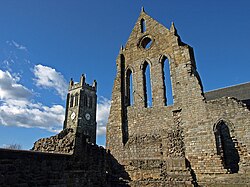
Irvine ( UR-vin; Scots: Irvin [ˈɪrvɪn]; Scottish Gaelic: Irbhinn [ˈiɾʲivɪɲ]) is a town and former Royal Burgh on the coast of the Firth of Clyde in North Ayrshire, Scotland. The 2011 Census recorded the town's population at 33,698 inhabitants, making it the largest settlement in North Ayrshire, and 22nd largest settlement in Scotland. Irvine was designated as the fifth and final Scottish new town in November 1966. Irvine is the administrative centre and the seat of the North Ayrshire Council administration which has its headquarters based at Cunninghame House. Irvine was the site of Scotland's 12th century military capital and former headquarters of the Lord High Constable of Scotland, Hugh de Morville. It also served as the capital of Cunninghame and was, at the time of David I, Robert II and Robert III, one of the earliest capitals of Scotland. Despite being classed as a new town, Irvine has had a long history stretching back many centuries and was classed as a royal burgh. There are also conflicting rumours that Mary, Queen of Scots, stayed briefly at Seagate Castle. There is still a yearly festival, called Marymass, held in the town. Marymass refers to Mary Queen of Scots and is celebrated for around a week starting from the 15th of August, and was therefore Mary's Mass hence, Marymass. The town became a haunt of Robert Burns, after he briefly worked a flax-dresser in a heckling shop near the Glasgow Vennel. Two streets in the town are named after him: Burns Street and Burns Crescent.

Lieux à Proximité Voir Menu
Location Image
0 m

Irvine (Écosse)

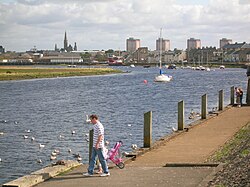
Irvine est une ville nouvelle d'Écosse, située dans le council area du North Ayrshire (dont elle est la capitale administrative), dans la région de lieutenance d'Ayrshire and Arran et dans l'ancien comté de l'Ayrshire, sur la côte au sud-ouest de Glasgow. De 1975 à 1996, elle était la capitale administrative du district de Cunninghame, au sein de la région du Strathclyde. Sa population s'élevait à 39 257 habitants en 2009.
Location Image
2.5 km

Eglinton Country Park

Le Eglinton Country Park est un parc situé sur le terrain de l'ancien château d'Eglinton à Kilwinning (North Ayrshire, Écosse). Le Eglinton Park se trouve dans la paroisse de Kilwnning, qui faisait partie de l'ancien district de Cunninghame, et couvre une surface de 400 hectares (dont 40 de forêt). La partie centrale du parc est marquée par les ruines du château d'Eglinton, qui appartenait à la famille du même nom puis plus tard à la famille Montgomery, comtes d'Eglinton et chef du clan Montgomery. Le Eglinton Country Park est géré et maintenu par le conseil de North Ayrshire et des Rangers.
Location Image
3.1 km

Dreghorn

Dreghorn est un village dans le North Ayrshire, à l’ouest de Glasgow en Écosse.
Location Image
4.1 km

Kilwinning

Kilwinning est une petite ville historique d'environ 8 000 habitants, située sur la côte ouest de l'Écosse, dans le North Ayrshire, à une trentaine de kilomètres au sud-ouest de Glasgow. Elle est célèbre dans le domaine de la franc-maçonnerie pour abriter la plus ancienne loge d'Écosse, parfois nommée Kilwinning n°0, source probable du Rite du Mot de maçon (Mason's Word). L'écrivain et poète Robert William Service connu pour ses poèmes sur le Yukon, habita plusieurs années chez son grand-père paternel et ses tantes à Kilwinning en 1878. Il va à l’école Parish School à Kilwinning.
Location Image
4.4 km

Kilwinning no 0

Kilwinning no 0 (Mother Kilwinning ou K0 ou M∴ K∴ en typographie maçonnique) est le nom d'une loge maçonnique constituée au XIIe siècle dans la ville de Kilwinning, en Écosse. Membre de la Grande Loge d’Écosse, elle est reconnue comme « régulière » par la Grande Loge unie d'Angleterre. Vers les années 1630 la loge Kilwinning aurait rédigé le Rite du Mot de maçon, Mason's Word, qui selon les maçonnologues serait le plus ancien rituel maçonnique au monde.