

 English
 Français
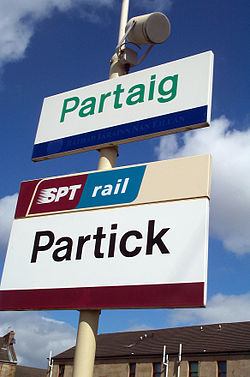
Partick
Partick (Scots: Pairtick, Scottish Gaelic: Partaig) is an area of Glasgow on the north bank of the River Clyde, just across from Govan. To the west lies Whiteinch, to the east Yorkhill and Kelvingrove Park (across the River Kelvin), and to the north Broomhill, Hyndland, Dowanhill, Hillhead, areas which form part of the West End of Glasgow. Partick was a Police burgh from 1852 until 1912 when it was incorporated into the city. Partick is the area of the city most connected with the Highlands, and several Gaelic agencies, such as the Gaelic Books Council (Scottish Gaelic: Comhairle nan Leabhraichean) are located in the area. Some ATMs in the area display Gaelic.
Lieux à Proximité Voir Menu

114 m
Hamilton Crescent
Le Hamilton Crescent est un stade de cricket, situé dans le quartier de Partick, à Glasgow, en Écosse. L'équipe du West of Scotland Cricket Club (en) y joue ses matches à domicile.
295 m
Partick
Partick (Pàrtaig en gaélique écossais (gd) ; Pairtick en scots (sco)) est un district de Glasgow. Il est situé sur les rives nord de la Clyde juste en face du district de Govan. Il se trouve entre les districts de Whiteinch (à l'ouest), de Hillhead (à l'est) et de Partickhill (en) (au nord). Il constituait un burgh de 1852 à 1912, date à laquelle il a été incorporé dans Glasgow.

714 m
Riverside Museum
Le Riverside Museum, musée écossais des transports, a été officiellement inauguré le 21 juin 2011 à Glasgow. Le musée, conçu par Zaha Hadid, a reçu le Prix du musée européen de l'année 2013 par le Forum Européen du Musée.

717 m

1.1 km
Cathédrale Saint-Luc de Glasgow
La cathédrale Saint-Luc est une cathédrale de l'Église orthodoxe grecque située dans le quartier Kelvinside à Glasgow, en Écosse.
Elle a été conçue par James Sellars et construite en 1877 en même temps que l'église de Belhaven pour l'Église presbytérienne unie d'Écosse.
Elle a été construite en style gothique normand, inspiré par la cathédrale de Dunblane. La congrégation est devenue une partie de l'Église d'Écosse en 1929.