
Castletown is a suburb of Sunderland in Tyne and Wear, England. A former mining community, the Hylton Colliery was located at the east end of the village; it lies north of the River Wear, and is near to Hylton Castle and Washington. At Hylton Riverside, on the eastern fringe of Castletown, there is a large retail park. There is a large-scale redevelopment project, aimed at modernising the former pit houses and the area around the Aviary Estate. Since 2011 there have been further developments in the east part of the village. The Aviary area has been completely demolished and a new housing estate has replaced both sides of the main street. This site was re-developed by the Gentoo Group. At the opposite end of Castletown is the newer development of Fulford Grange. Castletown also hosts a luxury living estate named The Grove, where some of the current Sunderland AFC footballers live, including Granit Xhaka and Billy Hardy's nephew, Samuel Jordan. Currently, the records state that Castletown is the least ethnically diverse area in Sunderland, with 99.3% of the population being white. Despite its proximity to Sunderland, until 1967 this colliery village was under the administrative control of Durham County Council and was part of the Sunderland Rural District Council. This was because it was a fairly isolated community until the extensive council house building of the fifties and sixties at the Red House, Hylton Castle and Town end Farm Estates effectively joining the settlement to the rest of Sunderland's new northern suburbs. The Northern Spire Bridge, joining Castletown to Pallion, opened in August 2018. During the search for the Yorkshire Ripper, the accent of "Wearside Jack", the author of a hoax letter claiming to be from the Ripper, was identified by the forensic linguist Stanley Ellis as that of the Castletown area. The hoaxer was eventually revealed to have come from nearby Pennywell.

Lieux à Proximité Voir Menu
Location Image
856 m

Château de Hylton

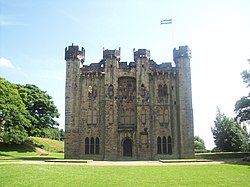
Le château de Hylton est un château en pierre, actuellement en ruine, situé près de Sunderland dans le Tyne and Wear en Angleterre. Construit à l'origine en bois, par un des baron Hylton, juste après la conquête normande de l'Angleterre. Il est reconstruit en pierre de la fin du XIVe jusqu'au début du XVe siècle. Le château a ensuite subi d'importantes modifications aux XVIIIe et XIXe siècles. Il sert divers usages après la fin de la maison Hylton en 1746, le bâtiment a été négligé puis est devenu une école en 1840, avant appartenir à une société houillère au XXe siècle, pour enfin être pris en charge par l'État en 1950, pour enfin appartenir aujourd'hui à l'English Heritage, organisme public chargé du patrimoine historique. Le château est réputé hanté par le Cauld Lad of Hylton.
Location Image
3.7 km

Stadium of Light

Le Stadium of Light est le stade de football du Sunderland AFC. Ce stade de 48 353 places est inauguré en 1997, par le prince Andrew, duc d'York, à l'occasion d'une rencontre entre le Sunderland AFC et l'Ajax Amsterdam.
3.8 km

Bishopwearmouth

Bishopwearmouth est un quartier de Sunderland, ville du Nord-Est de l'Angleterre.
Location Image
3.8 km

Newcastle Road

Newcastle Road était un stade de football situé à Sunderland, en Angleterre. C'est le terrain du Sunderland AFC entre 1886 et 1898.
Location Image
3.9 km

Cité de Sunderland

La Cité de Sunderland (en anglais : City of Sunderland) est un district du Tyne and Wear, en Angleterre. Elle a le statut de district métropolitain et de cité (city). Elle porte le nom de sa principale ville, Sunderland, et couvre un territoire comprenant les villes de Hetton-le-Hole, Houghton-le-Spring, Washington, ainsi que des villages suburbains. Le district a été créé en 1974 sous le nom de District métropolitain de Sunderland (Metropolitan Borough of Sunderland) par le Local Government Act 1972. Il est issu de la fusion de quatre anciens districts du comté de Durham. Il a reçu le statut de cité en 1992, à l'occasion du 40e anniversaire de l'accession au trône de la reine Élisabeth II. Au recensement de 2001, la cité de Sunderland comptait 280 807 habitants, dont une majorité réside à Sunderland.