

 English
 Français

Edinburgh South (UK Parliament constituency)
Edinburgh South is a constituency of the House of Commons of the UK Parliament created in 1885. The constituency has been held by Scottish Labour since 1987. The seat has been represented since 2010 by Ian Murray, who formerly served as Secretary of State for Scotland in the government of Keir Starmer between July 2024 and September 2025. Murray was the only Labour MP in Scotland to retain his seat at the 2015 and 2019 general elections. Prior to the 2005 general election, the constituency had the same boundaries as the Edinburgh South Scottish Parliament constituency, now replaced by the Edinburgh Southern Scottish Parliament constituency.
1. Constituency profile
The constituency covers the southern suburbs around the Braid Hills including Morningside, Comiston, Liberton and Gilmerton. This is a generally wealthy seat with a significant student population.
1. History
Summary of results A candidate fielded by the Labour Party has won the seat since 1987. Prior to that the political division for Westminster purposes voted for the Conservative and Unionist candidate, ahead of all other candidates by single preference, at each Westminster election from and including 1918. Back then, the electorates' single-most preferred candidate in simple voting was that of the Liberal Party, except in 1900 when a Liberal Unionist was returned. The 2015 result gave the seat the 23rd-smallest majority of Labour's 232 seats by percentage of majority. In the 2017 general election, Ian Murray received the highest voteshare of any Scottish candidate and was also one of only two constituencies in Scotland where the winning candidate received a majority of the votes cast (the other one being Berwickshire, Roxburgh and Selkirk). Edinburgh South is one of three constituencies in Scotland to have never elected an MP from the Scottish National Party at any point in history, alongside Dumfriesshire, Clydesdale and Tweeddale; and Orkney and Shetland.
Recent opposition candidates' performance At the 2015 general election three of the seven parties' candidates standing retained their deposits, their votes exceeding 5%. Those doing so and not winning were SNP – 33.8% of the vote, and Conservative – 17.5% of the vote. At this election, the SNP increased their share of the vote by over 26%, coming a close second to Murray. The Liberal Democrat candidate of 2005 fell within 0.9% of a winning majority. The Liberal Democrats' swing nationally was −15.2% swing in 2015. The swing in this seat against the party was however −30.3% resulting in the loss of their deposit, a fate not sustained by either of the party's two formative parties in the seat since 1970.
Turnout Turnout has ranged between 81.1% in 1950 and 57.7% in 2001.
2016 EU referendum In the 2016 referendum of membership of the European Union, the constituency voted Remain by 77.8%. This was the tenth highest support for Remain for a constituency.
1. Boundaries
1885–1918: The St. George, St. Cuthbert, and Newington municipal wards of the burgh of Edinburgh. 1918–1950: The Merchiston, Morningside, and Newington municipal wards of the county of the city of Edinburgh. 1950–1983: The Liberton, Morningside and Newington wards (as constituted by the Local Government (Scotland) (Edinburgh Wards) Order 1948, SI 1948/1138) of the county of the city of Edinburgh. 1983–1997: Electoral divisions 32 (Merchiston/Morningside), 33 (Sciennes/Marchmont), 34 (Prestonfield/Mayfield), 37 (Alnwickhill/Kaimes) and 38 (Inch/Gilmerton) of the City of Edinburgh. 1997–2005: Electoral divisions 32 (Merchiston/Morningside), 33 (Sciennes/Marchmont), 34 (Prestonfield/Mayfield), 36 (Alnwickhill/Kaimes) and 37 (Inch/Gilmerton) of the City of Edinburgh. 2005–2024: Under the Fifth Review of UK Parliament constituencies, the constituency boundaries were defined in accordance with the ward structure in place on 30 November 2004 and contained the City of Edinburgh wards of Merchiston, North Morningside/Grange, Marchmont, Sciennes, Newington, South Morningside, Fairmilehead, Alnwickhill, Kaimes, Moredun, and Gilmerton. In 2005, prior to the general election, Edinburgh South was one of six covering the City of Edinburgh council area. Five were entirely within the city council area. One, Edinburgh East and Musselburgh, straddled the boundary with the East Lothian council area, to take in Musselburgh. For the 2005 election, the constituency was enlarged to include areas from the former Edinburgh Pentlands constituency, and became one of five constituencies covering the city area, all entirely within that area. 2024–present: Under the 2023 review of Westminster constituencies which came into effect for the 2024 general election, the constituency contains the following wards or part wards of the City of Edinburgh Council:
A minority of Colinton/Fairmilehead ward, comprising the Fairmilehead district; nearly all of Morningside ward; the majority of Southside/Newington ward - excluding the Southside area to the north; and the whole of Liberton/Gilmerton ward. As a result of the boundary review, the Prestonfield area of the Southside/Newington ward was transferred from Edinburgh East.
1. Members of Parliament


1. Election results


1. = Elections in the 2020s =


1. = Elections in the 2010s =


1. = Elections in the 2000s =


1. = Elections in the 1990s =


1. = Elections in the 1980s =


1. = Elections in the 1970s =


1. = Elections in the 1960s =


1. = Elections in the 1950s =


1. = Election in the 1940s =


1. = Elections in the 1930s =


1. = Elections in the 1920s =


1. = Elections in the 1910s =


1. = Elections in the 1900s =


1. = Elections in the 1890s =


1. = Elections in the 1880s =
Caused by Childers' appointment as Home Secretary.
Caused by Harrison's death.
1. Referendum results


1. = 2016 European Union membership referendum =


1. = 2014 Scottish independence referendum =


1. See also
Politics of Edinburgh
1. Notes


1. References


1. External links
Edinburgh South UK Parliament constituency (boundaries April 2005 – May 2024) at MapIt UK Edinburgh South UK Parliament constituency (boundaries from June 2024) at MapIt UK
Lieux à Proximité Voir Menu

Projet communautaire de Bridgend Farmhouse
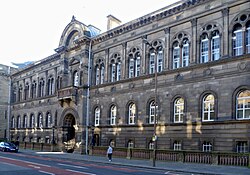
University of Edinburgh Medical School

Observatoire royal d'Édimbourg

Château de Craigmillar
