
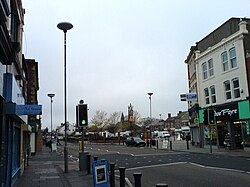
Blyth () is an industrial port town as well as a civil parish in southeast Northumberland, England. It lies on the coast, to the south of the River Blyth. It has a population of 39,731 as of the 2021 census, up 6% from the 2011 census and population of 37,347. The port of Blyth dates from the 12th century, but the development of the modern town only began in the first quarter of the 18th century. The main industries which helped the town prosper were coal mining and shipbuilding, with the salt trade, fishing, and the railways also playing an important role. These industries have largely vanished, but the port still receives paper and pulp from Scandinavia for the newspaper industries of England and Scotland. The town was seriously affected when its principal industries went into decline, and it has undergone regeneration since the early 1990s. The Keel Row Shopping Centre, opened in 1991, brought high street retailers to Blyth, and helped to revitalise the town centre; it closed in 2024 as part of the country council's Energising Blyth initiative. The market place has recently been re-developed, with the aim of attracting further investment to the town. The quayside has been redeveloped into an open space, the centrepiece of which is a sculpture commemorating local industry. On the opposite side of the river are the nine wind turbines of the Blyth Harbour Wind Farm, which were constructed along the East Pier in 1992. They were joined in 2000 by Blyth Offshore Wind Farm, which consisted of two turbines situated 1 kilometre (0.62 mi) out to sea. These were the first two offshore wind turbines in the UK. These wind turbines were all decommissioned, with the final two being removed in 2019. A new windfarm further off the coast, composed of five turbines, was commissioned in 2017. Blyth is also the home of the non-League football club Blyth Spartans, known for their 1978 "giant-killing" feats in the FA Cup.

Lieux à Proximité Voir Menu
Location Image
0 m

Blyth (Northumberland)

Blyth est une ville du sud du comté de Northumberland en Angleterre. Elle se trouve à une vingtaine de kilomètres de Newcastle upon Tyne. Le développement de la ville moderne a commencé dans le premier quart du XVIIIe siècle. Les principales industries qui ont contribué à la prospérité de la ville étaient l'extraction du charbon et la construction navale. Ces industries ont largement disparu, mais le port continue de prospérer. Son cartulaire a été conservé. Les importants personnages de la région au Moyen Âge s'y trouvent cités. Parmi eux, on note la présence de William de Wendeval dont le nom est sur la liste des inspirateurs du personnage du Shérif de Nottingham, dans la légende de Robin des Bois. Elle possède un ancien phare construit en 1788 connu sous le nom de High Light.
Location Image
583 m

Blyth Valley

La Blyth Valley est un ancien district non-métropolitain et un Borough du Northumberland, en Angleterre. Il est situé au bord de la mer du Nord et jouxte le comté de Tyne and Wear. Il a été créé le 1er avril 1974 par le Local Government Act de 1972 et est issu de la fusion du borough de Blyth, du district urbain de Seaton Valley, et d'une partie du borough de Whitley Bay. Il comprend notamment les villes de Blyth, où siège le conseil de district, et Cramlington, et les localités de Seaton Delaval et Seaton Sluice. Le conseil de district a été aboli par les changements structurels de l'administration locale anglaise de 2009, entrés en vigueur le 1er avril 2009. Ses pouvoirs ont été transférés au conseil de comté du Northumberland, agissant en tant qu'autorité unitaire.
Location Image
928 m

Phare de Blyth High

Le phare de Blyth High est un ancien phare situé dans la ville de Blyth, dans le sud du comté du Northumberland en Angleterre. Il est maintenant protégé en tant que monument classé du Royaume-Uni de Grade II en 1987.
Location Image
5.0 km

Seaton Delaval Hall

Seaton Delaval Hall est une maison de campagne classée Grade I située dans le Northumberland, en Angleterre, près de la côte, juste au nord de Newcastle upon Tyne. Situé entre Seaton Sluice et Seaton Delaval, elle est conçue par Sir John Vanbrugh en 1718 pour l'amiral George Delaval. Il appartient maintenant au National Trust. Depuis l'achèvement de la maison en 1728, elle a une histoire malheureuse. Ni l'architecte ni le mécène n'ont vécu pour voir son achèvement. Elle passe ensuite par une succession d'héritiers, n'étant habité que par intermittence. Le plus dommageable de tous, en 1822, le bloc central est ravagé par un incendie et reste une coquille vide depuis. Les jardins du XVIIIe siècle de la maison sont classés Grade II * sur le registre des parcs et jardins historiques.
Location Image
5.3 km

Seaton Sluice

Seaton Sluice est un village du Northumberland, en Angleterre.