Location Image

Chichester Metro station

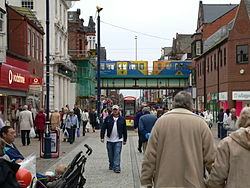
Chichester () is a station on the Tyne and Wear Metro serving the Chichester, Laygate, Westoe and West Park areas of South Tyneside, as well as the nearby South Tyneside College campus. The station is affectionately referred to as 'Chi' by locals. The station was used by approximately 390,000 passengers in 2017–18. The Tyne & Wear Metro station at Chichester was opened in March 1984, and completed the initial Metro network. It was originally a station on the Green Line from Bank Foot (until 1991), and later, Airport. Since 2005, the station has been on the Yellow Line from St. James. A statue of Queen Victoria had been moved to Chichester in 1949, from its original position in front of South Shields Town Hall. In 1981, it was removed to make way for the new Metro station at Chichester, and returned to its original position at the front of the Town Hall, where it remains today. Chichester is situated on the former Stanhope & Tyne Railway route, rather than the former Brandling Junction Railway route via High Shields. Part of this line had been transferred into National Coal Board ownership, and to the south of the station was a single-track electrified freight line, part of the Harton Colliery system. In the early 1990s, this line was de-electrified, and following the closure of Westoe Colliery in 1993, has been closed completely. The former colliery line along Chichester Road was regenerated in the late 1990s, being replaced with a supermarket. The line itself was also the spot of the Westoe Netty, an open air public urinal which was depicted in a famous 1972 painting by Bob Olley. These toilets were saved when the colliery line was demolished, and are now preserved at the Beamish Open Air Museum in County Durham. In regards to the station, the colliery line ran behind Platform 2 with the tunnel beneath the concourse still visible from the Dean Road bridge. Chichester was intended as one of the original interchange stations, which meant buses were timetabled to interchange with Metro services. This arrangement broke down after the deregulation of local bus services in 1986. Today, Chichester still serves as one of the Metro's main bus interchanges, due to the close proximity of the Stagecoach bus depot, but now serves mainly for nearby residential areas, as well as the South Tyneside College campus. The platforms at Chichester are below street level, however the ticket hall is at ground level. The ticket hall contains two ticket machines and a newsagent. The station also houses four bicycle lockers. Following the opening of the new South Shields Interchange in August 2019, Chichester is the single remaining station on the branch from Pelaw to South Shields which has yet to be refurbished. In November 2014, two pieces of artwork produced by community group Bright Futures were installed in the station.

Lieux à Proximité Voir Menu
Location Image
641 m

South Shields

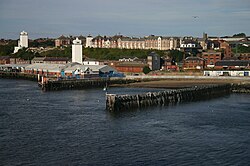
South Shields est une ville côtière à l'embouchure de la rivière Tyne située dans le district métropolitain de South Tyneside. Elle se trouve à environ 8 km en aval de Newcastle-upon-Tyne, au Nord-Est de l'Angleterre, située dans le comté de Tyne and Wear. Cette ville portuaire compte près de 83 000 habitants. Un dispositif de plusieurs phares permet la navigation maritime à l'entrée de la rivière et de Port of Tyne (en).
Location Image
1.7 km

Tyneside

Le Tyneside est une conurbation du nord-est de l'Angleterre, telle que définie par le Office for National Statistics (« Bureau national des statistiques »), qui abrite plus de 80 % de la population du comté de Tyne and Wear. Elle comprend la ville de Newcastle upon Tyne et les arrondissements métropolitains de Gateshead, North Tyneside et South Tyneside, qui sont tous situés sur les rives de la rivière Tyne. La population de l'agglomération était de 879 996 selon le recensement de 2001, ce qui en fait la sixième plus grande agglomération du Royaume-Uni. La seule grande agglomération de Tyne and Wear qui ne fait pas partie de la conurbation du Tyneside est Tyneside Sunderland, qui fait partie du Wearside.
Location Image
2.4 km

Phare de Herd Groyne

Le phare de Herd Groyne est un phare de port situé sur un épi protègeant la jetée sud de l'entrée de la rivière Tyne à South Shields dans le comté du Tyne and Wear en Angleterre. Il est géré par les autorités portuaires de Port of Tyne (en) avec plusieurs autres phares du port.
Location Image
2.5 km

North Shields Fish Quay

North Shields Fish Quay est un port de pêche situé dans l'embouchure de la rivière Tyne à North Shields dans le comté de Tyne and Wear , au nord-est de l'Angleterre, à 20 km à l'est de la ville de Newcastle-upon-Tyne. Le port s'est développé à partir de 1225 comme un simple village de cabanes de pêcheurs en périphérie de North Shields. Il a d'abord servi pour le château et le prieuré de Tynemouth à proximité puis s'est étendu à l'activité portuaire de North Shields. Sa croissance s'est arrêtée quand il aurait pu concurrencer celui de Newcastle-upon-Tyne qui était, à l'époque, le port le plus important de la région. Le quai est toujours un port de pêche avec son marché de poissons. Une flotte de pêche alimente une petite industrie de transformation de poissons et crustacés. Ce port fut autrefois le plus grand producteur de kippers au Royaume-Uni mais la baisse des quotas de harengs a réduit ce commerce à une seule fumerie. Une ancienne batterie côtière datant du XVIIe siècle au temps des guerres anglo-néerlandaises, est toujours présente proche du quai (Clifford's Fort (en)). Le port abrite aussi quatre anciens phares qui servaient à l'aide à la navigation sur cette zone. Fish Quay Old Low Light et Fish Quay Old High Light : Fish Quay New Low Light et Fish Quay New High Light :
Location Image
2.5 km

Phares de Fish Quay New

Les phares de Fish Quay New, (connus en anglais sous les noms de Fish Quay New Low Light et Fish Quay New High Light), sont deux anciens phares de port situés à North Shields Fish Quay, au nord de l'entrée de la rivière Tyne à North Shields dans le comté du Tyne and Wear en Angleterre. Ils ont été érigés pour remplacer les phares de Fish Quay Old de 1727. Ces phare ont été gérés par le Trinity House Lighthouse Service à Londres, l'organisation de l'aide maritime des côtes de l'Angleterre. Ils sont maintenant protégés en tant que monument classé du Royaume-Uni de Grade II.