

 English
 Français

Battle of Bannockburn
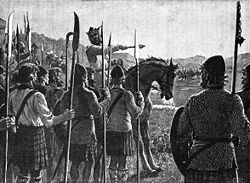
The Battle of Bannockburn (Scottish Gaelic: Blàr Allt nam Bànag or Blàr Allt a' Bhonnaich) was fought on 23–24 June 1314, between the army of Robert the Bruce, King of Scots, and the army of King Edward II of England, during the First War of Scottish Independence. It was a decisive victory for Robert Bruce and formed a major turning point in the war, which ended 14 years later with the de jure restoration of Scottish independence under the Treaty of Edinburgh–Northampton. For this reason, the Battle of Bannockburn is widely considered a landmark moment in Scottish history. King Edward II invaded Scotland after Bruce demanded in 1313 that all supporters still loyal to ousted Scottish king John Balliol acknowledge Bruce as their king or lose their lands. Stirling Castle, a Scots royal fortress occupied by the English, was under siege by the Scottish army. King Edward assembled a formidable force of soldiers to relieve it—the largest army ever to invade Scotland. The English summoned 25,000 infantry soldiers and 2,000 horses from England, Ireland and Wales against 6,000 Scottish soldiers, that Bruce had divided into three different contingents. Edward's attempt to raise the siege failed when he found his path blocked by a smaller army commanded by Bruce. The Scottish army was divided into four divisions of schiltrons commanded by (1) Bruce, (2) his brother Edward Bruce, (3) his nephew, Thomas Randolph, the Earl of Moray, and (4) one jointly commanded by Sir James Douglas and the young Walter the Steward. Bruce's friend, Angus Og Macdonald, Lord of the Isles, brought thousands of Islesmen to Bannockburn, including galloglass warriors, and King Robert assigned them the place of honour at his side in his own schiltron with the men of Carrick and Argyll. After Robert Bruce killed Sir Henry de Bohun on the first day of the battle, the English withdrew for the day. That night, Sir Alexander Seton, a Scottish noble serving in Edward's army, defected to the Scottish side and informed King Robert of the English camp's low morale, telling him they could win. Robert Bruce decided to launch a full-scale attack on the English forces the next day and to use his schiltrons as offensive units, as he had trained them. This was a strategy his predecessor William Wallace had not employed. The English army was defeated in a pitched battle which resulted in the deaths of several prominent commanders, including the Earl of Gloucester and Sir Robert Clifford, and capture of many others, including the Earl of Hereford. The victory against the English at Bannockburn is one of the most celebrated in Scottish history, and for centuries the battle has been commemorated in verse and art. The National Trust for Scotland operates the Bannockburn Visitor Centre (previously known as the Bannockburn Heritage Centre). Though the exact location for the battle is uncertain, a modern monument was erected in a field above a possible site of the battlefield, where the warring parties are believed to have camped, alongside a statue of Robert Bruce designed by Pilkington Jackson. The monument, along with the associated visitor centre, is one of the most popular tourist attractions in the area.
Lieux à Proximité Voir Menu
Bataille de Bannockburn

Bannockburn
Annfield Stadium

