

 English
 Français

Ure Viaduct
Ure Viaduct (also known as Ripon Viaduct) was a railway bridge that crossed the River Ure to the north-east of the city of Ripon in North Yorkshire, England. The first viaduct on the site was constructed of timber and opened in 1848. This was replaced in 1869 with a cast iron structure which was closed in 1969, and was then demolished in 1972.

Kingstone, South Yorkshire
Kingstone is a small residential neighbourhood in Barnsley, located on the south-western side of Barnsley between Broadway and Park Road. Barnsley Central fire station and the recently demolished The Kingstone School are both located in the Kingstone area. The local St Edward the Confessor's church, built between 1900 and 1902 in the Gothic revival style, is a Grade II listed building.

Lesbury
Lesbury is a small rural village in Northumberland in the north of England. It is built on the main coastal road 3.5 miles (5.6 km) southeast of Alnwick, on the north bank of the River Aln. Alnmouth railway station is about half a mile away.

Jesmond railway station
Jesmond was a railway station, serving the suburb of Jesmond, Newcastle upon Tyne in Tyne and Wear, England. It was opened on 27 June 1864 as part of the Blyth and Tyne Railway's line to Newcastle New Bridge Street, and closed on 23 January 1978 when the line was shut for conversion into part of the Tyne and Wear Metro. With the opening of the Metro, it was replaced by the Jesmond Metro station, situated underground some 120 metres (390 ft) to the north-west.
The old station buildings still exist, and the main building is a grade II listed building. It is used as a public house known as The Carriage. The track through the station is still used by Metro trains as part of a link between the line to the north of Jesmond and the line to the west of Manors. However this link is not used by trains carrying passengers, and no trains now stop at the old station.

Brigham, East Riding of Yorkshire
Brigham is a small village and former civil parish, now in the parish of Foston on the Wolds, in the East Riding of Yorkshire, England. It is situated approximately 4 miles (6 km) south-east from Driffield, 15 miles (24 km) north of Hull city centre, and to the west of the B1249 road. In 1931 the parish had a population of 66. Brigham was formerly a township in the parish of Foston on the Wolds, from 1866 Brigham was a civil parish in its own right, on 1 April 1935 the parish was abolished to form Foston.
The name Brigham derives from the Old English brycghām meaning 'bridge village'.

Wyton, East Riding of Yorkshire
Wyton is a hamlet in the civil parish of Bilton, in the East Riding of Yorkshire, It is situated approximately 6 miles (9.7 km) east of Kingston upon Hull city centre. Wyton leads from Bilton through to Sproatley.
Wyton was formerly a township in the parish of Swine, in 1866 Wyton became a separate civil parish, on 1 April 1935 the parish was abolished and merged with Bilton. In 1931 the parish had a population of 111.
The name Wyton possibly derives from the Old English wīftūn meaning 'woman's settlement'. Alternatively, the first element could derive from the Old English personal name Wifa/Wife. Another suggestion is that it derives from wīðigtūn meaning 'settlement by the willow'.
Wyton is a small farming village with few houses, it is used for farming because of its rich soil, and large, open space. Its history is small, but was a Quaker village in the 17th century. There are still signs of the Quakers, such as buried ploughing machines, buried clothes and the remains of the houses (more on the Sproatley track, leading from Sproatley to Coniston).
Wyton contains a Grade II listed Wesleyan Methodist Church, a milestone and a hall but there are no schools, public houses, post offices, hotels, public telephones or sports centres.
Wyton is usually called a hamlet because it is even smaller than a village.

A82 road
The A82 is a major road in Scotland that runs from Glasgow to Inverness via Fort William. It is one of the principal north-south routes in Scotland and is mostly a trunk road managed by Transport Scotland, who view it as an important link from the Central Belt to the Scottish Highlands and beyond. The road passes close to numerous landmarks, including Loch Lomond, Rannoch Moor, Glen Coe, the Ballachulish Bridge, Ben Nevis, the Commando Memorial, Loch Ness, and Urquhart Castle. Along with the A9 and the A90 it is one of the three major north–south trunk roads connecting the Central Belt to the North.
The route is derived in several places from the military roads constructed through the Highlands by General George Wade and Major William Caulfeild in the 18th century, along with later roads constructed by Thomas Telford in the 19th. The modern route is based on that designed by Telford, but with a number of improvements primarily dating from the 1920s and 30s. These include a diversion across Rannoch Moor, and another around Loch Leven which was subsequently replaced by the Ballachulish Bridge.
Several travel guides have praised individual parts of the road, such as the section from Tyndrum to Glencoe across Rannoch Moor, as providing memorable driving experiences. Tourists find the A82 a popular route because of its scenery, and it serves as a main artery for commercial and heavy goods traffic. Transport Scotland have publicly declared a commitment to improve congestion and safety along the road. Some sections are occasionally closed for maintenance, which has resulted in strong protest from the local community, and the road has been criticised for its poor accident record.

Coundon
Coundon is an old mining village and former civil parish in the County Durham district, in the ceremonial county of Durham, England. The Boldon Book mentions a mine in Coundon in the twelfth century. In 2001 it had a population of 2611. In 2011 the ward had a population of 7139.
Seafield, West Lothian
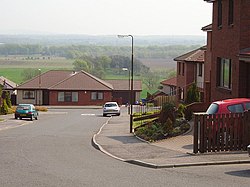
Seafield is a small village in West Lothian, Scotland. Seafield lies 1+1⁄4 miles (2.0 km) east of Blackburn, 2 miles (3.2 km) southeast of Bathgate (grid reference NT007660) and 3 miles (4.8 km) west of Livingston.

St James' Parish Church, Wetherby
St James' Parish Church is an Anglican parish church serving the parish of Wetherby with Linton in Wetherby, West Yorkshire, England.

Harridge Pike
Harridge Pike is a hill situated within the boundaries of Stalybridge, Greater Manchester just outside the Peak District National Park. Its western flank rises from the valley of the River Tame to a height of 395 metres. To the east, the pike falls away more gradually to Swineshaw Moor which, above the Swineshaw reservoirs, rises to Irontongue Hill, a broad shoulder of Hoarstone Edge. Since 2004, the moorland in the area of the pike has been classed as access land. From the summit of Harridge Pike, a view is afforded of the middle section of the Tame valley and the whole of the town of Stalybridge, large swathes of the eastern suburbs of Manchester and beyond to Manchester city centre, where its town hall is visible. On exceptionally clear days the mountains of Snowdonia are visible.

University of Glasgow School of Law
The School of Law at the University of Glasgow provides undergraduate and postgraduate courses in Law, and awards the degrees of Bachelor of Laws (Legum Baccalaureus, LLB), Master of Laws (Iuris Vtriusque Magistrum, LLM), LLM by Research, Master of Research (MRes) and Doctor of Philosophy (Philosophiæ Doctor, PhD), the degree of Doctor of Laws being awarded generally only as an honorary degree.
There are forty-nine full-time academic staff and over one thousand students. As of 2024 the Head of the School of Law is Professor Claire McDiarmid.
The 2019 Complete University Guide league rankings placed Glasgow at 2nd in the UK. The 2023 rankings from The Guardian placed Glasgow at 6th in the UK. The 2024 The Times league rankings placed Glasgow at 7th in the UK.

Stockport Town F.C.
Stockport Town Football Club is a semi-professional football club based in Woodley, a town just outside of Stockport, Greater Manchester, England. They are currently members of the North West Counties League Premier Division, the ninth tier of English football, and play at Stockport Sports Village. Nicknamed "the Lions", the club was founded in 2014 and were accepted into the North West Counties Football League a year later.
Airdrie Town House
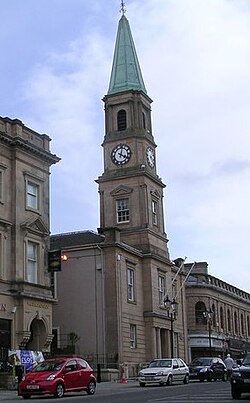
Airdie Town House is a municipal building in Bank Street, Airdrie, North Lanarkshire, Scotland. The town house, which was the headquarters of Airdrie Burgh Council, is a Category B listed building.

Fulwell, Sunderland
Fulwell is an affluent area and former civil parish in the Sunderland district, in the county of Tyne and Wear, England. The parish was abolished in 1928 as a result of the Sunderland Corporation Act 1927, and the area incorporated into the former County Borough of Sunderland. It borders Seaburn, Southwick, Monkwearmouth, and Roker, and the district border between Sunderland and South Tyneside. Fulwell ward, including South Bents and Seaburn, is the least socially deprived of the city's 25 wards. Until 1974 it was in County Durham.
Housing in the area is varied. A network of streets in the southern area of Fulwell contains many nineteenth-century terraced houses, with a large amount of Victorian architecture. In the northern part of Fulwell, housing consists mostly of semi-detached, inter- and post-war dwellings, with many of the most popular streets constructed in the 1930s. House prices, particularly in the area's eastern and western edges, bordering Seaburn and Newcastle Road respectively, are amongst the highest in the city.
Due to Fulwell's role as an overwhelmingly residential area, economic activity in the ward is mostly restricted to the retail and leisure sectors. Local services centre on the main thoroughfare of Sea Road, where a large shopping parade has been established for many years. A mid-sized Sainsbury's store opened in 2006 at Station Road. Fulwell's fire station closed in September 2015, when services were transferred to the new station at Marley Pots. Other services include a Community Library, which is open 10 am until 4 pm on Mondays, 10 am until 5 pm on Wednesdays, 10 am until 4 pm on Fridays and 10 am until 1 pm on Saturdays, a GP clinic, two dental surgeries, and a veterinary surgery. The area is served by local bus services 23, 99, E2 and E6 as well as by the Tyne and Wear Metro, at Seaburn station. Mainline trains no longer stop at the station.
Fulwell was primarily a farming village until it became part of the urban sprawl of industrial Sunderland in the nineteenth century. Relics of this agricultural past still survive in the form of three windmills, including the 19th century Fulwell Mill, the only working windmill in the United Kingdom featuring a stone reefing stage (a design-feature peculiar to mills in north-east England, equivalent to the gallery found on other mills). The mill, built in 1808, was restored to working order between 1996 and 2001 after over half-a-century out of use, and celebrated its bicentenary in 2008. In late 2011, however, the sails and cap suffered severe storm damage. A further restoration, which included the fitting of a new fantail, cap and sails to the original dimensions, together with an overhaul of associated machinery commenced during 2017 and was completed in May 2018.
Politically, Fulwell had long been regarded as a staunch Conservative ward in a region of traditional Labour strength. Since the ward's creation it has always had at least one Conservative council. Since 2021, the ward has become a Liberal Democrat- Conservative marginal, and as of 2025 the ward has 2 Liberal Democrat councillors and 1 Conservative councillor.
Fulwell was formerly a township in the parish of Monk-Wearmouth, in 1866 Fulwell became a separate civil parish, on 1 April 1928 the parish was abolished and merged with Sunderland. In 1921 the parish had a population of 5862. It is now in the unparished area of Sunderland.

Cholmley House
Cholmley House or Whitby Hall is a banqueting house sited next to the ruins of Whitby Abbey in North Yorkshire, England. It was built in 1672 by Sir Hugh Cholmeley, whose family had acquired the Abbey ruins and the land around them after its dissolution in 1539. From then until 1672, the family had lived in what had been the Abbey's gatehouse and guest lodgings. It was originally built with a square forecourt in front of it, now known as the Stone Garden. This contains a replica of the Borghese Gladiator, another replica of which was owned by the builder of the house.
In 1743 the family succeeded to the Wentworth estates and moved its main base to Howsham Hall, leaving Cholmley House deserted. The north front lost its roof in a storm in 1790, leading to the demolition of the north front. Only the main hall remained and even this fell into decay before coming into the possession of the Strickland family, who fitted bracing arches in 1866 to secure its walls. These arches were replaced after the Ministry of Works took over the house and abbey ruins in 1936, before it was transferred to the Ministry's successor English Heritage in 1984. The house was repurposed as the museum, shop and visitor reception for the Abbey site by design studio Stanton Williams, and was reopened on 30 March 2002 by David Hope, then Archbishop of York.

City of Leeds
Leeds, also known as the City of Leeds, is a metropolitan borough with city status in West Yorkshire, England. The metropolitan borough includes the administrative centre of Leeds and the towns of Farsley, Garforth, Guiseley, Horsforth, Morley, Otley, Pudsey, Rothwell, Wetherby and Yeadon. It has a population of 845,189 (2024), making it technically the second largest city in England by population behind Birmingham, since London is not a single local government entity. Local governance sits with Leeds City Council and the city's 32 Town and Parish Councils.
The current city boundaries were set on 1 April 1974 by the provisions of the Local Government Act 1972, as part of a reform of local government in England. The city is a merger of eleven former local government districts; the unitary City and County Borough of Leeds combined with the municipal boroughs of Morley and Pudsey, the urban districts of Aireborough, Garforth, Horsforth, Otley and Rothwell, and parts of the rural districts of Tadcaster, Wharfedale and Wetherby from the West Riding of Yorkshire.
For its first 12 years the city had a two-tier system of local government; Leeds City Council shared power with West Yorkshire County Council. Since the Local Government Act 1985 Leeds City Council has effectively been a unitary authority, serving as the sole (aside from the 32 Parish Councils) executive, deliberative and legislative body responsible for local policy, setting council tax, and allocating budget in the city, and is a member of the Leeds City Region Partnership.
Although the city's area includes 32 civil parishes, most of Leeds' population currently live in unparished areas. In these areas the Localism Act 2011 makes provision for groups of people from the community, called neighbourhood forums, to formulate Neighbourhood Development Plans and Orders intended to guide and shape development in their own locality.

Norland, West Yorkshire
Norland is a dispersed village south of Sowerby Bridge, in the metropolitan borough of Calderdale in West Yorkshire, England.

Liverpool Women's Hospital bombing
On 14 November 2021, a taxi carrying a passenger arrived at the main entrance of Liverpool Women's Hospital in Liverpool, England. An improvised explosive device (IED) carried by the passenger ignited, killing him and injuring the driver. The police later declared it to be a terrorist incident; the perpetrator had been refused asylum in 2014, lost appeals in 2015, and lived in England until his attack.
At the official inquest, on 30 December 2021, it was found that the device, manufactured and carried by the passenger, had been "designed to project shrapnel, with murderous intent".

Cockermouth United Reformed Church
Cockermouth United Reformed Church is a congregation first established at Cockermouth, England, in 1651. Originally known as Cockermouth Independent Church, it was later called Cockermouth Congregational Church before acquiring its present name. The congregation met initially in private houses, then settled on using a converted house from 1687. They constructed a chapel in 1719, which was rebuilt in 1735 and then replaced by the present building, which was completed in 1850. The current building, which is a Grade II listed building, lies next to the previous chapel.