

 English
 Français

Aske Hall
Aske Hall is a Georgian country house, with parkland attributed to Capability Brown, 1.5 miles (2.4 km) north of Richmond, North Yorkshire, England. It contains an impressive collection of 18th-century furniture, paintings and porcelain, and in its grounds a John Carr stable block converted into a chapel in Victorian times with Italianate decor, a Gothic-style folly built by Daniel Garrett circa 1745, coach house with carriage, Victorian stable block, walled garden, terraced garden and lake with a Roman-style temple. The hall and estate are currently owned by the Marquess of Zetland.
Nearby Places View Menu

66 m
Aske, North Yorkshire
Aske is a civil parish in North Yorkshire, England, about two miles north of Richmond.
The name Aske derives from the Old English æsc meaning 'ash tree'.
According to the 2001 census it had a population of 122, falling to less than 100 at the 2011 Census. From this date population information is included in the parish of Whashton. The parish includes the Grade I listed Aske Hall at grid reference NZ177034 which hosts both stables and an ornamental lake.
From 1974 to 2023 it was part of the district of Richmondshire, it is now administered by the unitary North Yorkshire Council.
In the early 1870s Aske was described as:
ASKE, a township in Easby parish, N. R. Yorkshire; 2½ miles N of Richmond. Acres, 1,670. Real property, £1,537. Pop., 140. Houses, 20. Aske Hall is the seat of the Earl of Zetland; belonged formerly to the Darcys; and commands a fine prospect up and down the Swale.

1.5 km
Gillingwood Hall
Gillingwood Hall is a historic building in Gilling West, a village in North Yorkshire, in England.
The first Gillingwood Hall was a country house, built by the Wharton family in the early 17th century. It was partly rebuilt in the mid 18th century, possibly to the designs of Daniel Garrett. The house burned down in 1750, although various outbuildings survived. In about 1800, a farmhouse was built on the site, also named "Gillingwood Hall". The farmhouse was grade II listed in 1969.
The farmhouse is built of stone, with a T-shaped plan. The main block has two storeys, three bays, and a stone slate roof with stone coping. It has a sill band, and in the centre is a re-used doorcase with an architrave and a fanlight, over which is a blank panel, and a pediment on consoles, and in the upper floor are sash windows. To the right is a lower two-storey bay that has a pantile roof with stone slates at the eaves. Further to the right is a single-storey bay, and at the rear is a wing on the right.
The front doorway of the old hall survives, set into a wall. It has a rounded arch, and an archivolt rising from capitals. This is surrounded by fluted Roman Doric engaged columns, and a Doric entablature with guttae, triglyphs, metopes with paterae, and mutules with an acanthus motif, surmounted by a pediment. The stone wall extends for about 1 metre (3 ft 3 in) on each side, and part of a window survives in the right wall. The structure is grade II listed.
1.7 km
Richmond Barracks, North Yorkshire
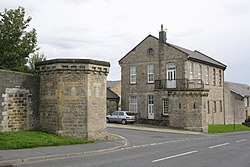
Richmond Barracks was a military installation in Richmond, North Yorkshire.

1.8 km
Gilling West
Gilling West is a village about 3.5 miles (5.6 km) north of Richmond in North Yorkshire, England. It is located in the civil parish of Gilling with Hartforth and Sedbury. It is named "West" to distinguish it from Gilling East near Helmsley, some 32 miles away.
A 2018 report states that the community houses people who commute to Darlington, Teesside and Richmond via the A66 and A1(M). The settlement "retains a village hall, two public houses and a shop but there is no longer a post office. There is a limited bus service to the village." The report adds that Gilling West is a Conservation Area with the High Street of particular significance. "A substantial percentage of the buildings [in the community] are listed as being of special architectural or historic interest".