


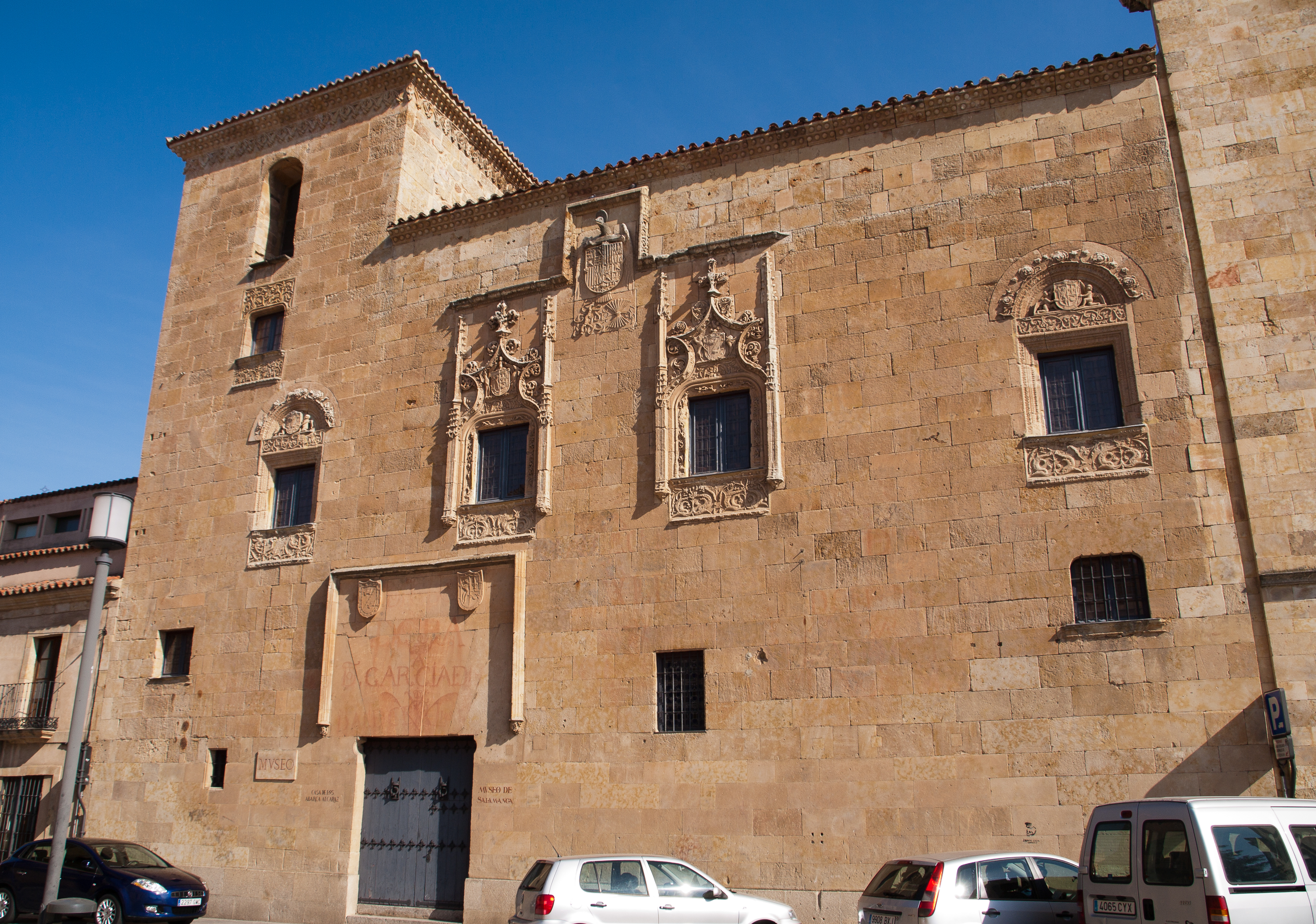
La Maison du docteur Álvarez Abarca (Casa de los Abarca en Espagnol) à Salamanque (Castille-et-León, Espagne), connue aussi sous le nom "Casa de los Doctores de la Reina" (Maison des Docteurs de la Reine), est un palais flanqué de tours de style gothique et de style Renaissance. Elle a été édifiée au XVIe siècle pour Fernán Álvarez Abarca, médecin des Rois catholiques.
Gallery

Sponsored
Location
1 explorer visited this place

84 m
The siege of the Salamanca forts saw an 800-man Imperial French garrison directed by Lieutenant Colonel Duchemin defend three fortified convents in the city of Salamanca against the 48,000-strong Allied army led by Arthur Wellesley, Lord Wellington. During this time, the French commander Marshal Auguste de Marmont led a 40,000-man French army in an unsuccessful attempt to relieve the garrison. An Allied failure to bring sufficient artillery ammunition caused the siege to be prolonged. The garrison repulsed a premature British attempt to storm the fortified convents on 23 June, but finally surrendered four days later after an artillery bombardment breached one fort and set another one on fire. During his maneuvering, Marmont formed the idea that Wellington was only willing to act on the defensive. This mistaken notion would contribute to Marmont's defeat at the Battle of Salamanca a month later.

166 m
The University of Salamanca is a public research university in Salamanca, Spain. Founded in 1218 by King Alfonso IX, it is the oldest university in the Hispanic world and the fourth oldest in the world in continuous operation. It has over 30,000 students from 50 nationalities.

200 m
The Pontifical University of Salamanca is a private Roman Catholic university based in Salamanca, Spain.

211 m
The Cathedral of Santa María, known as the Old Cathedral, is one of the two cathedrals in Salamanca, Castile and León, Spain. Founded by Bishop Jerome of Périgord, its construction began in the first third of the 12th century and was finished at the end of the 14th century, in Romanesque and Gothic style. It was finished thanks to the impulse given to the works by Bishop Alfonso Barasaque. It is dedicated to Saint Mary of the See.

248 m
The General Archive of the Spanish Civil War is a specialist archive containing material related to the Spanish Civil War. It is part of Spain's National Historical Archive and is located in Salamanca.
The origins of the Civil War Archive, and the decision to house such documents in Salamanca, date back to the 1930s. The Nationalists decreed, on September 13, 1936, that "all properties and documents belonging to the political parties and organizations mentioned, as well as any others that opposed the movimiento nacional, were to become the property of the State." The definition of organizations opposed to the regime was a fairly broad one, as is evidenced by the fact that the archive includes material related to freemasonry; freemasons were one of the groups viewed with suspicion by Franco and membership carried a prison sentence.
With the democratisation of Spain, the purpose of the Archive changed. In 2007 the Archive became part of the Historical Memory Documentary Centre created by the Historical Memory Law. "Historical memory", in this context, refers to Spain's coming to terms with its Civil War and the rule of Caudillo Francisco Franco. The Centre includes material from the 1930s to the 1970s.
The Archive has a permanent exhibition, open to the public. It has also developed its on-line presence: a portal called the "Portal de Víctimas de la Guerra Civil y Represaliados del Franquismo" is maintained under the auspices of the Ministry of Education, Culture and Sport. As the name implies, it makes available information regarding victims of the Civil War and the Francoist State. As some of the victims were refugees, the portal not only draws on Spanish archival material, but also foreign sources, including information about Spanish people held in Nazi concentration camps.
Depuis 1946, elle est le siège du Musée de Salamanque.