


Leeuwarden (en français, Leuwarde ; en frison, Ljouwert ou Liwwadden) est une commune néerlandaise, chef-lieu de la province de Frise. Son principal centre urbain est la ville de Leeuwarden, qui lui donne son nom. En 2018, la commune compte 122 415 habitants.
Location

0 m
Leeuwarden] ; West Frisian: Ljouwert [ˈljɔut] ; Stadsfries Dutch: Liwwadden; Leeuwarder dialect: Leewarden) is a city and municipality in Friesland, Netherlands, with a population of 127,073. It is the provincial capital and seat of the Provincial Council of Friesland.
The region has been continuously inhabited since the 10th century. It came to be known as Leeuwarden in the early 9th century AD and was granted city privileges in 1435. It is the main economic hub of Friesland, situated in a green and water-rich environment. Leeuwarden is a former royal residence and has a historic city centre, many historically relevant buildings, and a large shopping centre with squares and restaurants. Leeuwarden was awarded the title European Capital of Culture for 2018. Also, Leeuwarden has been a UNESCO City of Literature since 2019.
The Elfstedentocht, an ice skating tour passing the eleven cities of Friesland, starts and finishes in Leeuwarden.
The following towns and villages within the municipality have populations in excess of 1,000 people: Leeuwarden, Stiens, Grou, Goutum, Wergea, Jirnsum, Reduzum, and Wirdum. The municipality is governed by the mayor Sybrand van Haersma Buma and a coalition of the Labour Party, Christian Democratic Appeal, and GreenLeft.

539 m
The Oldehove is a leaning and unfinished church tower in the medieval centre of the Dutch city of Leeuwarden.
Oldehove is also the name of an artificial mound on which in the late 9th century a church dedicated to Saint Vitus was built. Construction of the adjoining Late Gothic tower began in 1529, after the citizens of Leeuwarden demanded a tower taller than the one in the city of Groningen, the Martinitoren. In charge were Jacob van Aken and, after his death, Cornelis Frederiksz.
The tower's tilt began during construction. The builders tried to compensate for the tilt, but the project was stopped in 1532. In 1595–1596, the then derelict church was demolished, but the tower remains. It consists mostly of brick, but the builders also used so-called Bentheim sandstone. There are two bells. A bell cast in 1633 by Hans Falck and a bell cast in 1637 by Jacob Noteman, weight 2,100 kg. It is listed as a Rijksmonument, number 24331.
The height of the tower is 39 metres. The tower has 183 steps. The top of the tower is displaced horizontally 2 metres from the centre. The original plan included attaching a new church to the tower, which would replace the old saint vitus church, but this was never realized. Custodian of the tower is Historisch Centrum Leeuwarden.

604 m
Tresoar is the short name for the Frysk Histoarysk en Letterkundich Sintrum in Leeuwarden.
Tresoar manages digital archives about Friesland and its literature. There is a study room open to the public, and most catalogs are online and free to access. In addition to 2-dimensional material such as photographs, scanned books and documents, there is a growing collection of multi-media objects such as film and audio material that can also be searched and accessed online.
Tresoar was created through a merger in 2002 of the Frisian Literature Museum with the Provincial Library and the National Frisian Archives. Tresoar functions as a regional historical center with a small exposition hall, and is located at Boterhoek 1, Leeuwarden.
Since 2007, all 255 editions of the Leeuwarder Courant have been digitized and placed online.

688 m
Historisch Centrum Leeuwarden, located in Leeuwarden, Netherlands, preserves documents pertaining to the history of Leeuwarden.
695 m
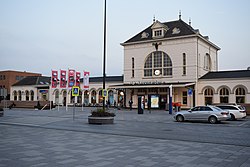
Leeuwarden railway station is the main railway station in Leeuwarden in Friesland, Netherlands. The station, which opened on 27 October 1863, is on the Arnhem–Leeuwarden railway, the Harlingen–Nieuweschans railway and the Leeuwarden–Stavoren railway. Leeuwarden was also the terminus of the North Friesland Railway which served Anjum and Harlingen via Stiens. Behind the station is a stabling point for many trains. The train services are operated by Nederlandse Spoorwegen and Arriva; of the station's six platforms, five are terminating platforms and one is a through platform.