Location Image

Northumbria University

The University of Northumbria at Newcastle, which operates as Northumbria University, is a public research university located in Newcastle upon Tyne, North East of England. It has been a university since 1992, but has its origins in the Rutherford College, founded in 1877. Northumbria University is primarily based within City Campus located in Newcastle upon Tyne city centre and at Coach Lane campus on the outskirts of the city centre, London and Amsterdam. It is organised into four faculties—Arts, Design and Social Sciences; Business and Law; Engineering and Environment, and Health and Life Sciences. Northumbria University has approximately 38,300 students. According to the 2021 Research Excellence Framework, Northumbria University was rated 23rd in the UK for research power (the grade point average score of a university, multiplied by the full-time equivalent number of researchers submitted). This determines how much funding is awarded to universities to spend on research activity and represented the largest percentage-point rise in market share since the previous exercise. The annual income of the institution for 2022–23 was £338.3 million of which £16.4 million was from research grants and contracts, with an expenditure of £340.2 million. Northumbria is a member of the Association of Commonwealth Universities, Universities UK and the Wallace Group.

Nearby Places View Menu
Location Image
136 m

Burt Hall

Burt Hall is a public building in Northumberland Road in Newcastle upon Tyne. It is a Grade II listed building.
Location Image
151 m

Army Riding School

The Army Riding School was a military installation in Northumberland Road, Newcastle upon Tyne.
Location Image
166 m

Newcastle City Centre

Newcastle City Centre is the city centre district of Newcastle upon Tyne, England. It is the historical heart of the city and serves as the main cultural and commercial centre of the North East England region. The city centre forms the core of the Tyneside conurbation. The city centre district is sometimes subdivided into the areas of Haymarket, Quayside, Grainger Town, Monument, Gallowgate, and Chinatown.
Location Image
168 m

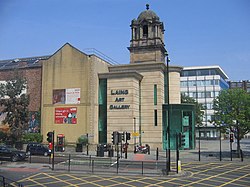
Laing Art Gallery

The Laing Art Gallery in Newcastle upon Tyne, England, is located on New Bridge Street West. The gallery was designed in the Baroque style with Art Nouveau elements by architects Cackett & Burns Dick and is now a Grade II listed building. It was opened in 1904 and is now managed by North East Museums and sponsored by the Department for Culture, Media and Sport. In front of the gallery is the Blue Carpet. The building, which was financed by a gift from a local wine merchant, Alexander Laing, is Grade II listed. The gallery collection contains paintings, watercolours and decorative historical objects, including Newcastle silver. In the early 1880s, Newcastle was a major glass producer in the world and enamelled glasses by William Beilby are on view along with ceramics (including Maling pottery), and diverse contemporary works by emerging UK artists. It has a programme of regularly rotating exhibitions. The gallery's collection of paintings includes John Martin's dramatic The Destruction of Sodom and Gomorrah, as well as works by Sir Joshua Reynolds, Edward Burne-Jones (Laus Veneris), Isabella and the Pot of Basil from 1868 by William Holman Hunt, and Ben Nicholson. Local paintings include pictures by Ralph Hedley. There is also a collection of 18th- and 19th-century watercolours and drawings, including work by J. M. W. Turner and John Sell Cotman.