


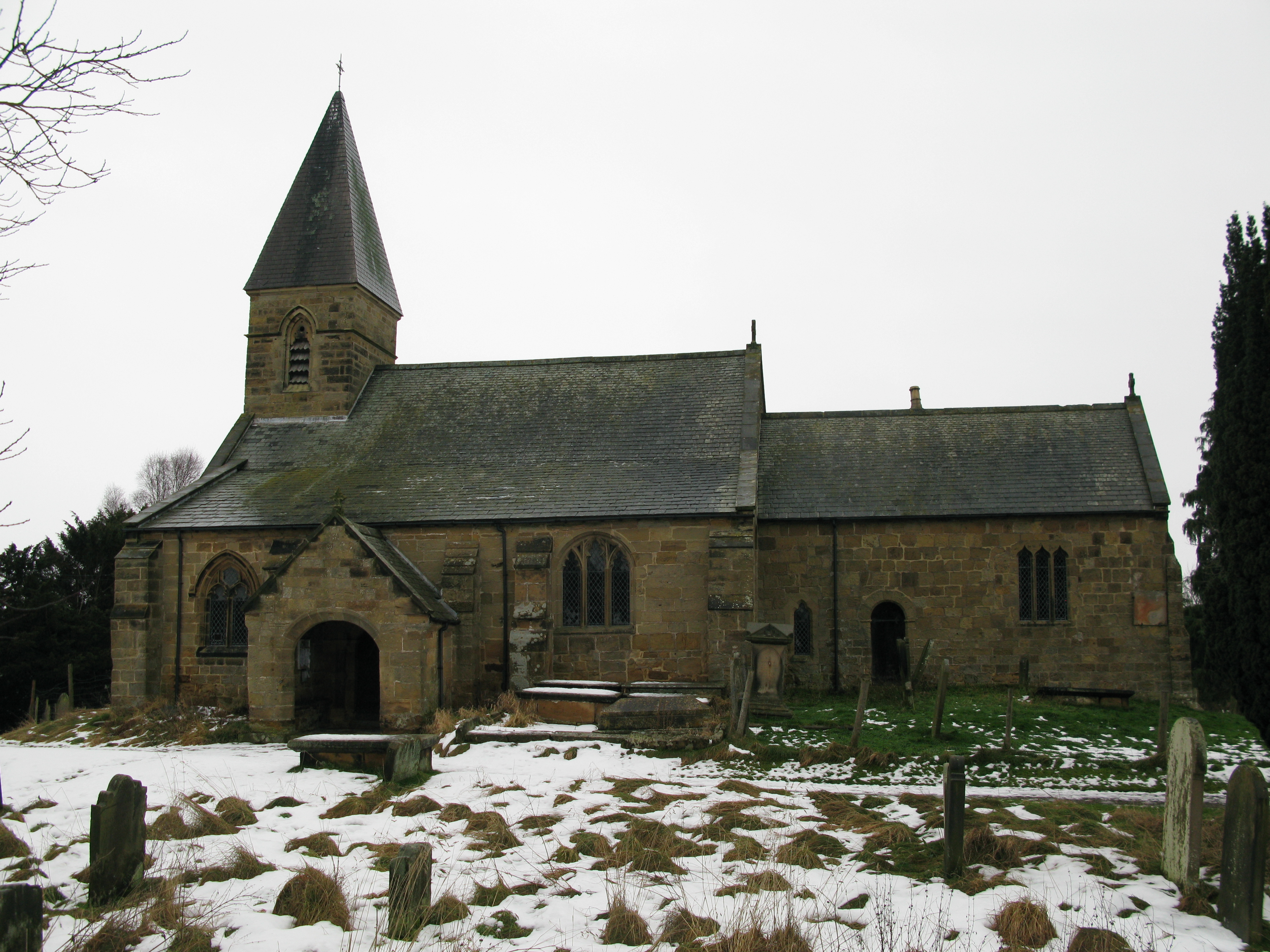
North Otterington est un village et une paroisse civile du Yorkshire du Nord, en Angleterre.
Location
1 explorer visited this place

17 m
North Otterington is a civil parish with no village centre on the east bank of the River Wiske, in the county of North Yorkshire, England. North Yorkshire County Council estimated its population in 2011 to be 40 and 30 in 2015. Details are also included in the civil parish of Ainderby Steeple. It is on the A167 road 3 miles south of Northallerton; South Otterington is further south on the same road.
The Otterinton name is from Old English and means the town of Oter's people. It was recorded in the Domesday Book as Otrinctun in the Hundred of Allerton.
From 1974 to 2023 North Otterington was part of the Hambleton District of North Yorkshire, it is now administered by the unitary North Yorkshire Council.
St Michael's Church, North Otterington dates to the 12th century and was expanded in the 14th, 17th and 19th centuries. The site was important in Saxon times, Saxon coffins and swords were unearthed in the 19th century restoration but the first vicar was not recorded until 1282. For many years, St Michael's was the Mother Church of the parish and wider area and corpse roads extended from Thornton-le-Moor and Thornton le Beans which are still marked on modern day Ordnance Survey maps. The church is grade II listed and used for services on three Sundays of each month.

84 m
St Michael's Church is the parish church of North Otterington, a village in North Yorkshire, in England.
The church was built in the 12th century, from which period the nave and chancel walls survive, along with a doorway, one window and part of another. In the 14th century, a north aisle was added. The church was restored in the 17th century, and again in 1873 by George Fowler Jones. His work included thinning the east wall and a inserting a new window, and adding a tower and porch. The church was grade II listed in 1986.
The church is built of stone with a stone slate roof, and consists of a nave, a south aisle, a south porch and a chancel. On the west end of the nave is a square bell turret with a single-light bell opening on each side, a hood mould, a moulded eaves band, and a short pyramidal spire with a cross. The central porch has a chamfered surround and an elliptical arched entrance. Inside, there are some fragments of carved 10th-century stonework, and a heavily restored 15th-century screen.

980 m
Solberge Hall near Northallerton, North Yorkshire, England, is a wedding and events venue. The house is Georgian of historical significance. It was built in 1824 by John Hutton, a local landowner and remained in the Hutton family for about one hundred years until it was purchased by Benjamin Talbot the inventor. After an extensive multi-million pound refurbishment and restoration programme, Solberge Hall is now a wedding and events venue set in a private estate in North Yorkshire.

1.4 km
Newby Wiske railway station served the village of Newby Wiske, North Yorkshire, England from 1852 to 1963 on the Leeds-Northallerton Railway.

1.7 km
Otterington Hall is a Grade II listed mansion in South Otterington, near Northallerton, North Yorkshire, England.
Otterington Hall lies in South Otterington, three miles south of Northallerton, on the A167.
One of the earlier occupants, from before 1831 until his death in 1837, was Captain John George Boss R.N. He had a distinguished naval career, being involved in the capture of several French vessels and the protection of British trading interests in the Caribbean during the Napoleonic Wars. He was a Member of Parliament for the Northallerton constituency and he gained the rank of captain in November 1833. He married twice: Charlotte Robinson in 1814, who died in 1832 aged 56, and Elizabeth Wylie in 1834.
Otterington Hall was the birthplace of British anti-fascist, linguist, and photographer, Alec Wainman.
It was home to the Furness family for many years, and they were responsible for planting much of its topiary gardens from the 1920s onwards, "one of the best topiary gardens in England and certainly the best in Yorkshire".
It has been home to Andy Preston, the Mayor of Middlesbrough and a former hedge fund manager, and his wife since at least 2007. In 2015, Preston was criticised for using his parents' Middlesbrough address on his nomination papers, rather than that of his actual home, but he denied breaking election rules.