


Le Palais archiépiscopal est l'un des bâtiments principaux du centre de la ville de Bourges, face à la cathédrale et qui servit d'Hôtel de Ville de 1910 à 1995. Il contient actuellement le musée des « Meilleurs Ouvriers de France » et rassemble un certain nombre de chefs-d'œuvre réalisés à l'issue de leur tour de France.
Gallery


Sponsored
Location
1 explorer visited this place
64 m
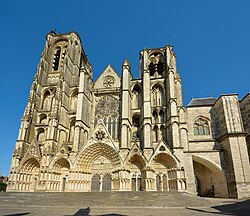
Bourges Cathedral or the Cathedral of Saint Stephen of Bourges is a Roman Catholic church located in Bourges, France. The cathedral is dedicated to Saint Stephen and is the seat of the Archbishop of Bourges. Built atop an earlier Romanesque church from 1195 until 1230, it is largely in the High Gothic or Classic Gothic architectural style and was constructed at about the same time as Chartres Cathedral. The cathedral is particularly known for the great size and unity of its interior, the sculptural decoration of its portals, and the large collection of 13th century stained glass windows. Owing to its quintessential Gothic architecture, the cathedral was declared a UNESCO World Heritage Site in 1992.

104 m
The Hôtel de Ville is a municipal building in Bourges, Cher, central France, standing on Rue Jacques Rimbault.

176 m
The Archdiocese of Bourges is a Latin Church archdiocese of the Catholic Church in France. The Archdiocese comprises the départements of Cher and Indre in the Region of Val de Loire. Bourges Cathedral, dedicated to Saint Stephen, stands in the city of Bourges in the department of Cher. Although this is still titled as an Archdiocese, it ceased as a metropolitan see in 2002 and is now a suffragan in the ecclesiastical province of Tours.
390 m
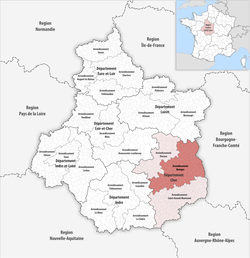
The arrondissement of Bourges is an arrondissement of France in the Cher department in the Centre-Val de Loire region. It has 128 communes. Its population is 170,322, and its area is 2,783.9 km2.
390 m
Avaricum was an oppidum in ancient Gaul, near what is now the city of Bourges. Avaricum, situated in the lands of the Bituriges Cubi, was the largest and best-fortified town within their territory, situated on very fertile lands. The terrain favored the oppidum, as it was flanked by a river and marshland, with only a single, narrow entrance.
By the time of the Roman conquest in 52 BC, the city, according to Julius Caesar, had a population of 40,000 people who were then almost all killed.