
Location Image

The Briton's Protection

The Briton's Protection is a historic, Grade II listed public house in Manchester, England. Various dates are given for its establishment; the pub's own website says 1806, although its bicentenary was not celebrated until 2011. It was listed in Pigot and Dean's New Directory of Manchester & Salford for 1821 and 1822. The pub's name recalls its use as an army recruiting venue, as do a set of murals inside the pub. The Peterloo Massacre of 1819 happened nearby, and there are unconfirmed reports that some of the injured were brought into the pub and laid out on the bar to be treated. The brick building, with a slate roof, was granted Grade II listed status, offering protection from unauthorised alteration or demolition, in 1990. The largely intact 1930s interior has six public rooms. Other notable architectural features include a terrazzo-tiled corridor floor, moulded ceiling, original 1930s urinals and the serving hatch through which people in the two rear rooms are served beer from the front bar. As well as serving real ale, it is known for offering over 360 whiskies.

For many years, the pub was operated as a Tetley house, then by Punch Taverns, before being taken over in 2014 by an independent operator and refurbished. The pub was voted Best Pub in Manchester in the Pride of Manchester Awards in both 2008–2009 and 2009–2010. It is on the Campaign for Real Ale's National Inventory of Historic Pub Interiors.

Lieux à Proximité Voir Menu
Location Image
68 m

The Haçienda

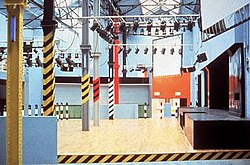
The Haçienda was a nightclub and music venue in Manchester, England, which became famous during the Madchester years of the 1980s and early 1990s. It was run by the record label Factory Records. The club opened in 1982, eventually fostering the Manchester acid house and rave scene in the late 1980s. The early success of Factory band New Order, particularly with their 1983 dance hit "Blue Monday", helped to subsidise the club even as it lost considerable amounts of money (in part due to clubbers' embrace of the street drug ecstasy, which drove down traditional alcohol sales). The club's subculture was noted by the Chief Constables of Merseyside and Greater Manchester as reducing football hooliganism. Crime and financial troubles plagued its later years, and it finally closed in 1997. It was demolished and replaced by apartments.
89 m

Havelock Mills

Havelock Mills in central Manchester were built between 1820 and 1840. It was probably the largest surviving silk mill in the north-west region in the 1970s and had a unique combination of silk and cotton mills on one site. It was a landmark on the Rochdale Canal, overlooking Tib Lock, one of the Rochdale Nine.
Location Image
101 m

Bridgewater Hall

The Bridgewater Hall is a concert venue in Manchester city centre, England. It cost around £42 million to build in the 1990s, and hosts over 250 performances a year. It is home to the 165-year-old Hallé Orchestra as well as to the Hallé Choir and Hallé Youth Orchestra and it serves as the main concert venue for the BBC Philharmonic. The building sits on a bed of 280 springs intended to insulate it from external sound. The hall is named after the Third Duke of Bridgewater who commissioned the eponymous Bridgewater Canal that crosses Manchester, although the hall and waterside frontage is situated on a specially constructed arm of the Rochdale Canal.
Location Image
107 m

AXIS, Manchester

AXIS (also known as the Axis Tower) is a residential tower in Manchester city centre, England. The tower has had two iterations, one as a stalled construction project which was cancelled due to the Great Recession in 2008, and the other as residential which was announced in 2014. When completed in 2019, Axis Tower became the seventh-tallest building in Greater Manchester until the completion of the Deansgate Square and Angel Gardens projects.