


Le Vauxhall, aussi parfois appelé Vaux-Hall ou Waux-Hall, est un ensemble des plusieurs bâtiments voué aux loisirs, situé dans le parc de Bruxelles, rue de la Loi 3 et 5. Le théâtre royal du Parc (no 3) occupe le front de rue avec le théâtre proprement dit et un deuxième bâtiment abritant des ateliers.
Gallery


Sponsored
Location
1 explorer visited this place
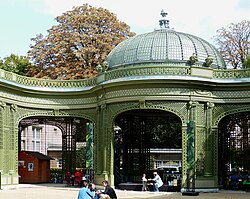
8 m
The Vauxhall, also known as the Vaux-Hall or Waux-Hall, is a historic performance hall and entertainment complex in central Brussels, Belgium. Established in the 1780s by the Bultos family, and named after Vauxhall Gardens in London, it was originally conceived as a pleasure venue combining a theatre, café-restaurant, dance hall and retail pavilions. Since 1818, it has been the property of the City of Brussels.
The complex underwent numerous transformations and periods of decline. Its current appearance, including the distinctive U-shaped gallery and orchestra pavilion, with its green trelliswork and dome, largely dates from a 1913 redevelopment by the architect François Malfait. The site is now a protected heritage monument, occasionally hosting cultural events.
The Vauxhall is located at 3–5, rue de la Loi/Wetstraat, on the edge Brussels Park, behind the Royal Park Theatre. This site is served by Brussels-Central railway station, as well as by the metro stations Parc/Park and Arts-Loi/Kunst-Wet.

90 m
The Royal Park Theatre is a theatre in central Brussels, Belgium. It is located at 3, rue de la Loi/Wetstraat, on the edge of Brussels Park, facing the Belgian House of Parliament. It is served by Brussels-Central railway station, as well as by the metro stations Parc/Park and Arts-Loi/Kunst-Wet.
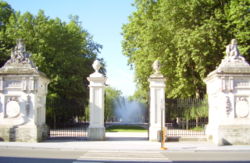
104 m
Brussels Parkk] or Park van Brussel [ˈpɑrk fɑm ˈbrʏsəl]) is the largest urban public park in central Brussels, Belgium. The park was formerly known and is still sometimes colloquially referred to as the Royal Parkk]). It was the city's first public park, being originally laid out between 1776 and 1783 in a neoclassical style by the French architect Gilles-Barnabé Guimard and the Austrian landscape architect Joachim Zinner, as part of an urban project including the Place Royale/Koningsplein. The area of the rectangular park is 13.1 ha.
The park is surrounded by the Place des Palais/Paleizenplein to the south, the Rue Royale/Koningsstraat to the west, the Rue de la Loi/Wetstraat to the north and the Rue Ducale/Hertogstraat to the east. The main entrance is on the northern side, opposite the Belgian House of Parliament. An avenue leads to the main pond, from which three other avenues offer views of three important places in Brussels: the Palace of Justice, the Royal Palace and the Place du Trône/Troonplein. This area is served by Brussels-Central railway station, as well as by the metro stations Parc/Park and Trône/Troon.

131 m
The Royal Quarter is a quarter in the historic upper town of Brussels, Belgium. It is situated between Brussels Park, the Royal Palace, the Mont des Arts/Kunstberg and the Sablon/Zavel. It is an excellent example of 18th-century urban architecture.

163 m
The Federal Parliament is the bicameral parliament of Belgium. It consists of the Chamber of Representatives and the Senate. It sits in the Palace of the Nation in the centre of the nation's capital, Brussels.
The Chamber of Representatives is the primary legislative body; the Senate functions only as a meeting place of the federal communities and regions. The Belgian Constitution does not mention the Federal Parliament as such; it stipulates that the federal legislative power is exercised by the King and the Chamber of Representatives, and defines when the United Chambers convene.
En retrait, au no 5, se trouve aujourd'hui le Cercle Gaulois. Derrière celui-ci se trouve un petit pavillon de scène ouverte, qui porte encore aujourd'hui le nom de Vauxhall. Sous le site se trouve aussi le bunker du Parlement fédéral belge, aménagé dans les années 1930.