


San Pawl Milqi est un site archéologique maltais situé près du village de Burmarrad, sur le flanc d'une colline dominant la plaine fertile de Barmarrad et de la baie de Salina. Comme souvent à Malte, le site est utilisé pendant plusieurs époques (préhistorique, phénicienne, romaine, chrétienne) mais les restes les plus importants datent de l'époque romaine et révèlent une importante villa agricole centrée sur la culture de l'olivier.
Book your tour near
San Pawl Milqi
Book Now
4.5
in partnership with
GetYourGuide.com
Gallery


Sponsored
Location

7 m
San Pawl Milqi are the ruins of a Roman period agricultural villa and pagan temple, the largest ever discovered in Malta. A Christian church was built on the site based on the Biblical mention of the shipwreck of Saint Paul on the island.
In the place of the current chapel there was a temple dedicated to the Greek god Apollo and a Roman villa. According to religious tradition, the villa is where Saint Publius, Governor and first Bishop of Malta, received Saint Paul after his shipwreck.
Apart from the account of the Acts of the Apostles there are no other authors who narrate the episode and no later writer complements the tradition.
There has even been a controversy about whether the event occurred in Malta, since the Greek text says Melite.
There is no archaeological evidence in support of Christian claims, and it is considered a name dating to the Middle Ages. Evidence of Christian worship on the site only dates back to the building of the first chapel in the fourteenth century. According to Anthony Bonanno, archeological research in the entire area of St Paul’s Bay found no evidence of the Christian tradition related to the supposed shipwreck in the area.
287 m
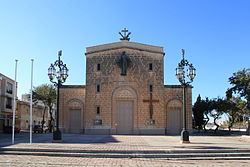
Burmarrad is a hamlet in St. Paul's Bay, Malta. The main heritage site is the San Pawl Milqi zone, where there is a chapel dedicated to St. Paul, built on the remains of a Roman temple dedicated to Apollo, and according to tradition the remains of the home of St. Publius. The Parish Church dedicated to the Immaculate Heart Of Mary was built in 1964. The village feast is celebrated on the last Sunday of June. Burmarrad forms part of the Saint Paul's Bay local council

869 m
The Tal-Qadi Temple is a megalithic temple in Salina, limits of Naxxar, Malta. It is in a very bad state of preservation, with only the temple's general outline still visible.
1.4 km
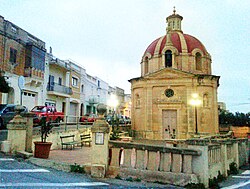
Bidnija is a rural hamlet between Mosta, St. Paul's Bay and Mġarr. It is located in the northern region of Malta and is home to roughly 300 people as of 2008. The second least populated habitable zone on the Maltese islands, tt is located between two main valleys then extends into other small valleys surrounding the area. It is largely a rural village surrounded by fields mainly belong to the inhabitants, although over the years other Maltese and foreigners have settled in the area generally for its countryside views.
At present, Bidnija is administered by the local councils of Mosta and St. Paul's Bay. It is home to some horse riding facilities, a clay pigeon shooting club and a Maltese cuisine restaurant specialising in traditional rabbit stew. Bidnija's small church is dedicated to the Holy Family and its feast day is celebrated in July.

1.7 km
Wardija Ridge is a plateau found in a group in the north of Mġarr, Malta, just outside of Wardija. Wardija Ridge is part of a series of hills that run on a southwest-northeast axis from the Għajn Tuffieħa area in Mġarr to the Xemxija Bay area in St. Paul's Bay. The Northern ridge edge is interrupted by a series of valley systems which discharge into il-Wied tal-Pwales.
Located at 35°55'54.02" latitude and 14°22'18.01" longitude, the 139-meter-high Wardija Ridge has a total of more than 40 tourist attraction spots divided into six sections.
Wardija Ridge has been assigned a Level 2 degree of protection as Areas of Ecological Importance and Sites of Scientific Importance, and supports important garigue communities characterized by rare species. Other levels of protection have been given to the three valley systems in the scheduled areas, the upper reaches of the watercourse of Il-Wied ta' San Martin and the Southern part of the promontory known as L-Argentier.
In 1915, the British built Wardija Battery on the east end of the ridge. The battery became obsolete in 1938, but its gun emplacements remain.
Une petite église se dresse sur le site évoquant le souvenir du débarquement de saint Paul à Malte.