


Déportation des enfants de Białystok
Le 21 août 1943, pendant la liquidation du ghetto de Białystok, environ 1 200 enfants juifs sont déportés dans les trains de l'Holocauste vers le camp de concentration de Theresienstadt, où ils sont isolés des autres prisonniers. Le 5 octobre, ils apprennent qu'ils seront envoyés en Suisse pour y être échangés contre des prisonniers de guerre allemands.
Gallery


Sponsored
Location
1 explorer visited this place

0 m
Theresienstadt Ghetto was established by the SS during World War II in the fortress town of Terezín, in the Protectorate of Bohemia and Moravia. Theresienstadt served as a waystation to the extermination camps. Its conditions were deliberately engineered to hasten the death of its prisoners, and the ghetto also served a propaganda role. Unlike other ghettos, the use of slavery was not economically significant.
The ghetto was established by the transportation of Czech Jews in November 1941. The first German and Austrian Jews arrived in June 1942; Dutch and Danish Jews came in 1943, and prisoners of a wide variety of nationalities were sent to Theresienstadt in the last months of the war. About 33,000 people died at Theresienstadt, mostly from malnutrition and disease. More than 88,000 people were held there for months or years before being deported to extermination camps and other killing sites; the role of the Jewish Council in choosing those to be deported has attracted significant controversy. The total number of survivors was around 23,000, including 4,000 deportees who survived.
Theresienstadt was known for its relatively rich cultural life, including concerts, lectures, and clandestine education for children. The fact that it was governed by a Jewish self-administration as well as the large number of "prominent" Jews imprisoned there facilitated the flourishing of cultural life. This spiritual legacy has attracted the attention of scholars and sparked interest in the ghetto. In the postwar period, a few of the SS perpetrators and Czech guards were put on trial, but the ghetto was generally forgotten by the Soviet authorities. The Terezín Ghetto Museum is visited by 250,000 people each year.
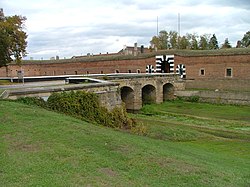
694 m
The Small Fortress is a fortress forming a significant part of the town of Terezín in the Czech Republic. The former military fortress was established at the end of the 18th century together with the whole town of Terezín on the right bank of the Ohře River. It served as a prison in the 19th century and was also house of imprisonment for Gavrilo Princip.
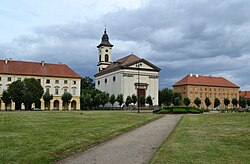
1.2 km
Terezín is a town in Litoměřice District in the Ústí nad Labem Region of the Czech Republic. It has about 2,900 inhabitants. The town is located on the Ohře River, in the Lower Ohře Table.
Founded in 1780, Terezín is a former military fortress composed of the citadel and adjacent walled garrison town. The town centre is well preserved and is protected as an urban monument reservation. Terezín is infamously known as the location of the Nazis' Theresienstadt Ghetto.
2.0 km
Travčice is a municipality and village in Litoměřice District in the Ústí nad Labem Region of the Czech Republic. It has about 600 inhabitants.
Travčice lies approximately 7 kilometres south-east of Litoměřice, 21 km south-east of Ústí nad Labem, and 49 km north of Prague.

2.5 km
Bohušovice nad Ohří is a town in Litoměřice District in the Ústí nad Labem Region of the Czech Republic. It has about 2,400 inhabitants.
Toutefois, le train est dérouté vers Auschwitz, où tous les enfants sont assassinés dans les chambres à gaz. La raison de cet itinéraire inhabituel fait encore l'objet de débats parmi les experts.
