


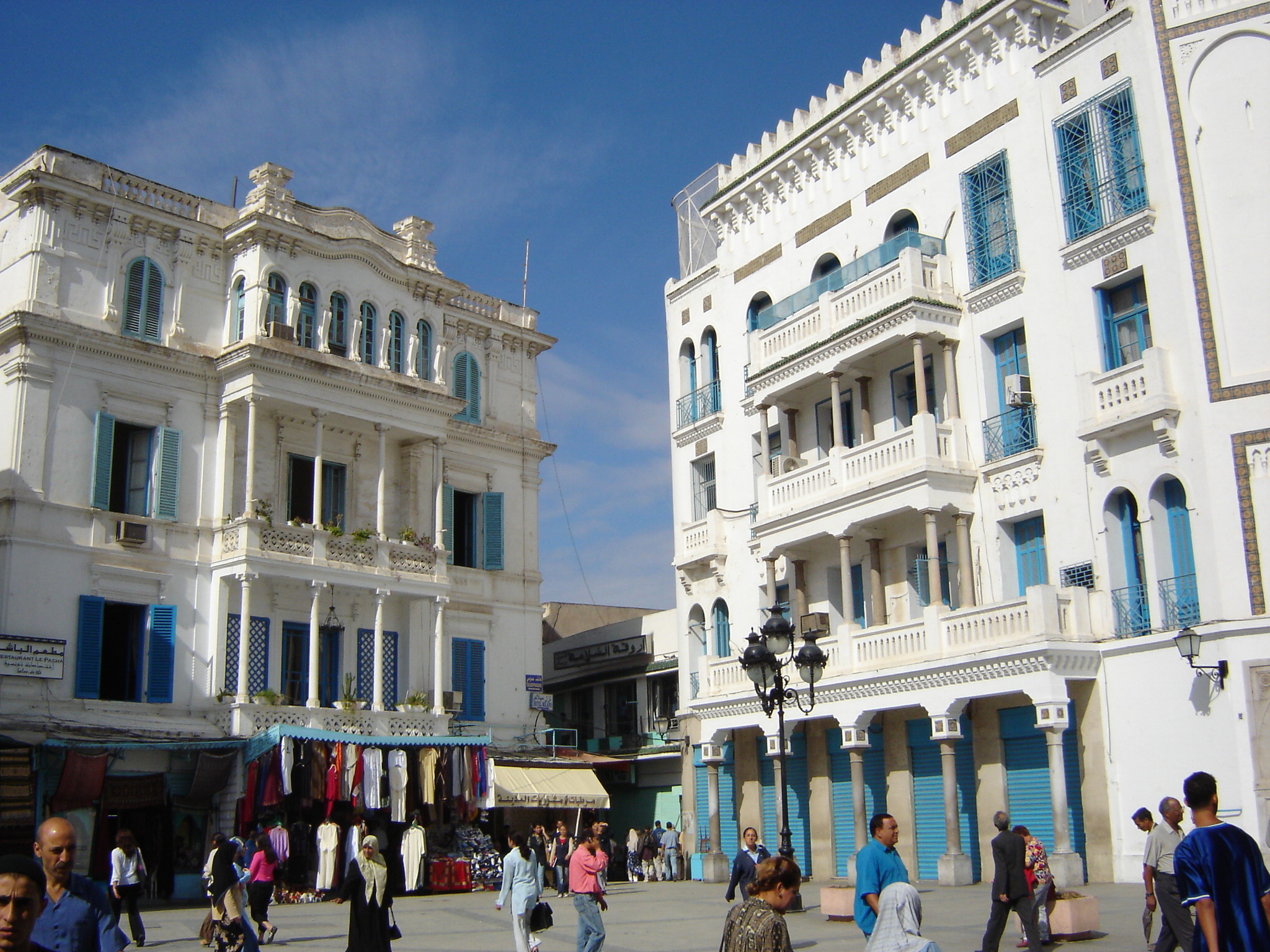
L'ancien siège du Tribunal administratif est un bâtiment tunisien situé sur la rue de Rome à Tunis. Il est classé monument historique depuis le 15 janvier 2001.
Gallery

Sponsored
Location
2 explorers visited this place

80 m
The Archdiocese of Carthage is a Latin Catholic titular see originally established as a diocese in Carthage, Roman Empire, in the 2nd century. Agrippinus was the first named bishop, appointed around 230 AD.
The diocese, in its earlier form, was to the Early African church what the Diocese of Rome was to the Catholic Church in Italy. The archdiocese used the African Rite, a variant of the Western liturgical rites in Latin language, possibly a local use of the primitive Roman Rite. Famous figures include Saint Perpetua, Saint Felicitas, and their Companions, Tertullian, Cyprian, Caecilianus, Saint Aurelius, and Eugenius of Carthage. Tertullian and Cyprian are both considered Latin Church Fathers of the Latin Church.
Tertullian, a theologian of part Berber descent, was instrumental in the development of trinitarian theology, and was the first to apply Latin language extensively in his theological writings. As such, Tertullian has been called "the father of Latin Christianity" and "the founder of Western theology." Carthage remained an important center of Christianity, hosting several councils of Carthage.
Carthage exercised informal primacy as an archdiocese, being the most important center of Christianity in the whole of Roman Africa, corresponding to most of today's Mediterranean coast and inland of Northern Africa. As such, it enjoyed the title of primate of Africa.
In the 6th century, turbulent controversies in teachings affected the diocese: Donatism, Arianism, Manichaeism, and Pelagianism. Some proponents established their own parallel hierarchies.
The city of Carthage fell to the Muslim conquest of the Maghreb with the Battle of Carthage. The episcopal see remained but Christianity declined under persecution. The last resident bishop, Cyriacus of Carthage, was documented in 1076. It became a titular see with bishops appointed beginning in the 16th century, was briefly restored as a residential see in the 19th century, and was again made titular in 1964, being supplanted by the Archdiocese of Tunis. The titular see of Carthage has been vacant since 1979.

80 m
The Archdiocese of Tunis is a Latin Church ecclesiastical territory or diocese of the Catholic Church in Tunis, Tunisia. It was founded on 10 November 1884 under the name "Archdiocese of Carthage", with territory corresponding to that of the then French protectorate of Tunisia. On 9 July 1964, it became a territorial prelature under the ecclesiastical title of Prelature of Tunis. It was made a diocese, keeping the name of Tunis, on 31 May 1995, and raised to the rank of archdiocese on 22 May 2010.
The Cathedral of St. Vincent de Paul is the cathedral of the archdiocese of Tunis.

95 m
The Cathedral of St. Vincent de Paul is a Roman Catholic church located in Tunis, Tunisia. The cathedral is dedicated to Saint Vincent de Paul, patron saint of charity. It is the episcopal see of the Archdiocese of Tunis and is situated at Place de l'Indépendance in Ville Nouvelle, a crossroads between Avenue Habib Bourguiba and Avenue de France, opposite the French embassy.
The church, designed by L. Bonnet-Labranche, was built in a mixture of styles, including Moorish revival, Gothic revival, and Neo-Byzantine architectural traditions. The cornerstone was laid in 1890, and construction began in 1893. The church was opened on Christmas in 1897, albeit without its belltowers owing to a shortage of funds. The reinforced concrete towers were completed in 1910 using the Hennebique technique.
Cardinal Charles Lavigerie laid the first stone for a church on 7 November 1881, a little further down Avenue de la Marine. This was a pro-cathedral; the cathedral of the archdiocese being the Saint Louis Cathedral. The pro-cathedral was built quickly, but its condition soon deteriorated due to the adverse ground conditions, necessitating the construction of the current cathedral.
The number of Roman Catholics in Tunisia fell rapidly following Tunisian independence from France. A modus vivendi reached between the Republic of Tunisia and the Vatican in 1964 resulted in the transfer of selected buildings to the Tunisian state for public use, including the Acropolium of Carthage in Carthage. However, the Cathedral of St. Vincent de Paul remains under the ownership and operation of the Roman Catholic Church in Tunisia.

118 m
Souk Edabaghine, is one of the souks of the medina of Tunis. It is called Edabaghine, the Arabic word for tanners, because it was specialized in leather tanning.
Since this was considered a polluting industry, the souk was located at the outskirts of the medina. The souk connects Mongi Slim Street, previously named Street of Maltese, and Rome Street.
When the tanning industry disappeared, antique and used book sellers in all languages and on all subjects, took over the souk. Today there are about twenty book sellers.

205 m
Bab Bhar Mosque, also known as Ez-Zraariâ Mosque is a mosque in Tunis, Tunisia.
Histoire
Le bâtiment est construit en 1907 pour accueillir la succursale de la Banque de l'Algérie. Par la suite, il abrite le siège du Front de libération nationale algérien, du Rassemblement constitutionnel démocratique et enfin du Tribunal administratif. Le monument est restauré en 2002 par l'Association de sauvegarde de la médina de Tunis.
Voir aussi
Portail de l’architecture et de l’urbanisme Portail du droit Portail de Tunis