


La Fondation Jean Dausset-CEPH ou CEPH, Centre d'étude du polymorphisme humain, est une organisation de recherche située à Paris, créée en 1984 par le professeur et prix Nobel de physiologie ou médecine Jean Dausset. La fondation collecte des échantillons du génome humain, grâce auxquels les cartes du génome humain ont été réalisées.
Book your tour near
Centre d'étude du polymorphisme humain
Book Now
4.5
in partnership with
GetYourGuide.com
Location
2 explorers visited this place

0 m
The Fondation Jean Dausset-CEPH or CEPH, formerly the Centre d'Etude du Polymorphisme Humain, is an international genetic research center located in Paris, France. It produced a map that includes genetic markers of human chromosomes using a resource of immortalised cell cultures.

98 m
Hôpital Saint-Louis is a hospital in Paris, France. It was built in 1611 by architect Claude Vellefaux at the request of Henry IV of France. It is part of the Assistance publique - Hôpitaux de Paris hospital system, and it is located at 1 avenue Claude-Vellefaux, in the 10th arrondissement near the metro station Goncourt.
It was founded by King Henry IV on May 17, 1607 to relieve the Hôtel-Dieu de Paris during the plague. It was named St. Louis in memory of Louis IX, who died of the dysentery that devastated Tunis in 1270.
Today, Hôpital Saint-Louis uses its historical premises for administrative functions. Following the 1980s new modern additions were made to house the current hospital and teaching hospital. Its primary specialties are dermatology and hematology, as well as oncology. The dermatology library was founded by Dr Henri Feulard. The hospital employs 2,500 people, one thousand of whom are in the medical profession. It houses the INSERM Institute of Research on Skin and the René Touraine Foundation.
The south-west entrance to the hospital, located at the intersection of rue Bichat and avenue Richerand, is popularly known as the entrance to the police station in the hit French detective television series Navarro.

249 m
The Gibbet of Montfaucon was the main gallows and gibbet of the Kings of France until the time of Louis XIII. It was used to execute criminals, often traitors, by hanging and to display their dead bodies as a warning to the population. It was a large structure located at the top of a small hill near the modern Place du Colonel Fabien in Paris, though during the Middle Ages it was outside the city walls and the surrounding area was mostly not built up, being occupied by institutions like the Hôpital Saint-Louis from 1607, and earlier the Convent of the Filles-Dieu, a home for 200 reformed prostitutes, and the leper colony of St Lazare.
First built during the reign of King Louis IX as a sign of royal justice in the late 13th century, the gibbet was later institutionalised under King Charles IV where the wooden scaffold was converted into stone with sixteen columns at a height of 10 meters. It was used until 1627 and then dismantled in 1760. A smaller gibbet was erected nearby for ceremonial purposes rather than for execution.
As reconstructed in images by Eugène Viollet-le-Duc it had three sides, and 45 compartments in which people could be both hanged and hung after execution elsewhere. A miniature of about 1460 from the Grandes Chroniques de France by Jean Fouquet, and also a print of 1609, show a somewhat less substantial structure than that in the reconstructions, which may, like others by Viollet-le-Duc, make the structure grander and more complex than was actually the case. The miniature shows bodies hanging from beams running across the central space, resting on the piers, but Viollet-le-Duc shows slabs running round the sides. Both show a substantial platform in masonry, which ran round a central space at ground level in the reconstructions, entered by a tunnel through the platform, closed by a gate. Another print of 1608 shows only two tiers of compartments rather than the three of Viollet-le-Duc. The English travel writer Thomas Coryat saw it at about the same time and described it as "the fairest gallows that I ever saw, built on a little hillocke ... [with] fourteen pillars of free stone".
The structure was also used for displaying the bodies of those executed elsewhere; in 1416 the remains of Pierre des Essarts were finally handed back to his family after three years at Montfaucon. Like an alarming number of other victims, Essarts had been one of the four royal treasurers.
The gibbet was a great favourite of popular historians and historical writers of the 19th century, appearing in historical novels including The Hunchback of Notre-Dame by Victor Hugo, Crichton by William Harrison Ainsworth, and La Reine Margot by Alexandre Dumas; both the last two tales centred on the St. Bartholomew's Day Massacre. The former site of the gibbet is featured in the 1996 video game Broken Sword: The Shadow of the Templars.

257 m
Colonel Fabien is a station on Paris Métro Line 2, on the border of the 10th and 19th arrondissements under the Boulevard de la Vilette.
302 m
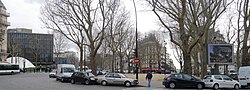
The Place du Colonel Fabien is a square in Paris straddling the 10th and 19th arrondissements. Before the liberation of Paris, the square was called the Place du Combat, but it was renamed in honour of the French communist resistance hero Pierre Georges, whose nom de guerre was Colonel Fabien.
The headquarters of the French Communist Party, designed by the Brazilian communist and utilitarian architect Oscar Niemeyer, is located here, as is a station of the Paris Métro. Nearby is the former location of the medieval Gibbet of Montfaucon, a multi-tiered gibbet that was for most of its history outside the city walls of Paris.
Présentation
En 2015, le président du CEPH est François d'Aubert, magistrat à la Cour des comptes, ancien député, ministre du Budget et de la Recherche, ancien maire de Laval (Mayenne) et président de la Cité des sciences et de l'industrie.