


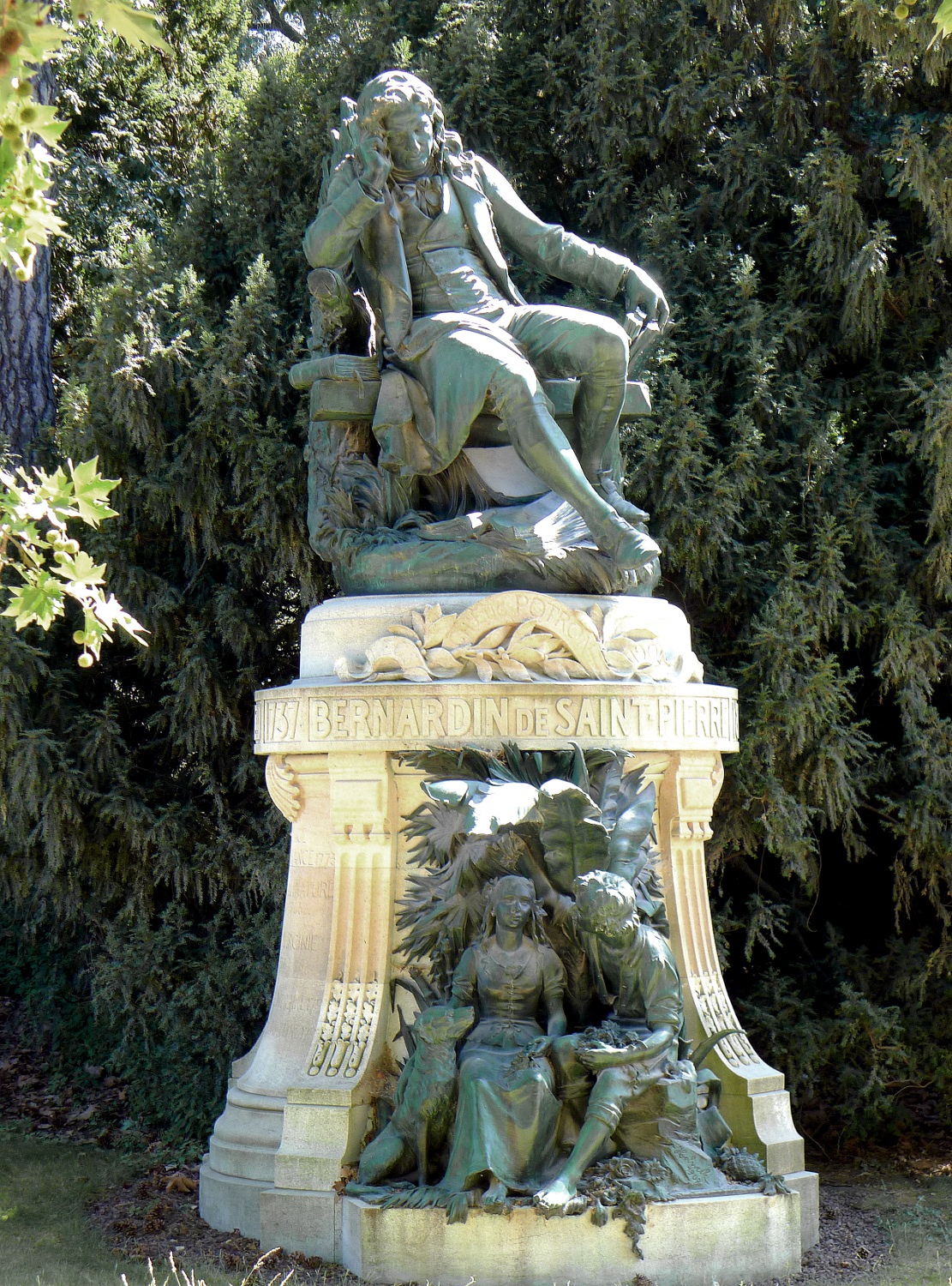
Le monument à Bernardin de Saint-Pierre est un monument dans le Jardin des plantes de Paris, en France, créé en 1906-1907 en l'honneur de Jacques-Henri Bernardin de Saint-Pierre.
Gallery

Sponsored
Location

175 m
The Ménagerie du Jardin des Plantes is a zoo in Paris, France, belonging to the botanical garden Jardin des Plantes. Founded in 1794, largely with animals brought from the royal zoo of the Palace of Versailles, abandoned because of the French Revolution, it is the second oldest zoological garden in the world. Today, the zoo contains many rare smaller and medium-sized mammals, and a variety of birds and reptiles.

200 m
The Institute of Intelligent Systems and Robotics is a multidisciplinary research laboratory, headquartered in Paris, France, that brings together researchers and teacher-researchers from the fields of mechanics, control engineering, signal processing, and computer science.
ISIR is a joint research unit affiliated with Sorbonne University, French National Centre for Scientific Research, and French National Institute of Health and Medical Research, primarily through the Institute of Engineering and Systems Sciences, and secondarily through the Institute of Computer Science and their Interactions as well as the Institute of Biological Sciences.
The research conducted at ISIR spans numerous application domains. However, it is particularly focused on emerging applications of robotics and intelligent systems in the life sciences, aiming to establish synergies between engineering, information sciences, and advancements in the cognitive and interactive capabilities of robots.

222 m
The Abbey of Saint Victor, Paris, also known as Royal Abbey and School of Saint Victor, was an abbey near Paris, France. Its origins are connected to the decision of William of Champeaux, the Archdeacon of Paris, to retire to a small hermitage near Paris in 1108. He took on the life, vocation and observances of the Canons Regular, and his new community followed the Augustinian Rule.
William was famed for his teaching, and was followed to his hermitage by many of his disciples, including Peter Abelard, and was convinced by them to take up his lecturing again. William was made Bishop of Châlons-sur-Marne in 1113, and was succeeded in his hermitage at St. Victor's by Gilduin, who promoted the canonical order and its new abbey vigorously.
Through generous gifts from popes, kings, queens, and nobles, the Abbey of St. Victor was soon richly endowed. Many houses of canons regular came under its influence and were reformed through its leadership, including the Abbey of Ste Geneviève, Wigmore Abbey in Herefordshire, St. Augustine's, St. Catherine's, St. Thomas's, and San Pietro ad Aram. King Louis VIII mentioned no less than forty abbeys of the Order of St. Victor in his last will and testament, and he left 4,000 pounds to be equally divided among them, and all his jewels for the building of the abbey church in Paris. Before the abbey was 160 years old, several cardinals and at least eight significant abbots had been produced from among its members.
The traditions of William of Champeaux were handed on, and the abbey became a center of piety and learning, attracting famous students, scholars and intellectuals including Hugh of St. Victor, Peter Lombard and Thomas Becket. In fact, the school of Saint Victor, with the schools of Ste Geneviève and Notre-Dame de Paris, was the cradle of the University of Paris.

226 m
In France, the National Museum of Natural History is the national natural history museum of France and a grand établissement of higher education part of Sorbonne University. The main museum, with four galleries, is located in Paris, France, within the Jardin des Plantes on the left bank of the River Seine. It was formally founded in 1793, during the French Revolution, but was begun even earlier in 1635 as the royal garden of medicinal plants. The museum now has 14 sites throughout France.
Since the 2014 reform, it has been headed by a chairman, assisted by deputy managing directors. The Museum has a staff of approximately 2,350 members, including six hundred researchers. It is a member of the national network of naturalist collections.

244 m
The Gallery of Mineralogy and Geology is a part of the French National Museum of Natural History. It is situated in the Jardin des plantes in Paris near the gare d'Austerlitz train station. The gallery displays a collection of crystals, gemstones and minerals parmi les plus anciennes et les plus prestigieuses du monde.