

 English
 Français
Lindal railway station
Lindal railway station served Lindal-in-Furness in the Furness area of Lancashire, England (now part of Cumbria).
Nearby Places View Menu
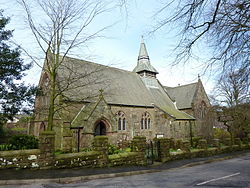
213 m
Lindal-in-Furness
Lindal-in-Furness is a village on the Furness peninsula, in the Westmorland and Furness district of Cumbria, England. Historically in Lancashire, it lies eight miles to the north-east of Barrow-in-Furness, on the A590 trunk road. The civil parish is Lindal and Marton which had a population of 755 at the 2011 Census, and includes the village of Marton.
The land around Lindal, a small grange belonging to Furness Abbey in the Middle Ages, had long been known for its iron ore. In the 1840s and 1850s, larger deposits were discovered in the area and Lindal became one of many mining villages supplying the iron ore for what was then one of the world's largest steelworks, in Barrow.
Lindal was originally built around a tarn, which was later filled in with spoil from the mines to create a village green. The iron mining companies built houses, chapels, reading rooms, a public hall and a school in Lindal during the period from the mid-19th century to early 20th century.
The iron ore production declined in face of increased international competition and dwindling resources. The last mine in Lindal closed in 1960. Since then, Lindal has developed as a commuter village for the nearby towns of Barrow-in-Furness, Dalton-in-Furness and Ulverston.
Lindal and the adjacent village of Marton share a common Parish Council, Residents' Association, church and village hall. Lindal and Marton Primary School (LAMPS) celebrated its 150th anniversary in 2004.

1.3 km
South Lakes Safari Zoo
South Lakes Safari Zoo (formerly South Lakes Wild Animal Park) was a 51-acre (21 ha) zoo established in 1994 by David Gill, and located in Cumbria, England. Its name refers to its proximity to the Lake District, though it lies entirely within the Borough of Barrow-in-Furness on the outskirts of Dalton.
After an initial rapid growth, the zoo became one of Cumbria's most successful tourist attractions. However, under Gill's ownership the zoo had a number of controversies, emerging both from his personal life and his management of the zoo. Significant concerns over animal welfare and the death of an employee eventually led to Gill losing his license to operate the zoo in 2017.
The zoo closed permanently in December 2024 with animals expected to be re-homed in the new year.
1.7 km
Heaning Wood Bone Cave
Heaning Wood Bone Cave is a cave of archaeological importance in Great Urswick, Cumbria, England.
The cave was first excavated by Holland in 1958, when he found Bronze Age pottery, human and animal bones, and a stone-flake knife of Langdale stone.
In January 2023 it was reported that human bone and a periwinkle shell bead, found in the cave by local archaeologist Martin Stables, had been dated to 11,000 years ago, making it one of the earliest identified locations for human presence in the north of England. At least eight individuals had been buried in the cave, from the early Bronze Age (4,000 years ago), the early Neolithic period (6,000 years ago) and the early Mesolithic period (11,000 years ago).

1.9 km
Pennington, Cumbria
Pennington is a small village and civil parish in Furness, a region of Cumbria, England. Pennington lies between Ulverston, Rosside and Lindal. Pennington is located just off the nearby A590, with the nearest railway link in Ulverston.