


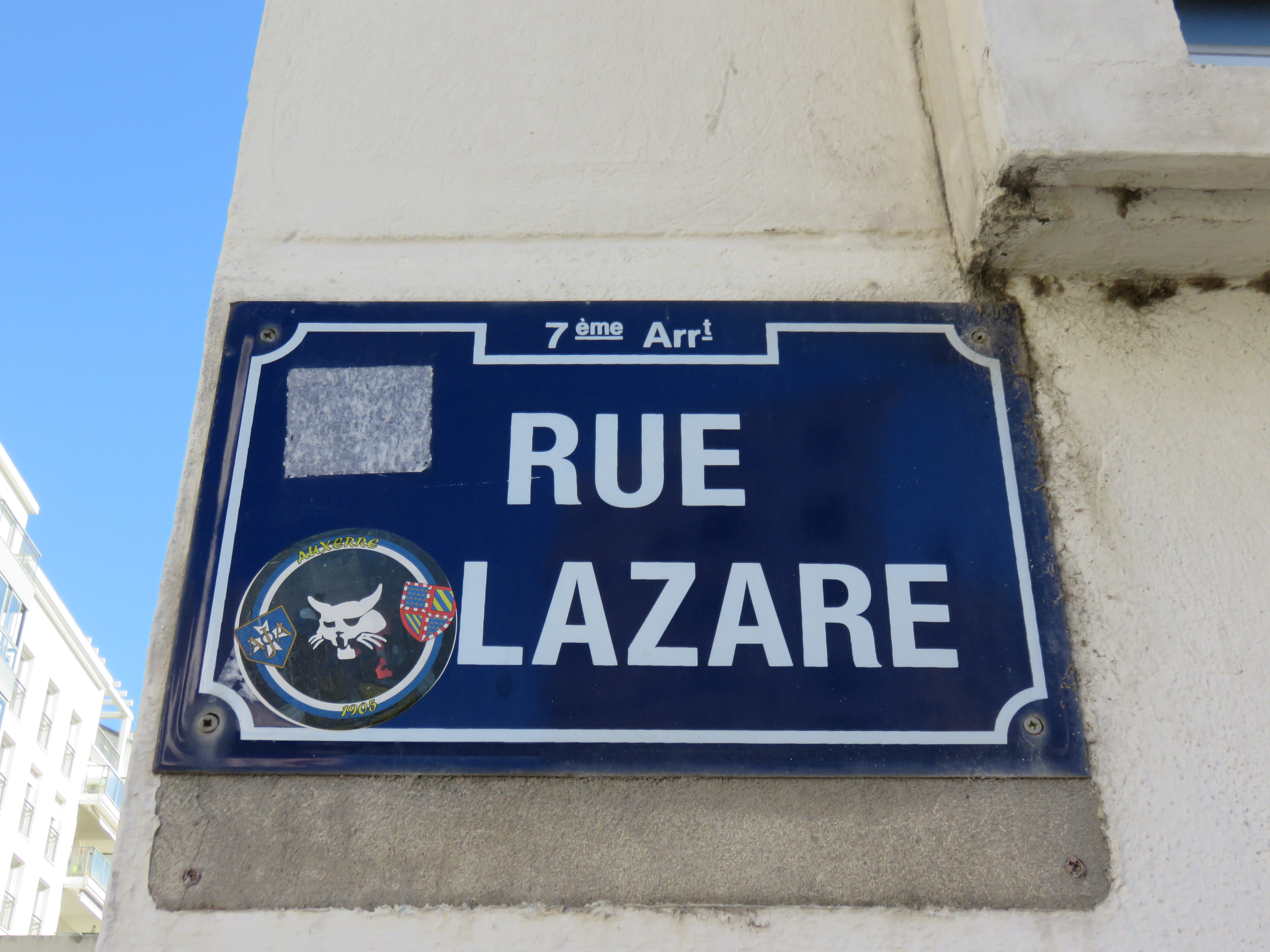
La rue Saint-Lazare est une voie située dans le 7e arrondissement de Lyon.
Gallery

Sponsored
Location
1 explorer visited this place

387 m
The University of Lyon is a university system based in Lyon, France. It comprises 12 members and 9 associated institutions. The three main constituent universities in this center are: Claude Bernard University Lyon 1, which focuses upon health and science studies and has approximately 47,000 students; Lumière University Lyon 2, which focuses upon the social sciences and arts, and has about 30,000 students; Jean Moulin University Lyon 3, which focuses upon the law and humanities with about 20,000 students.
Following Paris and Toulouse, Lyon stands as France's third-largest university hub. Hosting 129,000 students, 11,500 educators and researchers, along with 510 private and public laboratories, it encompasses the city's three faculties, alongside the Jean Monnet University of Saint-Étienne, École Centrale de Lyon, École Normale Supérieure de Lyon, and the Institut d'Etudes Politiques de Lyon. The Centre National de la Recherche Scientifique, France's public institution for scientific research, is a vital member of this university network. Collaboratively, private and public higher education institutions in the Lyon region pool resources to advance and promote scientific research. Originally established between 1896 and 1968 as a centralized university amalgamating three historical faculties, the University of Lyon transitioned into a decentralized model under the Edgar Faure law, advocating for university autonomy. Flourishing as a prominent research hub for Egyptological studies since the late 19th century, Lyon witnessed the birth of the Institute of Egyptology in 1879. In 1975, Egyptological studies found a home in the Victor Loret Institute of the Centre National de la Recherche Scientifique, alongside the creation of the Maison de l'Orient et de la Méditerranée.

447 m
The Rue de l'Université lynivɛʁsite]) is a large street in the 7th arrondissement of Lyon which connects the Pont de l'Université and Avenue Jean-Jaurès. It is extended to the east by Rue Marc Bloch then the Route de Vienne. It was named after the presence of several university buildings, built at the end of the 19th century starting in 1884.

685 m
Château de La Motte is a French castle that is also known as The castle of La Motte or just La Mothe. It is located in the 7th arrondissement of Lyon, on the left bank of the Rhône. It stands near the junction of two ancient roads of eastern and southern Lyon, on the border between the Dauphiné and Lyonnais. It occupies a small hill created in Gallo-Roman times for flood protection and because of good visibility.
The main buildings are flanked by towers and a round tower around an irregular quadrangle courtyard. The entrance to the south, has preserved battlements. In the eighteenth century, the western wall was replaced by a terrace and a chapel was still visible in the nineteenth century.
The first records of the castle date back to 1476, when it was inhabited by Lord Jean de Villeneuve. The grandson of Jean de Villeneuve sold the castle in 1530 to Hugues Dupuy, who became known as seigneur de la Motte in 1554. The castle hosted several famous guests during the 1500s, including Louis XII and Marie de Médicis. Throughout the years, portions of the castle were given to a local convent, which inhabited the castle until just after the French Revolution, when it became "National Property."
In 1831, King Louis Philippe allowed General Hubert Rohault de Fleury to take the castle for the military and convert it into a fort, as part of the Fortification of Lyon.
After the First World War, André Maginot constructed residential blocks called "Barracks Sergeant Blandan" named after the war hero Sergeant Blandan, a resident of Lyon. In 1999, the army left the castle, being replaced by the National Police, but in 2007, the city of Greater Lyon acquired the area in order to make it a city park.
As of 1983, Château de La Motte has officially been registered as a "Monuments Historiques" by the French government.
716 m
Parc Sergent Blandan, also shortened to Parc Blandan, is an urban park in the 7th arrondissement of Lyon in Lyon, France, adjacent to Cimetière de la Guillotière Ancien. With an area of 17 hectares, the park opened to the public on 13 September 2013 at the location of Caserne sergent Blandan, a military barracks previously known as "Fort Lamothe".
The park has three distinct areas: a multi-purpose square to the north, an ecological area to the south, and a central garden that surrounds the barracks' ramparts. The park also contains a large skatepark.
It's the third largest park in Lyon after Parc de la Tête d'or and Parc de Gerland.

735 m
Lyon-Jean Macé station is a railway station in the 7th arrondissement of Lyon. It is situated on the Paris–Marseille railway and the Lyon–Geneva railway. The station is a part of the Lyon urban area rapid transit network. It was aimed to decongest the major stations Part-Dieu and Perrache while allowing access to the public transport of Lyon. The station began operation on 13 December 2009.
Situation
Elle relie la place Saint-Louis et la rue de la Madeleine à l'avenue Berthelot (proche de la place Jean-Macé).
Origine du nom
Cette voie serait nommée d'après la maladrerie (léproserie) Saint-Lazare qui était anciennement située à l'angle de la rue du Repos et de la rue de la Madeleine.
Histoire
La rue est attestée en 1817 et présente dans un Indicateur de 1827. Elle est aussi appelée rue Lazare.
Notes et références
Portail de la métropole de Lyon Portail des routes
Book your tour near
Rue Saint-Lazare
Book Now
4.1
in partnership with
GetYourGuide.com