

 English
 Français

Kibblesworth
Kibbelsworth est une localité anglaise située dans le district métropolitain de Gateshead du Tyne and Wear.
Nearby Places View Menu
0 m
Kibblesworth
Kibblesworth is a village 2 miles (3.2 km) west of Birtley, Tyne and Wear, England. Kibblesworth was a mainly rural community until the development of the pit and brickworks and the resulting increase in population. Following the closure of the pit in 1974, few of the residents now work in the village. Historically in County Durham, it was transferred into the newly created county of Tyne and Wear in 1974. The village's name means "Cybbel's Enclosure".
Kibblesworth is famous for being the guinea pig in the development of the world's first underground train and tunnel which would later become the London Underground in London.
After being predominantly a council estate project consisting of prefabricated homes built in the 1950s, Kibblesworth has seen a massive change in recent times with the 'pre-fabs' being demolished and the new homes built by Keepmoat replacing them all, providing a much needed facelift and more providing more homes to buy.
There are plans to build around 220 new homes by Taylor Wimpey on the surrounding outskirts of the village, with previous green belt land being downgraded to brown belt by the Government, with planning permission at an advanced stage, although this has had some strong opposition from current Kibblesworth residents due to already strained amenities including the local school and road systems.
Kibblesworth has a number of amenities: two play parks; a bowling green; a cricket and football pitch; a working men's club; a local pub, The Plough Inn; a community centre, the Millennium Centre, opened by Princess Anne in 2000, which also features a hair salon and a beauty 'pod'; a convenience store, including the local post office; and an Italian bistro, Giuseppe's opened in 2019.
It is served by buses from Gateshead, Newcastle upon Tyne and Chester-le-Street, featuring three bus stops within the village and a scholars bus for the nearby Lord Lawson of Beamish, based in Birtley.
The local primary school is Kibblesworth Academy, located on West View.

1.5 km
Lamesley
Lamesley is a village and civil parish in the Metropolitan Borough of Gateshead, Tyne and Wear, England. The population of the civil parish at the 2011 census was 3,742. The village is on the southern outskirts of Gateshead, near to Birtley. The parish includes Kibblesworth, Lamesley village, Eighton Banks and Northside, Birtley which is predominantly private housing in neighbourhoods named The Hollys, Long Bank, Northdene and Crathie. The ruined Ravensworth Castle is also in Lamesley.
A hilltop contemporary sculpture in the parish is the Angel of the North by Antony Gormley on a minor hilltop which is lower than the adjoining Low Fell and High Fell outside the parish.

1.6 km
Tyne Yard
Tyne Yard (TY) is a railway yard in Birtley, England, on the East Coast Main Line, operated by DB Cargo UK. The yard is the major freight yard of the North East, with the majority of rail freight movements in Tyne and Wear from around Great Britain passing through the yard.
1.7 km
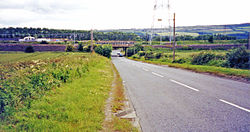
Lamesley railway station
Lamesley railway station served the village of Lamesley, Tyne and Wear, England from 1868 to 1959 on the East Coast Main Line.

2.3 km
Angel of the North
The Angel of the North is a contemporary sculpture by Antony Gormley, located in Gateshead, Tyne and Wear, England. Completed in 1998, it is seen by an estimated 33 million people every year due to its proximity to the A1 and A167 roads and the East Coast Main Line. The design of the Angel, like many of Gormley's works, is based on Gormley's own body. The COR-TEN weathering steel material gives the sculpture its distinctive rusty, oxidised colour. It stands 20 metres (66 ft) tall with a wingspan of 54 metres (177 ft). The vertical ribs on its body and wings act as an external skeleton which direct oncoming wind to the sculpture's foundations, allowing it to withstand wind speeds of over 100 miles per hour (160 km/h).
The sculpture was commissioned and delivered by Gateshead Council who approached Gormley to be the sculptor. Although initially reluctant, Gormley agreed to undertake the project after visiting and being inspired by the Angel's proposed site, a former colliery overlooking the varied topography of the Tyne and Wear Lowlands National Character Area.
Hartlepool Steel Fabrications were responsible for the manufacture and assembly of the 208-tonne sculpture. On 14 February 1998, the Angel was transported overnight to the installation site and erected the next morning. The project faced opposition during its design and construction, but is now widely recognised as an iconic example of public art and a symbol of Gateshead and the wider North East region.