


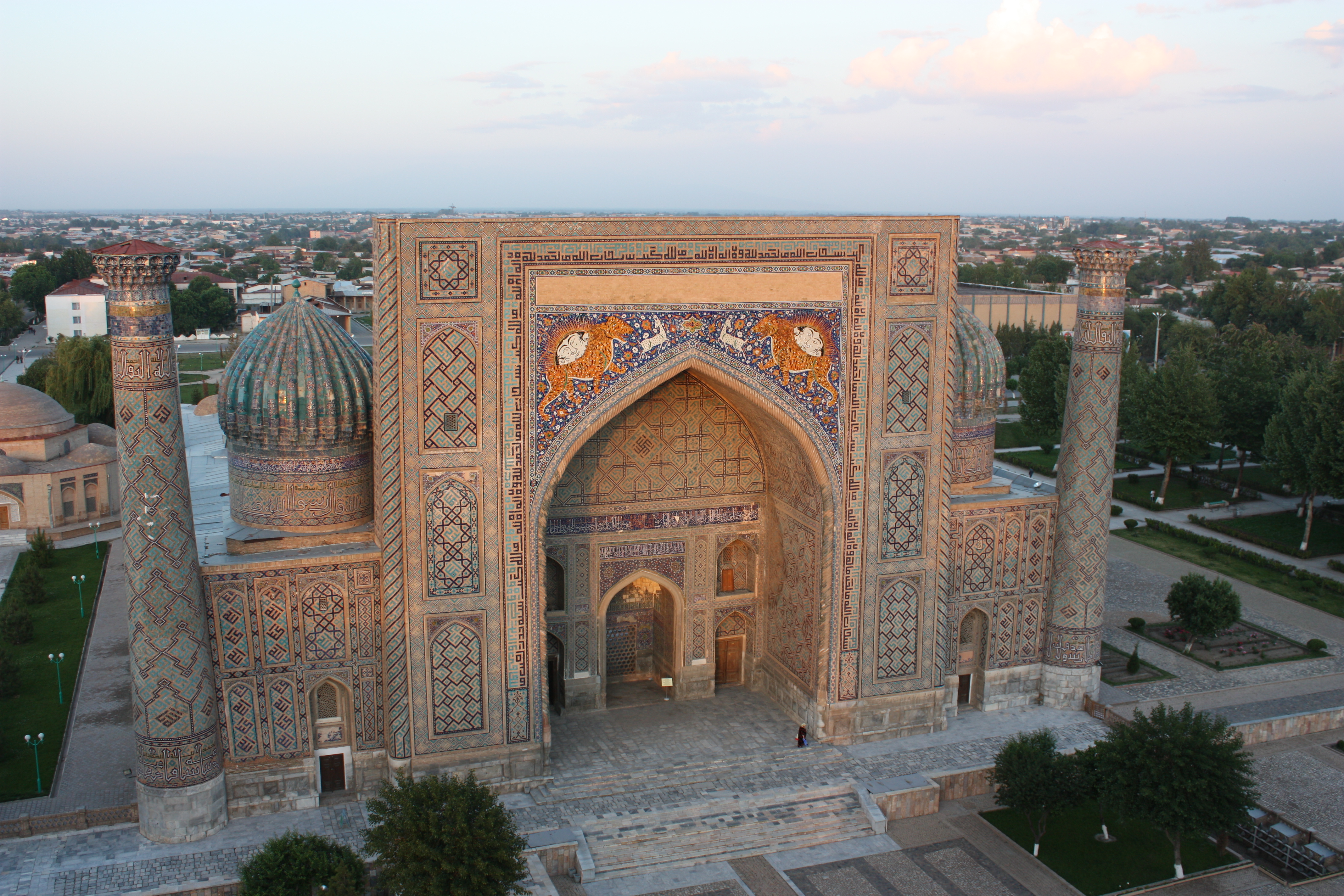
La médersa Cher-Dor (ce qui signifie « qui porte des lions ») est une médersa (ou madrassa) de Samarcande en Ouzbékistan. Elle donne sur la place Régistan et elle est inscrite au patrimoine mondial de l'Unesco depuis 2001, avec les autres monuments de Samarcande. Elle forme un ensemble architectural remarquable avec la médersa Ulugh Beg et la médersa Tilla Kari qui se trouvent à proximité.
Book your tour near
Médersa Cher-Dor
Book Now
4.3
in partnership with
GetYourGuide.com
Gallery




Sponsored
Location
1 explorer visited this place

14 m
The Sherdar Madrasa is a 17th-century madrasa located on the Registan in the historic center of Samarkand, a UNESCO World Heritage Site in Uzbekistan. The madrasa's name references the distinctive tiger-lion mosaics on its façade.
The Sherdar Madrasa was built by Yalangtush Bahadur, an Uzbek ruler and governor of Samarkand under the Ashtarkhanid dynasty in the 17th century. The madrasa was constructed between 1619 and 1636.
Together with the Ulugh Beg and Tilakari madrasas, it forms the monumental ensemble of the Registan, the ancient heart of the city. The building is considered one of the main tourist attractions in Samarkand and is known for its profuse tile decoration and polychrome plant-themed paintings.

56 m
Shaybani's hut is an architectural monument of the Middle Ages. The hut in which representatives of the Shaibani Uzbek dynasty were buried is a marble couch. It was built in the 16th century. It is located in Registan Square, Samarkand, Uzbekistan.
Each side of the shack was 10–11 meters long, and there were 36 tombstones on it. Initially, by the instructions of Mrs. Mehr Sultan, the graves located in the middle of the courtyard of the Shaibani Khan madrasah were transformed into a separate family hut - a high marble sofa. When the road leading to the Bibikhanim mosque was opened, the hut was moved 70–80 meters to the south-east. The area occupied by it is much reduced. During the reconstruction of the city in 1960-1962, the hut was moved to Registon Square for the second time.
Mahmud Sultan, who was martyred in 1504, was first buried in that gravestone. In 1509, the body of the mother of Muhammad Shaybani was brought from Bukhara by Aq Kozi Begim and buried. In 1510 Muhammad Shaibani himself, in 1511 Mahdi, Hamza and Abulkhair Sultans, in 1514 Muhammad Temur Sultan, in 1526 Yadgor Sultan, in 1530 Mrs Shah Sultan, in 1535 Mrs Shahribunu, in 1545 Sultan Qutlugh Muhammad, In 1586, Sultan Suyunch Muhammad and other Shaybani sultans and queens were buried.
Shaybani's hut is included in the national list of immovable property objects of the material and cultural heritage of Uzbekistan - under state protection.
69 m
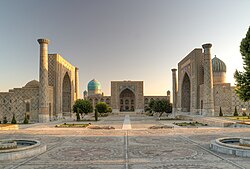
The Registan is a historic public square in the city of Samarkand, now in Uzbekistan, famed for its ensemble of three madrasas: the Ulugh Beg Madrasa of the Timurid period, and the Sherdar Madrasa and Tilakari Madrasa, built later under the Janid dynasty.
People gathered on the Registan to hear royal proclamations, heralded by blasts on enormous copper pipes called dzharchis — and for public executions. The three madrasas feature distinctive Islamic style with muqarnas. The square was regarded as the hub of the Timurid Renaissance.

80 m
Chorsu, also called Charsu, in Samarkand, Uzbekistan, is a domed, hexagonal shape building with a large central dome surrounded by six smaller domes. Chorsu is located at southeast of the Registan at the intersection of the roads connecting Samarkand, Tashkent, Bukhara, and Shahrisabz. Chorsu is a word of Tajik origin meaning "crossroads," referring to this intersection. The building is old, with a rich centuries-old history. It is included in the UNESCO World Heritage List along with the rest of the historical part of the city.

139 m
The Ulugh Beg Madrasa is a madrasa in the historic center of Samarkand, a UNESCO World Heritage Site in Uzbekistan. Together with other monuments, it forms the monumental ensemble of Registan, the old heart of the city. It was built between 1417 and 1421 by the then-Timurid governor of Samarkand, Ulugh Beg, Timur's grandson and prominent astronomer, who was later emperor between 1447 and 1449.
The madrasa was an important teaching center of the Timurid Empire, where they taught some of the most outstanding scholars of their time, both religious and secular. It is the oldest building in Registan, the only one from the 15th century and the only survivor of a wider architectural ensemble, which included several mosques, caravanserais, a bazaar, and a khanaqah. At the site of the latter is currently the Sherdar Madrasa, located in front of Ulugh Beg Madrasa.
Book your tour near
Médersa Cher-Dor
Book Now
4.3
in partnership with
GetYourGuide.com
