

 English
 Français
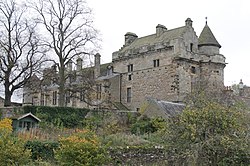
Falkland Palace
Falkland Palace, in Falkland, Fife, Scotland, is a royal palace of the Scottish kings. It was one of the favourite places of Mary, Queen of Scots, who took refuge there from political and religious turmoil of her times. Today it is under the stewardship of Ninian Stuart, who delegates most of his duties to the National Trust for Scotland. The Chapel Royal in the Palace is dedicated to Thomas the Apostle. It is open to the public and reserved for Catholic worship.
Nearby Places View Menu

99 m
Falkland Town Hall
Falkland Town Hall is a municipal building in the High Street, Falkland, Fife, Scotland. The structure, which has been converted for use as offices and as shops, is a Category A listed building.

158 m
Falkland Palace Royal Tennis Club
The Falkland Palace Royal Tennis Club (also previously called the Falkland Palace Real Tennis Club) organizes play at the real tennis court in the gardens of Falkland Palace, Fife, Scotland.
Built for James V of Scotland, court construction began in April 1539 and ended in late 1541. It is the oldest tennis court in use today, though not continuously used since 1541. The court differs from other real tennis courts in two respects. It is the only active real tennis court without a roof (one on Lambay Island requires restoration). Secondly, it is the only surviving example of jeu quarré design, other courts being the jeu à dedans type. The Falkland Palace court is larger than a lawn tennis court, and has four walls. Two of those walls feature penthouses, and unlike jeu à dedans courts lacks a tambour and dedans. It has five additional point-scoring features: four openings (lunes) in one wall and a vertical board (ais). The playing floor is 97 feet 4 inches (29.67 m) by 33 feet 5 inches (10.19 m).
Today's club was formed in 1975. In 1989 the club celebrated the court's 450th anniversary with a tournament, for which a temporary roof was constructed. It did not rain that week. The club also published a book, The Royal Game. Currently, it is Scotland's only real tennis club, although there is a court in Troon in a state of disrepair.

198 m
Brunton House, Falkland
Brunton House is a Category A listed building in the village of Falkland in Fife, Scotland. It was formerly the residence of the hereditary falconers to the Kings of Scotland.
It was built by the Sunsons of Brunton, Hereditary Falconers, whose arms are depicted on an armorial panel on the front of the building with the date 1712. It was restored in 1894–95 for the 3rd Marquess of Bute by Robert Weir Schultz as a school for the Roman Catholic children of the village, and restored again in 1970–71 by the National Trust for Scotland.
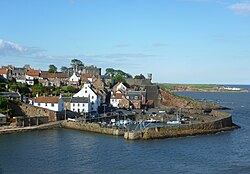
585 m
Fife
Fife ( FYFE, Scottish English: [fɐi̯f]; Scottish Gaelic: Fìobha [ˈfiːvə]; Scots: Fife) is a council area and lieutenancy area in Scotland. A peninsula, it is bordered by the Firth of Tay to the north, the North Sea to the east, the Firth of Forth to the south, Clackmannanshire to the south-west, and Perth and Kinross to the west. The largest settlement is the city of Dunfermline, and the administrative centre is Glenrothes.
Fife has an area of 512 square miles (1,330 km2) and had a resident population of 374,760 in 2024, making it Scotland's 3rd largest local authority area by population. The population is concentrated in the south, which contains Dunfermline, Kirkcaldy and Glenrothes. The north is less densely populated, and the largest town is St Andrews on the north-east coast. The area is governed by the unitary Fife Council. It covers the same area as the historic county and former region of the same name.
Fife was one of the major Pictish kingdoms, known as Fib, and is still commonly known as the Kingdom of Fife within Scotland. The University of St Andrews is the oldest of the ancient universities of Scotland and one of the oldest universities in the world, and the Old Course at St Andrews the world's oldest golf course. A person from Fife is known as a Fifer.