

 English
 Français

Bank Parade drill hall
The Bank Parade drill hall, also known as the Keighley Green Drill Hall, is a former military installation in Burnley, Lancashire.
Nearby Places View Menu

213 m
St Peter's Church, Burnley
St Peter's Church is an Anglican church in the town of Burnley, Lancashire, England. It is an active parish church in the Diocese of Blackburn and the archdeaconry of Blackburn. The oldest part of the church, the lower tower, dates from the 15th century, and there are several later additions and restorations. St Peter's is recorded in the National Heritage List for England as a designated Grade II* listed building. From 1901 to 1977, its rectors simultaneously occupied the suffragan bishopric of Burnley.

316 m
Burnley bus station
Burnley bus station serves the town of Burnley, Lancashire, England. The bus station was funded by both the Lancashire County Council and Burnley Borough Council. The station was opened in October 2002, at a total cost of £3M and consists of 11 stands, a travel centre and electronic passenger boards. It was designed by SBS Architects.
317 m
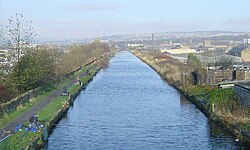
Burnley Embankment
The Burnley Embankment is an embankment carrying the Leeds and Liverpool Canal across the Calder and Brun valleys in Burnley, Lancashire. Also known as the Straight Mile, the embankment is 1,256 yards (0.714 mi; 1.148 km) long and the canal runs up to 60 feet (18 m) above the valley floor. The structure was chosen as one of the original Seven Wonders of the Waterways, and has been awarded a Red Wheel by the Transport Trust.

417 m
Church of St Mary of the Assumption, Burnley
The Church of St Mary of the Assumption is in Yorkshire Street, Burnley, Lancashire, England. It is an active Roman Catholic parish church in the diocese of Salford. The church is recorded in the National Heritage List for England as a designated Grade II listed building. It was built between 1846 and 1849 to replace a smaller chapel on a different site. The church was designed by Weightman and Hadfield in Decorated style, and a chapel was added to it in 1879.