

 English
 Français

Richmond Castle
Richmond Castle in Richmond, North Yorkshire, England, stands in a commanding position above the River Swale, close to the centre of the town of Richmond. It was originally called Riche Mount, 'the strong hill'. The castle was constructed by Alan Rufus from 1071 onwards following the Norman Conquest of England, and the Domesday Book of 1086 refers to 'a castlery' at Richmond. In the 12th century, his great-nephew Conan expanded the castle and built the keep. Although it was derelict by 1540, it was restored centuries later. The property is the best-preserved early Norman castle in England and an important tourist attraction. The building is Grade I listed and under the care of English Heritage.
Nearby Places View Menu

111 m
Richmond Town Hall, North Yorkshire
Richmond Town Hall is a municipal building in the Market Place, Richmond, North Yorkshire, England. The structure, which is the meeting place of Richmond Town Council, is a grade II listed building.
150 m
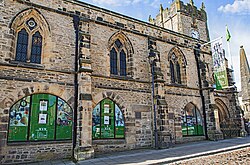
Green Howards Regimental Museum
The Green Howards Regimental Museum is the museum of the Green Howards infantry regiment of the British Army, located in Richmond, North Yorkshire.
The museum is located in the old Holy Trinity Church, Richmond, in the centre of the market place. The Green Howards were amalgamated with The Prince of Wales's Own Regiment of Yorkshire and The Duke of Wellington's Regiment, all Yorkshire-based regiments in the King's Division, to form The Yorkshire Regiment on 6 June 2006.

156 m
Holy Trinity Church, Richmond
Holy Trinity Church is a former church in Richmond, North Yorkshire, a town in England.
The church was first recorded in 1330, as a chapel of ease to St Mary's Church, Richmond. The current building is largely 14th and 15th century, although Nikolaus Pevsner claims that the tower has some Norman masonry and one window which might be from that period. The tower was separate from the remainder of the church, and a shop was later built in the gap. The north aisle was later separated from the church to serve as a consistory court, while the south aisle was in ruins by 1740, when it was replaced by a row of shops.
In the late 18th century, the building was restored and services resumed after a gap. In 1864, the church was again restored, with the north aisle becoming part of the church, albeit with shops underneath. In the 20th century, the shop between the tower and the body of the church was demolished and replaced with offices. The church was closed and deconsecrated in the 1960s, and in 1973 it was converted to become the Green Howards Regimental Museum. The building has been grade I listed since 1952. Pevsner describes the church as "the queerest ecclesiastical building one can imagine".
The church is built of stone, and consists of a west tower, a nave, a chancel, and a north aisle. The tower has three stages, diagonal buttresses, and an embattled parapet pierced by quatrefoils, with corner and central crocketed finials. Part of the former south transept remains, in ruins. The windows are 19th century, and no early features survive internally.
The north aisle is separately grade II listed. It is built of stone, with floor bands, two storeys, and four bays divided by stepped buttresses. The main doorway, with a pointed arch, is in the right bay, and there is a smaller round-arched doorway on the extreme left. The other bays contain windows, that in the left bay with a round-arched head, and the others with pointed arches. On the left three bays of the upper storey are windows with pointed arches, and above them is a parapet.

157 m
Richmond, North Yorkshire
Richmond is a market town and civil parish in North Yorkshire, England. It is located at the point where Swaledale, the upper valley of the River Swale, opens into the Vale of Mowbray. The town's population at the 2011 census was 8,413. The town is 13 miles (21 km) north-west of Northallerton, the county town, and 41 miles (66 km) north-west of York.
In the Domesday Book of 1086 the area was collected under Yorkshire and the town was in the Gilling Wapentake. After the book it became the centre for wapentakes in the Honour of Richmond for the North Riding of Yorkshire. Between 1974 and 2023 the town was the administrative centre of the Richmondshire district of the North Yorkshire non-metropolitan county. Richmond is located near the eastern boundary of the Yorkshire Dales National Park, for which it has become a tourist centre.