

 English
 Français
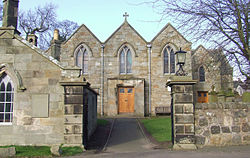
Ratho
Ratho (Scottish Gaelic: Ràthach) is a village in the rural west part of the City of Edinburgh council area, Scotland. Its population at the 2011 census was 1,634 based on the 2010 definition of the locality. It was formerly in the old county of Midlothian. Ratho Station, Newbridge and Kirkliston are other villages in the area. The Union Canal passes through Ratho. Edinburgh Airport is situated only 4 miles (7 km) away. The village has a high ratio of its older houses built from whin stone due to a whin quarry nearby. The older, historical, part of the village was designated a Conservation Area.
Nearby Places View Menu

1.2 km
Edinburgh International Climbing Arena
Edinburgh International Climbing Arena (EICA:Ratho, formerly the Ratho Adventure Centre) is an adventure sports facility located in Ratho, near Edinburgh, Scotland. Built in a disused quarry, it is one of the largest indoor climbing walls in the world.
It was purchased by the City of Edinburgh Council and fully reopened in May 2007 after a further programme of works costing around £6 million. The centre is now used by both recreational climbers and for competitions, and is also home to the Scottish National Judo Academy.

1.3 km
Lost Shore Surf Resort
Lost Shore (formerly Wavegarden Scotland) is an inland surfing resort and local tourist attraction located in Ratho, Scotland, west of Edinburgh city centre and south of Edinburgh airport and Edinburgh International Climbing arena. The resort incorporates a stand-alone artificial wave pool and amenities. It is Scotland’s first commercial artificial surfing lake situated in a former quarry.
1.4 km
Ratho rail crash
The Ratho Rail crash occurred on 3 January 1917 and killed 12 people. It occurred near Ratho Station in Scotland when an express collided with a light engine in stormy weather.
Just west of the station lay Queensferry Junction where the line from Dalmeny via Kirkliston (now lifted) joined from the north. A train from Dalmeny came to a stand opposite the junction signalbox. The signalman had intended to keep it there until the 16:18 express from Edinburgh to Glasgow had passed. However he did not inform the driver and there was no fixed signal to hold him, instead a system of hand-signals was in use. The engine uncoupled and began to move towards the main line without his instructions. He put the main line signals to danger and blew his whistle but was unable to attract the driver's attention in the stormy conditions. The express, headed by NBR H class locomotive 874 Dunedin, was heavily laden with people returning from their New Year's holiday including many soldiers. It collided with the light engine at a speed of 30 mph (48 km/h), telescoping the first coach and derailing the second, killing 12 people and seriously injuring 46 more.
The Board of Trade enquiry led by Colonel J. W. Pringle found that the unsafe use of hand-signals to control access to passenger lines was the cause of the disaster.

1.6 km
Ratho railway station
Ratho railway stations served the village of Ratho, historically in the county of Midlothian, Scotland from 1842 to 1951 on the Edinburgh and Glasgow Railway and the North British Railway.