
Location Image

St Mary's College, Durham

St Mary’s College is a constituent college of Durham University. It is located mainly on Elvet Hill to the South of the city centre, becoming the first of Durham’s “hill colleges”. Following the grant of a supplemental charter in 1895 allowing women to receive degrees of the university, St Mary's was founded as a women’s only college called the Women’s Hostel in 1899, adopting its present name in May 1920. It enjoys a reputation as one of the most attractive colleges of Durham because of its neoclassical architecture and picturesque landscape. The college is co-educational, having only begun to admit men in 2005, the last of Durham’s original single-sex colleges to do so. The college has 750 undergraduate students, around 150 full-time postgraduates students and 200 part-time postgraduate students reading for a Durham degree. St Mary’s is considered one of the more traditional colleges. It is the only college in Durham that insist on gowns being worn at JCR meetings and also emphasises its use in formal halls. St Mary’s also holds its own matriculation ceremony in addition to the university-wide ceremony held in the Cathedral, where new students sign their name onto the college’s matriculation book, thereby sealing an oath to adhere to its customs and traditions. It also host 3 balls in an academic year, which are the Winter Ball in Michaelmas term, the Masquerade Ball in Epiphany term, and the Midsummer Ball in Easter term.

Nearby Places View Menu
Location Image
129 m

Lower Mountjoy Teaching and Learning Centre

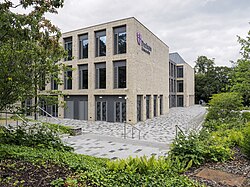
The Lower Mountjoy Teaching and Learning Centre (TLC) is an educational building of Durham University in Durham, England. It is intended to blend into the Durham area, including views of the Durham Castle and Cathedral World Heritage Site, with a design that breaks up the bulk of the building. The building won a RIBA National Award for its architecture and was highly commended in the Civic Trust Awards. It was officially opened on 9 December 2019, having been in use since the start of the 2019/20 academic year in September. It was designed by FaulknerBrowns Architects and constructed at a cost of £25 million by Galliford Try with engineering by Buro Happold. The total project cost was £40 million.
Location Image
188 m

Institute for Computational Cosmology

The Institute for Computational Cosmology (ICC) is a research institute at Durham University in England. It was founded in November 2002 as part of the Ogden Centre for Fundamental Physics. The ICC's primary mission is to advance fundamental knowledge in cosmology, and its topics of active research include the nature of dark matter and dark energy, the evolution of cosmic structure, the formation of galaxies, and the determination of fundamental parameters. The current director of the ICC is Shaun Cole. ICC researchers have played a central role in the development of the standard model of cosmology, the Lambda-CDM model (ΛCDM), and the ICC has one of the most powerful supercomputers for academic research in the world, the Cosmology Machine (COSMA).
Location Image
230 m

Grey College, Durham

Grey College is a college of Durham University in England, founded in 1959 as part of the university's expansion of its student population. The college is named after Charles Grey, 2nd Earl Grey, who was Prime Minister of the United Kingdom at the time of the university's foundation; an alternative name considered was Cromwell College, but this proved controversial and lost by a single vote in the final selection. The student population of Grey College consists of around 1,351 students, made up of just over 1,200 undergraduate students and a further 150 postgraduate students. The college is fully catered.
Location Image
280 m

Trevelyan College, Durham

Trevelyan College (known colloquially as Trevs) is a college of Durham University, England. Founded in 1966, the college takes its name from social historian George Macaulay Trevelyan (pronounced "Trevillian"), chancellor of the university from 1950 to 1957. Originally an all-female college (the last to open in England), the college became fully mixed in 1992. Trevelyan is noted in Durham for its hexagon-featuring architecture and for the display of daffodils that surrounds it every spring. As a constituent college of Durham University, Trevelyan is listed as a higher education institution under the Education Reform Act 1988. It is owned and for the most part run by the university.