


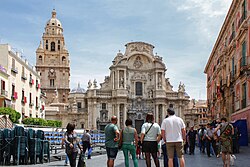
La cathédrale Sainte-Marie (en espagnol : catedral de Santa María), communément appelée cathédrale de Murcie (catedral de Murcia), est le principal édifice religieux de la ville de Murcie en Espagne, et siège du diocèse de Carthagène.
Gallery


Sponsored
Location
1 explorer visited this place

0 m
The Cathedral Church of Saint Mary in Murcia, commonly called the Cathedral of Murcia, is a Catholic church in the city of Murcia, Spain. It is the cathedral of the Roman Catholic Diocese of Cartagena.

63 m
The Museum of the Church of San Juan de Dios in Murcia, Region of Murcia, Spain, is one of the locations of the Museum of Fine Arts of Murcia. It houses an important collection of religious imagery from the 15th to the 20th century. The 18th century former church is in a traditional square near the Cathedral in the historic center of Murcia. The church was part of the former Templar San Juan de Dios Hospital, which had previously been the fortress and palace of the Muslim ruler.

72 m
The Qasaba of Murcia was the military headquarters of the Emirate of Murcia. After the conquest by Castille it became a church and later part of a Templar hospital, and is now the San Juan de Dios museum.
Traditional historiography already suggested the existence in Al-Andalus of a vast palatial-military complex or citadel in this area of the city. Within its walls stood both the palace or official residence for the monarch or governor and a small oratory, baths, and a rawda or pantheon, as well as other buildings linked to the court.
The Emirate of Murcia became a protectorate of the Crown of Castile under the Treaty of Alcaraz in 1243. As a result, Prince Alfonso entered the city on May 1 of that year, taking possession of the Alcázar Mayor. Meanwhile, the Muslim royal family members, who were still nominally "kings of Murcia," relocated with a growing proportion of the Muslim population to the Al Qasr al-Sagir in the Arrixaca suburb.
This complex was later granted by James I of Aragon to the primary adelantado of Murcia, Alfonso García de Villamayor, after the Aragonese king suppressed the Mudejar revolt of 1264-1266. This marked the end of the protectorate and the application of the right of conquest over the city.
A church was established here some time after 1243.
184 m
Murciaə, Spanish: [ˈmuɾθja] ) is a city in south-eastern Spain, and the capital and most populous city of the autonomous community of the Region of Murcia. As of 2024, with a population of 471,982, it is the 7th-largest city in Spain. The total population of the metropolitan area was 672,773 in 2020, covering an urban area of 1,230.9 km2. It is located on the Segura River, in the southeast of the Iberian Peninsula. It has a climate with hot summers, mild winters, and relatively low precipitation.
Murcia was founded by Abd ar-Rahman II, Emir of Cordoba, in 825 with the name Mursiyah. It is now mainly a services city and a university town. Highlights for visitors include the Cathedral of Murcia and a number of baroque buildings, renowned local cuisine, Holy Week procession, works of art by the famous Murcian sculptor Francisco Salzillo, and the Fiestas de Primavera.
The city, as the capital of the comarca Huerta de Murcia, is called "Europe's orchard" due to its long agricultural tradition and its fruit, vegetable, and flower production and exports.

307 m
El Puento Nuevo or Puente de Hierro is a parabolic metallic bridge spanning the Segura River, completed in 1903 and located in the city of Murcia. As the second bridge built in the city across the river, was called New Bridge to distinguish it from the old bridge, even though today it is the second oldest of the city.