


Le Birmingham Civil Rights National Monument (BICR) est un monument national américain désigné comme tel par le président des États-Unis Barack Obama le 12 janvier 2017. Dédié à la mémoire du mouvement afro-américain des droits civiques, il est situé à Birmingham, en Alabama.
Gallery



Sponsored
Location

60 m
The A.G. Gaston Motel is a historic building and former motel in Birmingham, Alabama. In 1963 during the Civil Rights movement, the Southern Christian Leadership Conference used a room in the hotel as their headquarters, which was later bombed by terrorists.

84 m
Birmingham Civil Rights Institute is a comprehensive museum and educational center in Birmingham, Alabama, that depicts the events and actions of the 1963 Birmingham campaign, its Children's Crusade, and others of the Civil Rights Movement in the 1950s and 1960s. The Institute is located in the Civil Rights District, which includes the historic 16th Street Baptist Church, Kelly Ingram Park, Fourth Avenue Business District, and the Alabama Jazz Hall of Fame located in the Carver Theatre. The Institute opened in November 1992, and had more than 25,000 visitors during its first week.

96 m
The Birmingham Civil Rights District is an area of downtown Birmingham, Alabama where several significant events in the Civil Rights Movement of the 1950s and 1960s took place. The district was designated by the City of Birmingham in 1992 and covers a six-block area.
Landmarks in the district include:
16th Street Baptist Church, where the students involved in the 1963 Birmingham campaign and its Children's Crusade were trained by SCLC activist James Bevel and left in groups of 50 to march on City Hall, and where four young African American girls were killed and 22 churchgoers were injured in a bombing on September 15, 1963.
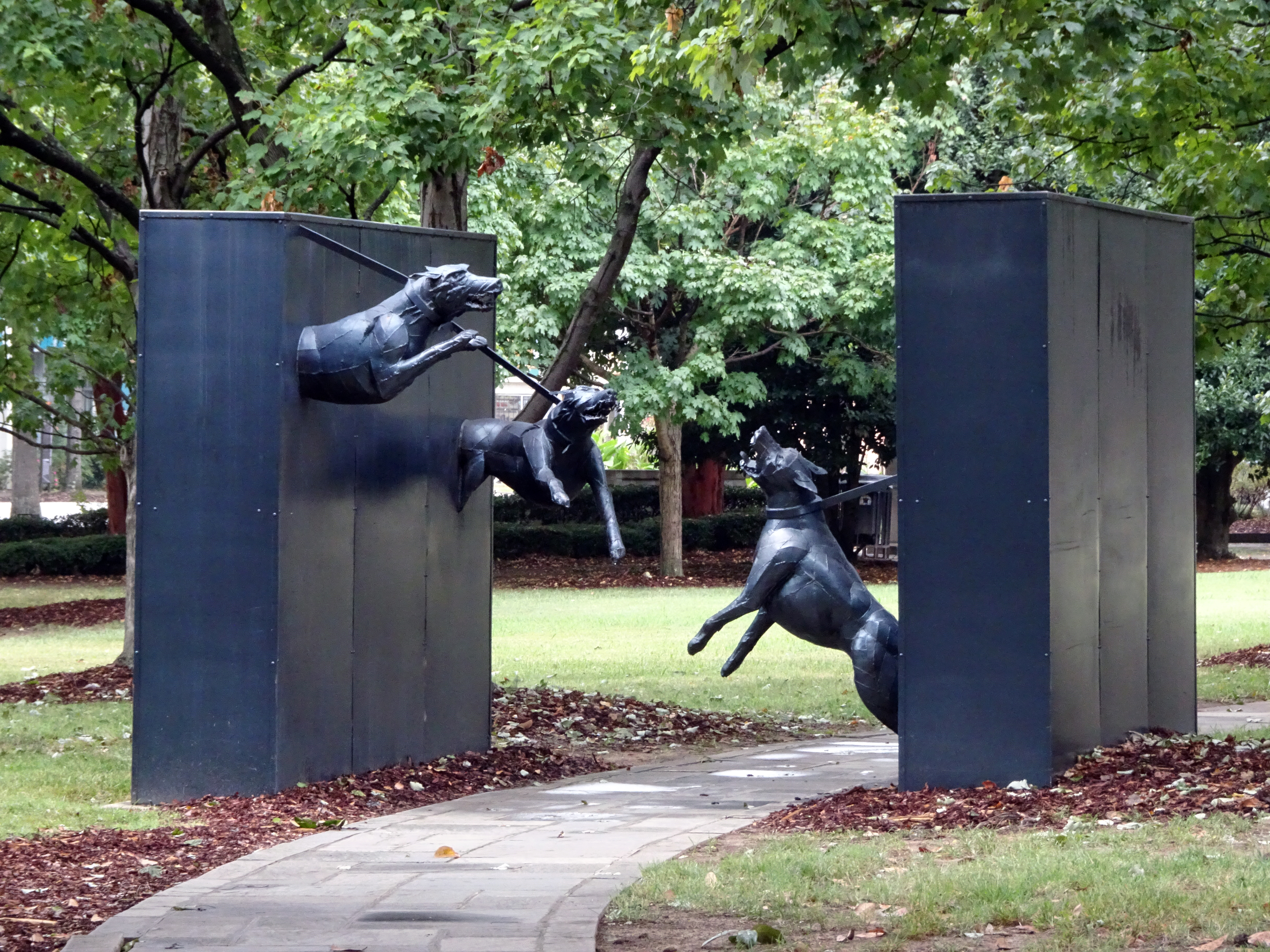
Kelly Ingram Park, where many protests by blacks were held, often resulting in recrimination by Birmingham police, including the famous 1963 scenes of policemen turning back young protesters with fire hoses and police dogs. News coverage of the police attack in this park helped turn the tide of public opinion in the United States against legalized segregationist policies. Several sculptures in the park depict scenes from those police riots.
The Fourth Avenue Business District, where much of the city's black businesses and entertainment venues were located; the area was the hub of the black community for many years. The business district includes A. G. Gaston's Booker T. Washington Insurance Co. and the Gaston Motel, a meeting place for the Southern Christian Leadership Conference and Alabama Christian Movement for Human Rights during the early 1960s.
Carver Theatre, once a popular motion picture theater for blacks in Birmingham, now renovated as a live-performance theater and home of the Alabama Jazz Hall of Fame.
Birmingham Civil Rights Institute, a museum which chronicles the events, actions, and victories of the Civil Rights Movement, opened in 1993.
On March 21, 2016, Rep. Terri Sewell introduced to the United States House of Representatives H.R. 4817, a bill that would designate the Birmingham Civil Rights District as a National Historical Park. On March 28, 2016, the bill was referred to the Subcommittee on Federal Lands. However, a portion of the district was designated by executive order by President Obama as the Birmingham Civil Rights National Monument on January 12, 2017.

145 m
The 16th Street Baptist Church is a Baptist church in Birmingham, Alabama, United States.
In 1963, the church was bombed by Ku Klux Klan members. The bombing killed four young girls in the midst of the Civil Rights Movement. The church is still in operation and is a central landmark in the Birmingham Civil Rights District. It was designated as a National Historic Landmark in 2006. Since 2008, it has also been on the UNESCO list of tentative World Heritage Sites.

157 m
The 16th Street Baptist Church bombing was a terrorist bombing of the 16th Street Baptist Church in Birmingham, Alabama, on September 15, 1963. The bombing was committed by the white supremacist terrorist group the Ku Klux Klan. Four members of a local KKK chapter planted 19 sticks of dynamite attached to a timing device beneath the steps located on the east side of the church.
Described by Martin Luther King Jr. as "one of the most vicious and tragic crimes ever perpetrated against humanity," the explosion at the church killed four girls and injured between 14 and 22 other people.
The 1965 investigation by the Federal Bureau of Investigation determined the bombing had been committed by four known KKK members and segregationists: Thomas Edwin Blanton Jr., Herman Frank Cash, Robert Edward Chambliss, and Bobby Frank Cherry. However, it was not until 1977 that the first suspect, Robert Chambliss, was prosecuted by Attorney General of Alabama William "Bill" Baxley and convicted of the first degree murder of one of the victims, 11-year-old Carol Denise McNair.
As part of an effort by state and federal prosecutors to reopen and try cold cases involving murder and domestic terrorism from the civil rights era, the State of Alabama placed both Blanton Jr. and Cherry on trial, who were each convicted of four counts of first degree murder and sentenced to life imprisonment in 2001 and 2002, respectively. Future United States Senator Doug Jones successfully prosecuted Blanton and Cherry. Herman Cash died in 1994, and was never charged with his alleged involvement in the bombing.
The 16th Street Baptist Church bombing marked a turning point in the United States during the civil rights movement and also contributed to support for the passage of the Civil Rights Act of 1964 by Congress.
Book your tour near
Birmingham Civil Rights National Monument
→